



We analyze real customer reviews to surface what matters: key strengths, ideal use cases, and honest considerations — so you can make an informed choice.
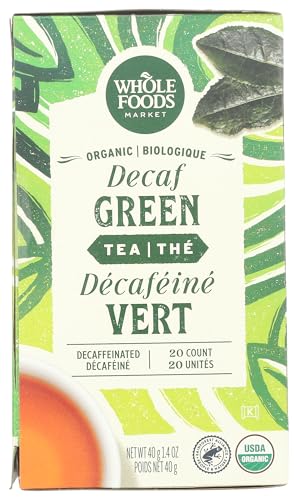
Whole Foods Market Organic Decaf Green Tea
Whole Foods' own-label decaf green — a USDA Certified Organic bag with a loyal audience: eight of fifteen reviewers say they'd order it again.
🎯 Best for: Daily green-tea drinking, Evening or nighttime cup without caffeine concern
🍃 Strength: Medium

🍃 Flavor Profile
Strength: Medium
Most reviewers describe the cup positively — smooth is the most-repeated taste note (mentioned by two of fifteen, the only term to repeat), with a handful reaching for stronger language like rich, flavorful, or full-bodied. One drinker called it less bitter than most greens she'd tried; another found the flavor a touch bland. We'd call the overall read dependable rather than distinctive.
✅ What Customers Love
- High repeat-purchase rate
- Overwhelmingly positive sentiment
- Organic + decaf pairing is the explicit draw
🎯 Best For
Daily green-tea drinking • Evening or nighttime cup without caffeine concern • Caffeine-avoiders who still want green-tea benefits
Brand: Whole Foods Market
Category: Green Tea
As an Amazon Associate we earn from qualifying purchases.
About This Green Tea
Whole Foods' own-label decaf green is a USDA Certified Organic bag with a loyal audience: eight of fifteen reviewers say they'd order it again. Most describe the cup positively, with smooth the most-repeated taste note — mentioned by two of fifteen, the only term to repeat. A handful reach for stronger language like rich, flavorful, or full-bodied; one drinker called it less bitter than most greens she'd tried, while another found the flavor a touch bland. We'd call the overall read dependable rather than distinctive.
Reviewers reach for it as an everyday favorite. Daily use leads the mentions, with evening and at-night cups also cited. Decaf status is the enabler here: three reviewers flag the organic certification and green tea's antioxidants as reasons to keep drinking it after the morning has passed, without caffeine concern.
That makes this a fit for two kinds of drinkers. Practical drinkers who want a reliable green-tea bag for daily rotation will find what they need. So will health-driven drinkers who want green tea's benefits without the caffeine that rules out an evening cup. The organic-plus-decaf pairing is the explicit draw across the reviews — not a single sensory signature, but a versatile bag that works across times of day.
A few honest notes on fit. This isn't a morning wake-up tea — it's naturally decaffeinated, so the caffeine is trace at most. And it isn't aimed at drinkers hunting single-origin character or source-based tasting notes; with smooth as the only repeating descriptor across fifteen reviewers and Whole Foods Market as the brand, the cup is positioned as a dependable everyday green rather than a tasting flight. If that's the brief, it delivers.
For an organic decaf green that holds up across daily, evening, and late-night cups — and that a majority of reviewers reorder — this is a workable house option.
Is Whole Foods Market Organic Decaf Green Tea Right for You?
Is Whole Foods' organic decaf green tea actually good for you?
Three of fifteen reviewers cite the USDA Organic certification as the reason they reach for it, and a few drinkers point to the antioxidant-rich-green-tea-without-the-caffeine framing. One reviewer mentioned sleeping better after switching; that's a single voice, not a clinical claim.
What time of day should I drink this — morning or evening?
Reviewers reach for it most often as a daily cup, but evening and at-night drinking come up explicitly because the decaf status removes the caffeine variable. It's not the tea to grab for a morning wake-up — there's no caffeine to lean on.
How does the flavor compare to other green teas?
One reviewer called it less bitter than most greens she'd tried, and another flagged a stronger green-tea flavor than expected. The most-repeated descriptor across the set is simply 'smooth' — two of fifteen reach for it — which lines up with a dependable rather than distinctive read.
Is the flavor strong or watered-down?
Most reviewers describe the cup positively, with a handful reaching for 'rich,' 'flavorful,' or 'full-bodied.' One drinker did find it a touch bland, so the read isn't unanimous — overall, expect a medium-strength green rather than a bold one.
Will buyers order it again?
Eight of fifteen reviewers signal they'd repurchase, and fourteen of fifteen reviews read positive overall. That's a strong loyalty signal at this review count, though not enough volume to call it universal.
Is this a good green tea for beginners?
Yes — the bag format removes any measuring or steeping finesse, and one reviewer explicitly noted it's less bitter than most green teas she'd tried, which often trips up newcomers. Decaf also takes caffeine sensitivity off the table as a variable.
As an Amazon Associate we earn from qualifying purchases.
Will this give me a caffeine boost?
No — the listing is explicitly decaf, and three reviewers reach for it precisely because they want green tea without the caffeine. If you need a morning lift, this isn't the cup.
Can I drink it at night without affecting sleep?
That's the explicit draw for several reviewers — one specifically noted she doesn't drink tea at night due to caffeine, and another mentioned sleeping better. Evening and at-night use both show up in the review set as everyday contexts.
Will I taste a distinctive single-origin character?
No — reviewers describe the cup as smooth and dependable rather than distinctive. If you're hunting source-driven tasting notes or single-origin character, look elsewhere; this is positioned as an everyday green-tea bag.
What do reviewers say works best about this tea?
The organic-plus-decaf pairing is the explicit draw — three reviewers cite the organic certification, two reach for the no-caffeine framing, and the cup works across daily, evening, and on-the-go contexts. Versatility plus the certification combo is what keeps people coming back.
Category: How much caffeine is in green tea?
A typical cup of green tea contains roughly 20-45 mg of caffeine, depending on the leaf, water temperature, and steep time. That is less than coffee but not low — high-grade shaded teas like gyokuro and matcha can rival or exceed a cup of brewed coffee because the youngest buds and shaded leaves carry the highest caffeine concentration in the plant.
Category: Does green tea have any side effects I should know about?
Most reported issues come from very high catechin intake via concentrated extract supplements rather than drinking the tea — a small number of liver injury cases have been linked to high-dose green tea extract taken on an empty stomach, especially in people with certain genetic variants of liver enzymes. As a beverage, the main practical concerns are caffeine sensitivity (jitters, sleep disruption) and tannin interference with iron absorption if drunk during meals.
As an Amazon Associate we earn from qualifying purchases.
Category: Can I drink green tea if I have high blood pressure?
A meta-analysis of 25 randomized trials with nearly 1,500 participants found that regular green tea consumption over 12+ weeks lowered systolic blood pressure by about 2.6 mmHg and diastolic by 2.2 mmHg, with the largest effect in people with elevated baselines. Acute intake can briefly raise blood pressure due to caffeine, so people on hypertension medication should still check with their physician, but habitual drinking trends in the right direction.
What Makes This Product Special
⚠️ Preliminary analysis based on 15-review sample • Our methodology
- High repeat-purchase rate
- Overwhelmingly positive sentiment
- Organic + decaf pairing is the explicit draw
- Versatile across time-of-day contexts
Taste Profile
Most reviewers describe the cup positively — smooth is the most-repeated taste note (mentioned by two of fifteen, the only term to repeat), with a handful reaching for stronger language like rich, flavorful, or full-bodied. One drinker called it less bitter than most greens she'd tried; another found the flavor a touch bland. We'd call the overall read dependable rather than distinctive.
Best Use Cases
🎯 Best For
- Daily green-tea drinking
- Evening or nighttime cup without caffeine concern
- Caffeine-avoiders who still want green-tea benefits
⚠️ Not Ideal For
- Morning wake-up or caffeine boost
- Drinkers hunting single-origin character or source-based tasting notes
How People Use It
Reviewers reach for it as an everyday favorite — daily use leads, with evening and at-night cups also cited. Decaf status is the enabler: three reviewers flag organic certification and green tea rich in antioxidants as reasons to drink it in the evening without caffeine concern.
Good for Beginners
✅ Yes
- Bag format — no measuring or steeping finesse required
- Decaf removes caffeine sensitivity as a variable
- One reviewer explicitly calls it less bitter than most green teas
About This Analysis
This analysis is based on 15 customer reviews. We're showing you everything we found, but with a moderate sample, there's a lot we likely haven't captured yet.
✅ What we're confident about: What customers love and best use cases
⚠️ What may be incomplete: Potential issues and considerations
For more perspectives, check customer reviews on Amazon.
Product Selection
In short: We only feature high-rated products.
Products on TeaDelight.net are selected based on strong Amazon customer ratings, sufficient review volume, and market presence. We focus on well-regarded products that tea enthusiasts are actively considering and purchasing.
As an Amazon Associate we earn from qualifying purchases.
You Might Also Like

✅ familiar Twinings character that drinkers return to
Twinings Green Tea with Jasmine

✅ Versatile organic everyday green
Bigelow Steep Pure Organic Green Tea

✅ Versatile across morning, daily, iced, and evening use
VAHDAM Organic Himalayan Green Tea
✅ Resteeps well on a second infusion