


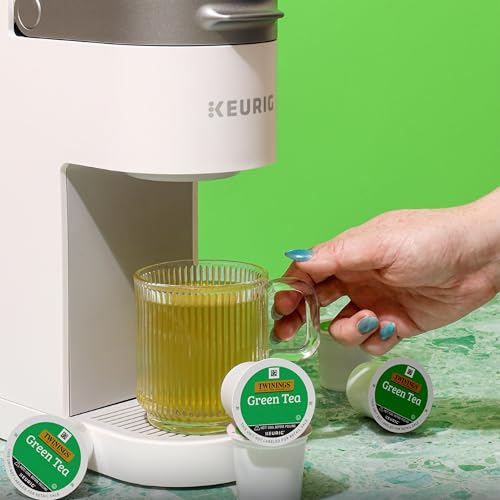


We analyze real customer reviews to surface what matters: key strengths, ideal use cases, and honest considerations — so you can make an informed choice.
Twinings Green Tea K-Cup Pods for Keurig
A no-fuss green tea in K-Cup form — built for Keurig owners who want a cup of tea without kettles, loose leaves, or steeping timers.
🎯 Best for: morning cup, single-serve convenience on a Keurig
🍃 Strength: Light

🍃 Flavor Profile
Strength: Light
Descriptor data runs thin here: reviewers describe the taste simply as 'refreshing' (one mention) and otherwise default to general praise like 'great taste' or 'delicious' without specific tasting notes. We'd call this a no-tasting-notes kind of cup — aggregated sentiment lands at twelve positive to eight negative across twenty-one reviews, with aroma and texture observations absent from the aggregated signal entirely.
✅ What Customers Love
- Versatile, low-effort cup for morning or off-caffeine moments
- Repeat-purchase loyalty signal
- Value framing appears repeatedly
🎯 Best For
morning cup • single-serve convenience on a Keurig • a lower-caffeine swap for coffee or soda
Brand: Twinings
Category: Green Tea
As an Amazon Associate we earn from qualifying purchases.
About This Green Tea
A no-fuss green tea in K-Cup form, built for Keurig owners who want a cup of tea without kettles, loose leaves, or steeping timers. Descriptor data here runs thin: reviewers tend to call the taste 'refreshing' (a single direct mention) and otherwise default to general praise like 'great taste' or 'delicious' without specific tasting notes. Aggregated sentiment lands at twelve positive to eight negative across twenty-one reviews, with aroma and texture observations absent from the aggregated signal entirely. Call it a no-tasting-notes kind of cup.
Morning drinking leads the use-context mentions, with a handful of reviewers reaching for it as a caffeine alternative or a way to cut back on soda. One reviewer pairs it with honey. The appeal is functional rather than ceremonial — single-serve convenience on a machine most Keurig owners already have, with enough caffeine to break from coffee without the full coffee experience.
Brewing is whatever your Keurig does: drop a pod, press a button. There's no steeping timer to manage and no leaves to clean up, which is the whole point of the format. Honey is the one pairing reviewers mention by name.
Three reviewers describe boxes arriving crushed with damaged or residue-contaminated pods — a shipping-integrity theme that shows up more often in negative reviews than any taste complaint. The descriptor vocabulary is also evaluative-only ('great', 'good') rather than specific, so drinkers who want a tea with named tasting notes or sensory depth will find this thin. The single-flavor format also draws one mention of limited variety.
Best for: a low-effort morning cup or an off-caffeine swap for coffee or soda, when convenience matters more than tasting-note depth.
Is Twinings Green Tea K-Cup Pods for Keurig Right for You?
Are these actual K-Cup pods that work in a Keurig?
Yes — the listing markets these as K-Cup pods built for Keurig brewers, designed for single-serve use without a kettle or loose leaves. Reviewers describe them as easy to drop into a Keurig and brew.
Do these green tea pods contain caffeine?
Yes — the listing labels them as caffeinated, and a small handful of reviewers reach for them specifically as a lower-caffeine swap for coffee or soda rather than as a wide-awake morning hit.
What does the tea actually taste like?
Hard to pin down with much specificity — across the aggregated reviews only one descriptor ('refreshing') surfaces, and most other comments default to general praise like 'great taste' without naming flavor notes. We'd call it a no-tasting-notes kind of cup at this review count.
Is this a good morning cup?
It appears to be — morning is the most-cited use context in the aggregated reviews, with two reviewers reaching for it as their morning drink and one pairing it with honey.
Can this help me cut back on coffee or soda?
A few reviewers describe using it that way — one specifically credits it with helping reduce soda intake, and others position it as a lighter alternative to coffee. The sample is small, but the use case shows up clearly.
Do drinkers keep reordering these?
Five of twenty-one reviewers reference reordering or long-standing use — a steady repeat-purchase signal, with several mentioning auto-delivery or sticking with the brand after trying others.
As an Amazon Associate we earn from qualifying purchases.
How does it compare to other green tea brands?
One reviewer notes trying several brands and returning to Twinings, and the broader repeat-purchase pattern hints at brand loyalty — but with only a handful of explicit comparisons in the aggregated data, the picture is more 'stuck with it' than head-to-head winner.
Is this a good starting point for someone new to green tea?
Likely yes — the K-Cup format removes brewing decisions like water temperature, steep time, and leaf quantity, and the sensory profile reads as mild with no polarizing flavor or texture complaints in the aggregated reviews.
Can I brew this as iced tea?
The listing positions it for either hot or iced use, though the aggregated reviews focus on hot-cup occasions and don't surface specific iced-brewing notes from drinkers.
Does anything pair well with it?
Honey is the only pairing that surfaces in the aggregated reviews — one reviewer specifically mentions adding it to the cup.
Is there much flavor depth or complexity here?
Not really — sensory depth is the soft spot. Descriptor vocabulary across the reviews is evaluative ('great taste,' 'delicious') rather than specific, with no aroma, body, or flavor-note entries in the aggregated signal. Drinkers chasing tasting-note nuance will likely want loose-leaf instead.
Category: Why does my green tea taste bitter?
Bitterness and astringency in green tea come mainly from catechins (especially EGCG) being over-extracted. The two biggest causes are water that is too hot — boiling water pulls catechins aggressively — and steeping for too long. Catechins also extract faster than the sweet, savory amino acids, so a shorter steep at lower temperature gives you the sweetness without the harshness.
As an Amazon Associate we earn from qualifying purchases.
Category: How much caffeine is in green tea?
A typical cup of green tea contains roughly 20-45 mg of caffeine, depending on the leaf, water temperature, and steep time. That is less than coffee but not low — high-grade shaded teas like gyokuro and matcha can rival or exceed a cup of brewed coffee because the youngest buds and shaded leaves carry the highest caffeine concentration in the plant.
Category: Why does green tea give a calmer focus than coffee?
Green tea contains L-theanine alongside caffeine, and the two work synergistically. Caffeine blocks adenosine receptors to drive alertness, while L-theanine crosses the blood-brain barrier and promotes alpha-wave brain activity associated with relaxed wakefulness. Randomized trials show the combination improves attention-switching and reduces the jitteriness and blood-pressure spike that caffeine alone can cause.
What Makes This Product Special
⚠️ Preliminary analysis based on 3-review sample • Our methodology
- Versatile, low-effort cup for morning or off-caffeine moments
- Repeat-purchase loyalty signal
- Value framing appears repeatedly
Taste Profile
Descriptor data runs thin here: reviewers describe the taste simply as 'refreshing' (one mention) and otherwise default to general praise like 'great taste' or 'delicious' without specific tasting notes. We'd call this a no-tasting-notes kind of cup — aggregated sentiment lands at twelve positive to eight negative across twenty-one reviews, with aroma and texture observations absent from the aggregated signal entirely.
- honey
Best Use Cases
🎯 Best For
- morning cup
- single-serve convenience on a Keurig
- a lower-caffeine swap for coffee or soda
⚠️ Not Ideal For
- drinkers who want specific tasting notes or sensory depth
- variety-seekers (single flavor only)
How People Use It
Morning drinking leads the use-context mentions, with a handful of reviewers reaching for it as a caffeine alternative or a way to cut back on soda. One reviewer pairs it with honey.
Good for Beginners
✅ Yes
- K-Cup format removes brewing decisions (temperature, time, leaf quantity)
- Sensory profile is mild — no polarizing flavor or texture reports
What to Consider
Three reviewers describe boxes arriving crushed with damaged or residue-contaminated pods — a shipping-integrity theme that appears in more negative reviews than any taste complaint.
- Packaging/shipping damage reports
- Thin sensory depth; descriptor vocabulary is evaluative-only
⚠️ based on 3-review sample. Some issues may not be captured.
About This Analysis
This analysis is based on 3 customer reviews. We're showing you everything we found, but with a moderate sample, there's a lot we likely haven't captured yet.
✅ What we're confident about: What customers love and best use cases
⚠️ What may be incomplete: Potential issues and considerations
For more perspectives, check customer reviews on Amazon.
Product Selection
In short: We only feature high-rated products.
Products on TeaDelight.net are selected based on strong Amazon customer ratings, sufficient review volume, and market presence. We focus on well-regarded products that tea enthusiasts are actively considering and purchasing.
As an Amazon Associate we earn from qualifying purchases.
You Might Also Like

✅ familiar Twinings character that drinkers return to
Twinings Green Tea with Jasmine

✅ Versatile organic everyday green
Bigelow Steep Pure Organic Green Tea

✅ Versatile across morning, daily, iced, and evening use
VAHDAM Organic Himalayan Green Tea
✅ Resteeps well on a second infusion