




We analyze real customer reviews to surface what matters: key strengths, ideal use cases, and honest considerations — so you can make an informed choice.
Kyo Hayashiya Uji Sencha Loose Leaf Green Tea
A Kyo Hayashiya Uji sencha whose 'no-kneading' processing keeps the leaves whole and the natural flavor intact.
🎯 Best for: Tea-time pairings with buttery cakes, mochi, and pastries, Multi-infusion brewing of a single-origin Japanese green
🍃 Strength: Medium

What Stands Out
🍃 Flavor Profile
Strength: Medium
Smooth and fresh lead the taste (mentioned in 4 and 3 of 8 reviews). A delicate umami anchors the core. The aroma reads grassy and aromatic with a subtle floral lift; the mild astringency works as counterpoint to the umami sweetness rather than as flaw.
✅ What Customers Love
- Smooth, fresh, umami-forward sencha profile
- Single-origin Uji sencha with no-kneading processing preserving leaf integrity
- Holds up across multiple infusions
🎯 Best For
Tea-time pairings with buttery cakes, mochi, and pastries • Multi-infusion brewing of a single-origin Japanese green • Drinkers seeking source-based, umami-forward descriptors in an Uji sencha
Brand: 京はやしや
Category: Green Tea
As an Amazon Associate we earn from qualifying purchases.
About This Green Tea
A Kyo Hayashiya Uji sencha whose no-kneading processing keeps the leaves whole and their natural flavor intact. Across the reviews, smooth and fresh lead the taste (noted in four and three of eight reviews, respectively), with a delicate umami anchoring the core. The aroma reads grassy and aromatic with a subtle floral lift, while a mild astringency works as counterpoint to the umami sweetness rather than as a flaw.
Pour it at tea time alongside buttery cakes, mochi, or pastries — one reviewer calls the bitterness a perfect counterpoint to rich sweets. It suits drinkers who want source-based, umami-forward descriptors from an Uji sencha, and rewards anyone willing to revisit the same leaves across a session.
Brew at 155–167°F with short steeps. The leaves hold up across multiple infusions, each pour offering its own profile, but they turn bitter quickly under boiling water or long pulls. Temperature control matters here.
Three of eight reviewers find it expensive for the amount, and a similar handful describe the profile as more subtle than expected for a high-grade sencha. This is a considered purchase whose payoff hinges on careful brewing — not the pick for effortless daily drinking without a thermometer, nor for buyers measuring value strictly per gram.
For those who'll meet it on its terms, the no-kneading process and Uji origin give the leaves room to unfold across a session rather than reveal everything in a single cup.
Is Kyo Hayashiya Uji Sencha Loose Leaf Green Tea Right for You?
What does this sencha actually taste like?
Across the eight eligible reviewers, the core impression is smooth and fresh (mentioned by 4 and 3 of 8) with a delicate umami anchor and a mild astringency that plays counterpoint rather than reading as a flaw. The overall profile is medium in strength, not the bold grassy slap some other senchas deliver.
What's the aroma like when you open the bag and brew it?
Reviewers describe the aroma as grassy and aromatic with a subtle floral lift — three of nine called the smell 'fresh' and a couple noted an old-school green-tea character. One drinker did flag the aroma as more subtle than they'd expected, so the nose here is delicate rather than dominant.
What water temperature should I use to brew this?
The brewing guidance points to 155–167°F with short steeps — much cooler than most green-tea defaults. Reviewers who used near-boiling water or long pours reported bitterness, so a thermometer or cooling step appears to matter more here than with everyday senchas.
Can I get multiple infusions from the same leaves?
Yes — two of nine reviewers specifically called out using the leaves across multiple infusions, and the synthesis notes the leaves 'remain smooth and aromatic' on later pours. One reviewer did warn that subsequent steeps run weaker, so expect the second infusion to step down in intensity rather than match the first.
What food pairings work with this sencha?
The use-context guidance points to tea time alongside buttery cakes, mochi, or pastries — one reviewer specifically called the tea's bitterness a counterpoint to coconut mochi cake. The mild astringency seems to do the work of cutting through rich, sweet bakes.
Is this a good sencha for someone new to Japanese green tea?
Probably not as a first sencha — the synthesis explicitly flags it as leaning toward experienced drinkers because the payoff depends on careful temperature control and short steeps. Beginners brewing at boiling-water defaults are the ones reviewers say end up with bitterness or a flat cup.
As an Amazon Associate we earn from qualifying purchases.
A few reviewers said the flavor felt subtle or thinner than expected — what's going on?
Three of eight reviewers describe the profile as more subtle than expected, with words like 'flat lacking depth' and 'dilutes quickly, requires more leaves' appearing in the negative aspects. The synthesis frames this as a considered Uji sencha whose payoff hinges on careful brewing — under-leafed or hot-water brews seem to be where the 'thin' impression comes from.
What does the 'no-kneading' processing in the title actually mean for the cup?
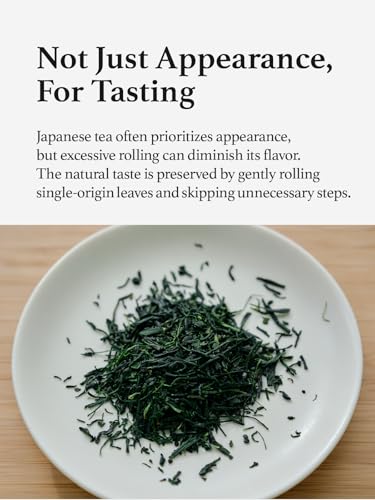
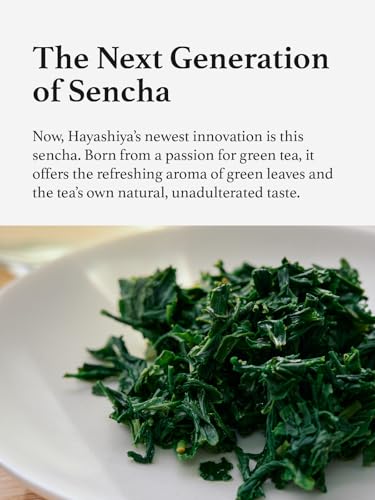
The listing positions this as a sencha that omits the appearance-focused rolling step to preserve the leaves' original aroma, and one reviewer connected that no-kneading process to the natural flavors being kept intact. In practice, expect whole-leaf integrity and a profile geared toward aroma preservation rather than the tightly-rolled needle look of standard sencha.
How is Uji sencha different from other Japanese green teas?
Uji is a historic tea-growing region near Kyoto, and the synthesis treats single-origin Uji sourcing from a named traditional producer (Kyo Hayashiya) as the connoisseur-register hook here. Some reviewers compared the experience to the premium mountain-grown tea their parents reserved for guests — the regional pedigree appears to read in the cup as a source-based umami descriptor rather than a generic 'Japanese green'.
Category: What actually makes green tea 'green'?
Green tea is leaf from Camellia sinensis that has been heated immediately after harvest to deactivate the polyphenol oxidase enzyme before oxidation can occur. That single step (called 'kill-green' or sassei) is what preserves the chlorophyll, the catechins like EGCG, and the fresh vegetal character. Without it, the same leaf would slowly turn into oolong or black tea instead.
Category: How can I tell good-quality green tea from low-quality?
Look at the leaf first — high-grade green tea has uniform color (vivid deep green for shaded, glossy emerald for sencha), tight needle or flake shape with minimal stems and dust, and a fresh, marine or grassy aroma rather than a dusty or hay-like smell. On the label, harvest date matters (April-May ichibancha beats summer harvests), and specificity in region or cultivar (Uji, Shizuoka, Yabukita, Saemidori) generally signals a producer targeting quality over volume.
Category: What water temperature should I use to brew green tea?
Most green teas brew best between 70C and 80C (160-175F). Boiling water aggressively extracts catechins and produces bitterness and astringency, while cooler water preserves the amino acids responsible for sweetness and umami. Shaded teas like gyokuro are typically brewed even lower, around 50-60C, specifically to draw out L-theanine without pulling harsh catechins.
What Customers Love
⚠️ Limited sample based on limited customer feedback (8 reviews) • Our methodology
- Smooth, fresh, umami-forward sencha profile
- Single-origin Uji sencha with no-kneading processing preserving leaf integrity
- Holds up across multiple infusions
- Versatile across tea-time, daily, and with-meals contexts
Taste Profile
Smooth and fresh lead the taste (mentioned in 4 and 3 of 8 reviews). A delicate umami anchors the core. The aroma reads grassy and aromatic with a subtle floral lift; the mild astringency works as counterpoint to the umami sweetness rather than as flaw.
- Buttery cakes
- Pastries
- Coconut mochi cake
Brewing: Brew at 155–167°F with short steeps; the leaves reward multiple infusions but turn bitter under boiling water or long pours.
Best Use Cases
🎯 Best For
- Tea-time pairings with buttery cakes, mochi, and pastries
- Multi-infusion brewing of a single-origin Japanese green
- Drinkers seeking source-based, umami-forward descriptors in an Uji sencha
⚠️ Not Ideal For
- Effortless daily brewing without temperature control
- Buyers prioritizing functional wellness claims or named adaptogens
- Value-per-gram daily-drinker green
How People Use It
We'd pour this at tea time alongside buttery cakes, mochi, or pastries — one reviewer calls the bitterness a perfect counterpoint to rich sweets.
For Experienced Users
✅ Worth Exploring
- Single-origin Uji sencha from a named traditional Kyoto producer
- Source-based umami descriptor with balance to mild astringency — connoisseur register
- No-kneading processing preserves whole leaves and rewards multiple infusions
What to Consider
Three of eight reviewers find it expensive for the amount, and a similar handful describe the profile as more subtle than expected — a considered purchase whose payoff hinges on careful brewing.
- Expensive for the amount (value cluster)
- Profile may read more subtle or dilute than expected for high-grade sencha
⚠️ Important: This analysis is based on limited customer feedback (8 reviews). We've shared what we found, but there may be additional considerations we haven't captured.
About This Analysis
This analysis is based on 8 customer reviews. We're showing you everything we found, but with a small sample, there's a lot we likely haven't captured yet.
✅ What we're confident about: What customers love and best use cases
⚠️ What may be incomplete: Potential issues and considerations
For more perspectives, check customer reviews on Amazon.
Product Selection
In short: We only feature high-rated products.
Products on TeaDelight.net are selected based on strong Amazon customer ratings, sufficient review volume, and market presence. We focus on well-regarded products that tea enthusiasts are actively considering and purchasing.
As an Amazon Associate we earn from qualifying purchases.
You Might Also Like

✅ familiar Twinings character that drinkers return to
Twinings Green Tea with Jasmine

✅ Versatile organic everyday green
Bigelow Steep Pure Organic Green Tea

✅ Versatile across morning, daily, iced, and evening use
VAHDAM Organic Himalayan Green Tea
✅ Resteeps well on a second infusion