


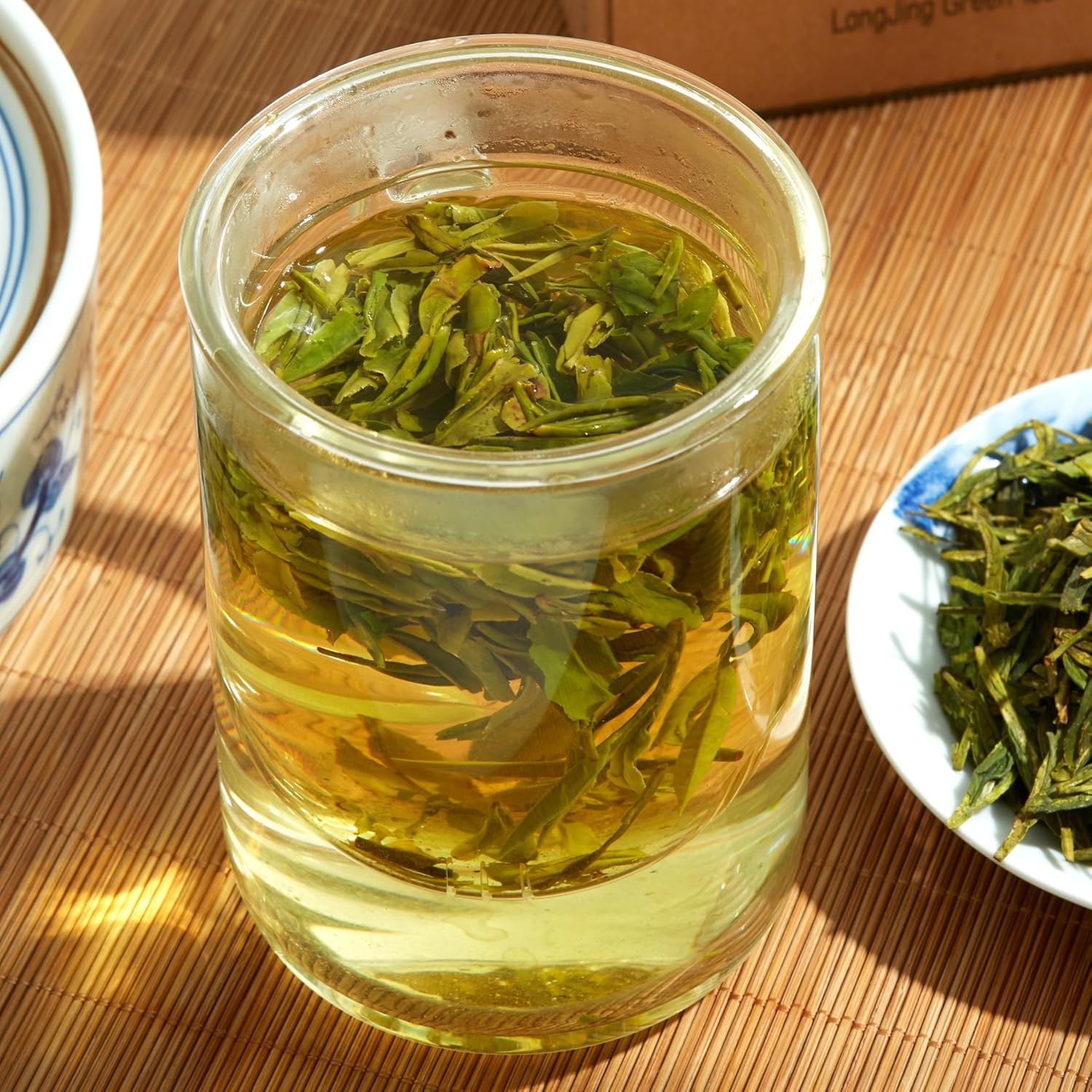


We analyze real customer reviews to surface what matters: key strengths, ideal use cases, and honest considerations — so you can make an informed choice.
ChaWuWarmSun Dragon Well Green Tea
A B-grade Dragon Well in value territory — clean, subtle, and recognizably Longjing without higher-grade refinement.
🎯 Best for: everyday drinking, taken plain, an entry point to Chinese green tea
🍃 Strength: Light

What Stands Out
🍃 Flavor Profile
Strength: Light
Three reviewers settle on 'subtle,' three on 'fresh,' with 'light' and 'smooth' close behind. Nutty, clean notes come with butter, grassiness, and light roasting from stir-drying — we'd call it recognizably Longjing, without the layered complexity of top-tier picks.
✅ What Customers Love
- Value-tier Longjing with authentic Dragon Well character
- Clean, subtle cup with a nutty Longjing signature
- Vacuum-sealed packaging preserves leaf integrity
🎯 Best For
everyday drinking, taken plain • an entry point to Chinese green tea • short-steep loose-leaf brewing with multiple infusions
Brand: ChaWuWarmSun
Category: Green Tea
As an Amazon Associate we earn from qualifying purchases.
About This Green Tea
This is a B-grade Dragon Well in value territory — clean, subtle, and recognizably Longjing without the refinement of higher-grade lots. Three reviewers settle on 'subtle,' three on 'fresh,' with 'light' and 'smooth' close behind. Nutty, clean notes come with butter, grassiness, and light roasting from stir-drying — recognizably Longjing, without the layered complexity of top-tier picks.
Reviewers frame it as a daily drinker and a green-tea entry point, taken plain. Four of fourteen plan to reorder, including one twenty-year Dragon Well drinker — a signal that the cup holds up for people who know the style, even at this price point.
For brewing, keep the first steep short at 175–180°F for 20 seconds to two minutes. The second infusion can push to 200°F for around three minutes, drawing out a fuller cup from the same leaves. Short steeps suit the subtle character; longer ones risk pulling more of the light grassy edge than the nuttiness.
The honest caveat: three of fourteen reviewers call the aroma or flavor faint or light. That's the trade-off for the B-grade over first flush lots — if you're seeking bold flavor intensity or top-tier Dragon Well refinement, this isn't the lot for that. Reviewers comparing it to higher grades note those will be sweeter and more refined in taste.
As an everyday Longjing taken plain, or as a way into Chinese green tea without committing to premium-tier pricing, it does the job.
Is ChaWuWarmSun Dragon Well Green Tea Right for You?
What does this Dragon Well taste like?
Across the small set of reviewers, three settle on 'subtle' and three on 'fresh,' with nutty, clean notes and hints of butter and grassiness from the stir-drying. It reads as recognizably Longjing — lighter and less layered than top-tier picks.
Is this Dragon Well good for everyday drinking?
Reviewers frame it as a daily drinker taken plain — no milk, no sugar — and four of fourteen signal they plan to reorder. The subtle, clean profile holds up to regular sipping with little bitterness reported.
How should I brew this leaf?
Reviewers suggest a short first steep at 175–180°F for 20 seconds to two minutes, then a second steep at around 200°F for about three minutes. A filter helps, and getting temperature, timing, and dosage right is what reviewers flag as the difference between a clean cup and a flat one.
Is the flavor too weak?
Three of fourteen reviewers (roughly 21%) describe the aroma or flavor as faint or light, with one calling it 'too weak regardless of brew time.' That's the trade-off the B-grade signals — a lighter cup than first-flush lots.
Does it taste like authentic Longjing?
Reviewers describe a distinct Long Jing aroma, the pretty leaf color from stir-drying, and leaves consistent with the B-grade description — one twenty-year Dragon Well drinker calls it a stable source. It appears to deliver the Longjing signature without the refinement of higher grades.
How does it compare to higher-grade Dragon Well?
One reviewer notes higher grades will be sweeter and more refined; another, comparing it to top-shelf Longjing from a Chinese tea store, said they couldn't tell much taste difference. Expect recognizably Longjing character without the layered complexity of first-flush picks.
As an Amazon Associate we earn from qualifying purchases.
Is this a good starting point for someone new to green tea?
A reviewer explicitly cites it as an introduction to green teas, and the subtle, clean profile with little bitterness reported makes it forgiving for newer palates. Reviewer-supplied brewing parameters (175–180°F, short first steep) give beginners a clear starting point.
Can I get a second steep out of the same leaves?
Yes — reviewers describe a second brew at higher temperature around 200°F for roughly three minutes, with one noting the second steep tastes more like a black or oolong than the first. Multi-infusion appears to work on this leaf at the brewing parameters reviewers share.
Is the inner packaging airtight?
Reviewers praise the vacuum-sealed inner pouch inside a cardboard box, which keeps the leaves consistent, healthy, and relatively tender. One reviewer flagged unnecessary plastic in the wrap as a minor gripe.
Should I add milk or sugar to this Dragon Well?
Reviewers take it plain — no milk, no sugar — and the synthesis frames that as the right call. The subtle, clean Longjing character is what buyers come for, and dairy or sweetener would mask the nutty signature.
Category: Why does my green tea taste bitter?
Bitterness and astringency in green tea come mainly from catechins (especially EGCG) being over-extracted. The two biggest causes are water that is too hot — boiling water pulls catechins aggressively — and steeping for too long. Catechins also extract faster than the sweet, savory amino acids, so a shorter steep at lower temperature gives you the sweetness without the harshness.
Category: How can I tell good-quality green tea from low-quality?
Look at the leaf first — high-grade green tea has uniform color (vivid deep green for shaded, glossy emerald for sencha), tight needle or flake shape with minimal stems and dust, and a fresh, marine or grassy aroma rather than a dusty or hay-like smell. On the label, harvest date matters (April-May ichibancha beats summer harvests), and specificity in region or cultivar (Uji, Shizuoka, Yabukita, Saemidori) generally signals a producer targeting quality over volume.
As an Amazon Associate we earn from qualifying purchases.
Category: What water temperature should I use to brew green tea?
Most green teas brew best between 70C and 80C (160-175F). Boiling water aggressively extracts catechins and produces bitterness and astringency, while cooler water preserves the amino acids responsible for sweetness and umami. Shaded teas like gyokuro are typically brewed even lower, around 50-60C, specifically to draw out L-theanine without pulling harsh catechins.
What Customers Love
⚠️ Limited sample based on limited customer feedback (12 reviews) • Our methodology
- Value-tier Longjing with authentic Dragon Well character
- Clean, subtle cup with a nutty Longjing signature
- Vacuum-sealed packaging preserves leaf integrity
- Positive overall sentiment
Taste Profile
Three reviewers settle on 'subtle,' three on 'fresh,' with 'light' and 'smooth' close behind. Nutty, clean notes come with butter, grassiness, and light roasting from stir-drying — we'd call it recognizably Longjing, without the layered complexity of top-tier picks.
Brewing: Keep the first steep short at 175–180°F for 20 seconds to two minutes; the second can push to 200°F for three minutes.
Best Use Cases
🎯 Best For
- everyday drinking, taken plain
- an entry point to Chinese green tea
- short-steep loose-leaf brewing with multiple infusions
⚠️ Not Ideal For
- drinkers seeking bold flavor intensity
- buyers expecting top-tier Dragon Well refinement
How People Use It
Reviewers frame it as a daily drinker and a green-tea entry point, taken plain. Four of fourteen plan to reorder — one is a twenty-year Dragon Well drinker.
Good for Beginners
✅ Yes
- Explicitly cited by a reviewer as an introduction to green tea
- Specific brewing parameters available from reviewers (175–180°F, short first steep)
- Subtle, clean profile with little bitterness reported
For Experienced Users
✅ Worth Exploring
- Named-origin Longjing with transparent B-grade disclosure
- Multi-infusion brewing protocol supported by the data (second steep at ~200°F)
- Validated by a long-term Dragon Well drinker as a stable source
What to Consider
Three of fourteen reviewers call the aroma or flavor faint or light — a trade-off for the B-grade over first flush lots.
- Faint aroma and light-side flavor for some palates
⚠️ Important: This analysis is based on limited customer feedback (12 reviews). We've shared what we found, but there may be additional considerations we haven't captured.
About This Analysis
This analysis is based on 12 customer reviews. We're showing you everything we found, but with a small sample, there's a lot we likely haven't captured yet.
✅ What we're confident about: What customers love and best use cases
⚠️ What may be incomplete: Potential issues and considerations
For more perspectives, check customer reviews on Amazon.
Product Selection
In short: We only feature high-rated products.
Products on TeaDelight.net are selected based on strong Amazon customer ratings, sufficient review volume, and market presence. We focus on well-regarded products that tea enthusiasts are actively considering and purchasing.
As an Amazon Associate we earn from qualifying purchases.
You Might Also Like

✅ familiar Twinings character that drinkers return to
Twinings Green Tea with Jasmine

✅ Versatile organic everyday green
Bigelow Steep Pure Organic Green Tea

✅ Versatile across morning, daily, iced, and evening use
VAHDAM Organic Himalayan Green Tea
✅ Resteeps well on a second infusion