


We analyze real customer reviews to surface what matters: key strengths, ideal use cases, and honest considerations — so you can make an informed choice.
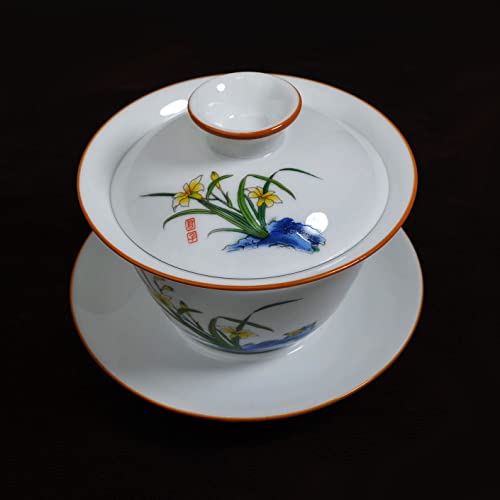
Liang Baobao Porcelain Sancai Gaiwan Tea Set
A porcelain sancai gaiwan — the three-piece lid-bowl-saucer format used for traditional Chinese gongfu infusion.
🎯 Best for: solo or small-group gongfu brewing, everyday porcelain gaiwan for aesthetic display

✅ What Customers Love
- Clean, attractive porcelain finish
- Solid build for the price tier
🎯 Best For
solo or small-group gongfu brewing • everyday porcelain gaiwan for aesthetic display
Brand: Liang baobao
Category: Gaiwan
As an Amazon Associate we earn from qualifying purchases.
About This Product
A porcelain sancai gaiwan — the traditional three-piece lid, bowl, and saucer format used for Chinese gongfu infusion. Functional performance signal is thin in the aggregation, but reviewers describe the finish as beautiful (4 of 10) with solid construction (3 of 10), and one reviewer notes the porcelain body is fine enough for light to pass through.
Capacity signals point at the 150–200ml range, which puts this in solo-to-small-group gongfu territory rather than Western mug-style brewing. It suits drinkers who want a straightforward porcelain gaiwan for short, repeated infusions, and the clean white body lends itself to aesthetic display between sessions.
Hand-wash with warm water and a soft cloth. Before the first pour, warm the porcelain with a splash of hot water to avoid thermal shock. One reviewer notes the rim gets hot enough to be hard to hold in use — that's characteristic of thin-walled gaiwan design rather than a manufacturing flaw, and most gongfu drinkers learn a pinch grip on the lid and base that keeps fingers off the rim.
The honest caveat: four separate reviewers of ten report arrival damage — chipped rims, a small chip, broken bits, or a piece chipped on arrival. That's a higher rate than most porcelain, so inspecting the set carefully on unboxing matters here. It's also not the right tool for matcha preparation; a chawan and chasen are the correct format for that.
For a reviewer-grounded entry-level porcelain gaiwan at this size, it does the core job — provided the set arrives intact.
Is Liang Baobao Porcelain Sancai Gaiwan Tea Set Right for You?
Is the porcelain attractive enough to display?
Four of ten reviewers describe the finish as beautiful, and one notes the porcelain body is fine enough that light passes through it. The clean white sancai form reads well as a display piece between sessions.
Is this sized for gongfu brewing or Western mug-style use?
Capacity signals point to the 150-200ml range, which fits solo-to-small-group gongfu sessions rather than Western mug brewing. The three-piece lid-bowl-saucer format is the traditional gongfu workflow.
Roughly how much tea does it hold?
Capacity falls in the 150-200ml range based on reviewer signals — typical for a single-serve or two-cup gongfu gaiwan rather than a mug substitute.
Does the rim get hot to hold while pouring?
One reviewer reports the rim heats up enough to be hard to hold during use. That is characteristic of thin-walled gaiwan design rather than a manufacturing flaw — most gongfu drinkers grip the saucer and lid rather than the bowl itself.
How fragile is the porcelain?
The porcelain is thin enough that light passes through one reviewer's piece, and several reviewers note chipped rims. Handle this as delicate teaware — the same thinness that gives the gaiwan its elegance is what makes the rim chip-prone.
How should I clean it?
Hand-wash with warm water and a soft cloth. Skip the dishwasher and abrasive scrubbers — thin porcelain and the lid's edges don't tolerate harsh handling.
As an Amazon Associate we earn from qualifying purchases.
Do I need to warm it before brewing?
Yes — pour a splash of hot water through the gaiwan before the first infusion to warm the porcelain and avoid thermal shock. This is standard practice with thin-walled porcelain teaware.
Can I use this for matcha?
No — this is a gongfu gaiwan designed for steeping loose-leaf Chinese tea, not for whisking matcha. Matcha needs a wide flat-bottomed chawan and a chasen whisk, neither of which matches the sancai bowl's geometry.
Who is this gaiwan best for?
Solo or small-group gongfu drinkers who want a traditional porcelain three-piece set, and buyers who care how the gaiwan looks on the shelf between sessions. The clean white sancai shape works for both daily use and aesthetic display.
How solid does the build feel in hand?
Three of ten reviewers describe the construction as solid, and the finish reads as clean and well-made across multiple reports. That said, the walls are on the thin side — characteristic of traditional porcelain gaiwan rather than a sturdier mug-style build.
Is this a traditional sancai-style gaiwan?
Yes — the listing describes a three-piece lid-bowl-saucer format, which is the traditional sancai design used in gongfu brewing. The plain white porcelain finish is the most common stylistic treatment for this format.
Category: How do I clean and care for a gaiwan?
Rinse with hot water after each session and let it air-dry — porcelain doesn't need soap, and any residual scent can transfer to delicate teas later. Light staining on the interior can be lifted with a soft cloth and a little baking soda. Because porcelain is non-porous, a single gaiwan can brew any tea type without flavor crossover, unlike clay pots that get dedicated to one tea. Avoid sudden extreme temperature changes (cold pot, boiling water poured straight in) to prevent thermal-shock cracks.
As an Amazon Associate we earn from qualifying purchases.
Category: What is a gaiwan used for?
A gaiwan is a lidded porcelain brewing vessel used primarily for gongfu-style Chinese tea, where a high leaf-to-water ratio and multiple short infusions reveal a tea's flavor in layers. The lid lets you hold leaves back while pouring, trap and smell the accumulated aroma, and brew oolong, white, green, or pu'er across many short steepings. Porcelain gaiwans are favored because they are flavor-neutral and non-reactive, making them ideal for tasting a tea honestly without the vessel adding character of its own.
Category: Where does the gaiwan come from culturally?
The gaiwan rose to prominence during the Ming Dynasty when loose-leaf brewing replaced powdered tea, and it became central to gongfu cha — the Chinese practice of brewing tea with high skill across many short infusions. In Chaozhou, the cradle of gongfu, the gaiwan and small clay pot are equally traditional; in the modern Taiwanese tea revival the gaiwan often pairs with a fairness pitcher and aroma cups to refine the sensory progression. It is a vessel as much about presence and process as about the leaf itself.
What Makes This Product Special
⚠️ Preliminary analysis based on 10-review sample • Our methodology
- Clean, attractive porcelain finish
- Solid build for the price tier
Quality & Care
Functional performance signal is thin in the aggregation, but reviewers describe the finish as beautiful (4 of 10) with solid construction (3 of 10) and a porcelain body one reviewer calls fine enough for light to pass through. One reviewer notes the rim gets hot enough to be hard to hold — characteristic of thin-walled gaiwan design rather than a manufacturing flaw.
Care
Hand-wash with warm water and a soft cloth; warm the porcelain with a splash of hot water before the first pour to avoid thermal shock.
Best Use Cases
🎯 Best For
- solo or small-group gongfu brewing
- everyday porcelain gaiwan for aesthetic display
⚠️ Not Ideal For
- matcha preparation
How People Use It
Capacity signals point at the 150–200ml range — solo-to-small-group gongfu sessions rather than Western mug-style brewing.
What to Consider
Four separate reviewers of ten report arrival damage — chipped rims, a small chip, broken bits, or a piece chipped on arrival — so inspecting the set on unboxing matters more here than with most porcelain.
- Arrival damage / chipping
- Rim heats up in use
⚠️ based on 10-review sample. Some issues may not be captured.
About This Analysis
This analysis is based on 10 customer reviews. We're showing you everything we found, but with a moderate sample, there's a lot we likely haven't captured yet.
✅ What we're confident about: What customers love and best use cases
⚠️ What may be incomplete: Potential issues and considerations
For more perspectives, check customer reviews on Amazon.
Product Selection
In short: We only feature high-rated products.
Products on TeaDelight.net are selected based on strong Amazon customer ratings, sufficient review volume, and market presence. We focus on well-regarded products that tea enthusiasts are actively considering and purchasing.
As an Amazon Associate we earn from qualifying purchases.
You Might Also Like

✅ Pattern and glaze suit blue-and-white decor
vv8oo Blue and White Butterfly Porcelain Gaiwan

✅ Solid construction at this price tier
vv8oo Dragon Phoenix Porcelain Gaiwan

✅ Beautiful glaze
YBK Tech Large Gaiwan with Lotus Pattern

✅ Heat-managed lip-cup design