




We analyze real customer reviews to surface what matters: key strengths, ideal use cases, and honest considerations — so you can make an informed choice.
YQL Reusable Cotton Spice Bags with Drawstring
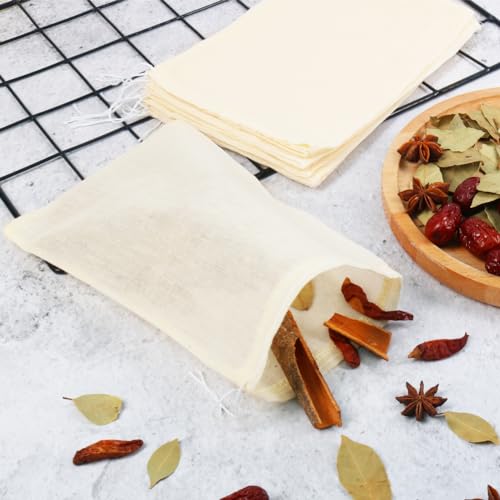
Large-format cotton drawstring bags for infusing spices and herbs in soups, stews, and brews — reusable, boil-safe, and weighted to sink rather than float.
🎯 Best for: Large batch soup and stew spice bags, Brewing loose tea in pitchers

✅ What Customers Love
- Large size - holds substantial amount of spices/herbs (5 mentions)
- Reusable and washable (4 mentions)
- Good quality construction with tight stitching (4 mentions)
🎯 Best For
Large batch soup and stew spice bags • Brewing loose tea in pitchers • Drying herbs • Making sachets for fragrance or pest control
Brand: YQL
Category: Tea Filter Bags
As an Amazon Associate we earn from qualifying purchases.
About This Product
Made from tightly woven cotton with a drawstring closure, these bags excel at containing whole spices and dried herbs through long simmers — reviewers note they sink to the bottom and stay put rather than floating. Construction holds up through repeated boiling and washing without fraying, and the bags can be turned inside out for thorough cleaning. The dense weave saturates more slowly than cheesecloth, which makes them less suited for gravies or any application requiring quick liquid absorption. Comes in a set of 30, accommodating both single-use and repeated-reuse approaches. Best for large-batch soups, curry spice bundles, pickle processing, kefir straining, and loose-tea brewing in pitchers.
Is YQL Reusable Cotton Spice Bags with Drawstring Right for You?
Can you use these for brewing loose leaf tea?
Yes, and the large size is actually ideal for loose leaf tea. Tea leaves need room to expand and unfurl to release their full flavor, and these 5.9x7.8 inch bags give them plenty of space — much more than a typical single-cup infuser. They're especially good for brewing tea in pitchers for iced tea or large batches. The bags sink in liquid rather than floating, which means consistent steeping without having to weigh them down.
Are these bags big enough for making soup stock?
More than big enough, actually. At 5.9x7.8 inches, these are on the larger side for spice bags, which is exactly what you want for loading up with bay leaves, peppercorns, thyme, and other aromatics for a big pot of stock. Multiple reviewers specifically mention using them for soups and stews and praise the large size for holding substantial amounts of spices and herbs. If anything, some users find them too large for smaller applications.
Can these bags be used for things other than cooking?
Absolutely — reviewers have found a surprising range of uses beyond the kitchen. People use them as lavender sachets for pest control and fragrance in closets, as small gift bags (apparently the natural cotton has an elegant look), for drying herbs, and even for making kefir cheese by pouring the liquid in with a funnel and hanging the bag to strain. The versatility is one of the most praised aspects of these bags.
How do these compare to using cheesecloth?
The biggest advantage over cheesecloth is convenience. With cheesecloth, you have to cut it to size and tie it with twine — these bags already have a drawstring closure, so you just fill and pull closed. Reviewers specifically call out eliminating the need for tying cheesecloth as a major plus. The trade-off is that the cotton weave is thicker and denser than cheesecloth, meaning these are slower to saturate with liquid and may be too thick for some applications like gravies where you need finer straining.
Are these good for Indian cooking and curry spices?
They're well-suited for it. Indian cooking often involves whole spices like cardamom pods, cloves, cinnamon sticks, and bay leaves that you want to infuse into curries and dals but don't want to eat. These bags can hold a substantial amount of whole spices, hold up in boiling conditions, and make retrieval easy — just pull the bag out when you're done cooking. The large size means you can fit all your whole spices for a big batch in a single bag.
Are muslin spice bags reusable?
Yes, and the YQL bags are specifically designed for reuse. They're made from natural cotton with tight stitching that holds up through multiple washes. Reviewers confirm you can turn them inside out for cleaning and reuse them many times. The one caveat: the drawstrings can sometimes fall out during machine washing, so hand washing or being gentle with them extends their life significantly.
As an Amazon Associate we earn from qualifying purchases.
Do the drawstrings hold up over time?
This is the one area where reviewers have some concern. While the bags themselves are well-constructed with tight stitching, the drawstrings can fall out during washing. The string quality has been called out as a weak point. If you plan to reuse the bags many times, hand washing is gentler on the drawstrings than machine washing. It's not a dealbreaker for most users, but it's worth knowing.
Do the YQL spice bags have a smell when you first open them?
Yes, reviewers note a noticeable odor when the bags first arrive. It's a natural cotton smell, not chemical, but it's strong enough that you'll want to wash the bags before using them for food. A quick rinse or soak takes care of it. It's a minor inconvenience but worth knowing about so you don't plan to use them straight out of the package.
How to use a tea filter bag?
Using the YQL bags is straightforward: open the drawstring, add your loose leaf tea (or spices, herbs, etc.), pull the drawstring closed, and drop it into your hot water. The bags are large enough at 5.9x7.8 inches that you don't need to stuff them tight — giving the tea leaves room to expand actually improves your brew. Reviewers note these bags sink in liquid rather than floating, which means better infusion without having to push them down. When done, just pull the bag out by the string.
How to use tea bags correctly?
With the YQL bags, the key steps are: first, wash the bags before first use (they can have a natural cotton smell out of the package). Then add your tea — don't overfill; leave room for the leaves to expand. Close the drawstring snugly but not crushing the contents. Place the bag in your vessel before or as you add hot water. Let it steep for the recommended time for your tea type, then remove. These bags handle boiling water without any issue, so you don't need to worry about temperature.
Who should NOT buy these bags?
These might not be right for you if you need bags for making gravies (the cotton is too thick for fine straining), if you need quick liquid absorption like cheesecloth offers, or if you specifically need smaller bags for single-cup tea brewing or small sachets. The 5.9x7.8 inch size is generous, which is great for soups and pitchers but oversized for some applications. Also, if you're not willing to wash them before first use, the initial cotton smell could be off-putting.
Do these bags float or sink in liquid?
They sink, which is actually a notable advantage. Reviewers specifically mention that the bags sink in liquid rather than floating on the surface. This means better, more even infusion whether you're steeping tea or cooking with spices — no need to push the bag down or weigh it with a spoon. The natural cotton absorbs enough water to stay submerged on its own.
As an Amazon Associate we earn from qualifying purchases.
What to look for when buying tea filter bags?
Material, size, and closure method matter most. The YQL bags check several boxes: natural cotton (no microplastics or chemical leaching), a generous 5.9x7.8 inch size that gives tea leaves room to expand, and a drawstring closure that's much easier than tying cheesecloth with twine. One thing to watch for with any cotton bag is weave density — these YQL bags have a tight weave with good stitching, which keeps fine particles out of your brew but means they're a bit slow to saturate initially.
Which tea bags do not leach microplastics?
The YQL bags are made from natural cotton, so microplastics aren't a concern here at all. Unlike nylon or polypropylene tea bags that can release billions of microplastic particles when heated, cotton is a natural fiber that stays intact in boiling water. If avoiding microplastics is important to you, natural cotton bags like these are a solid choice for brewing loose leaf tea.
How can a tea bag work as a filter?
The YQL bags work as filters because the natural cotton weave is tight enough to contain tea leaves, spices, and herbs while still allowing water and dissolved flavors to pass through freely. Think of it like a very fine, flexible sieve. The cotton construction means effective straining without the chemical concerns of synthetic materials. Reviewers confirm they do a good job keeping particles out of the liquid while letting all the flavor through.
What is the best material for a drawstring bag?
For cooking and brewing purposes, natural cotton like what the YQL bags use is one of the best choices. It's food-safe, handles boiling temperatures without breaking down, and doesn't leach chemicals or microplastics into your food. Cotton is also breathable enough to let flavors infuse while keeping solids contained. The trade-off compared to synthetic materials is that cotton is slower to saturate with liquid — it doesn't absorb water as quickly as cheesecloth, which can matter for some applications.
What are the best tea strainers?
It depends on what you're brewing and how much. For single cups, metal mesh strainers work well. But for larger batches — like brewing loose tea in a pitcher — cotton drawstring bags like the YQL are hard to beat. You fill the bag, drop it in, and pull it out when you're done. No mess, no loose leaves floating around. Reviewers specifically praise these for pitcher-sized tea brewing because the 5.9x7.8 inch size gives leaves plenty of room to expand and infuse properly.
Are tea strainers worth buying?
If you brew loose leaf tea regularly, absolutely. The YQL bags offer a different approach than traditional metal strainers — they're disposable or reusable (your choice), and at 30 bags per pack they're excellent value. The big advantage over metal strainers is convenience: fill, close the drawstring, brew, and either wash for reuse or toss. No scraping wet tea leaves out of a fine mesh basket.
As an Amazon Associate we earn from qualifying purchases.
What's the best type of tea strainer?
For large-batch brewing like iced tea pitchers or sun tea, cotton drawstring bags like the YQL are arguably the best option. The 5.9x7.8 inch size accommodates a generous amount of loose leaf tea and lets the leaves unfurl fully for better flavor extraction. For single cups, you might prefer a metal infuser for convenience. But these cotton bags really shine when you're making bigger batches or want something you can just lift out and discard or wash.
Why are you not supposed to squeeze tea bags?
Squeezing tea bags pushes out tannins and bitter compounds that were still trapped in the leaves, making your brew taste more astringent. With the YQL bags, the large 5.9x7.8 inch size actually helps with this — because the tea leaves have plenty of room to spread out, you get good extraction during steeping without needing to squeeze. Just let the bag drain naturally when you remove it.
Do you put tea bags in the water before or after it boils?
Generally, you want to add the bag after bringing the water to the right temperature for your tea type. With the YQL cotton bags, reviewers confirm they hold up well in boiling conditions, so you can add them to actively boiling water for herbal teas and black teas that need full boiling temps. For more delicate green or white teas, let the water cool slightly first. The cotton material handles heat well either way.
What Makes This Product Special
⚠️ Preliminary analysis based on 15-review sample • Our methodology
- Large size - holds substantial amount of spices/herbs (5 mentions)
- Reusable and washable (4 mentions)
- Good quality construction with tight stitching (4 mentions)
- Drawstring closure is convenient (3 mentions)
- Good value - 30 bags in package (3 mentions)
- Holds up well in boiling conditions (2 mentions)
- Effective straining/filtering (2 mentions)
Best Use Cases
🎯 Best For
- Large batch soup and stew spice bags
- Brewing loose tea in pitchers
- Drying herbs
- Making sachets for fragrance or pest control
- Cheese-making (kefir straining)
- Pickle and preserve processing
- Indian food and curry spice infusions
⚠️ Not Ideal For
- Adding to gravies (too thick)
- Applications requiring quick liquid absorption
- Users who need smaller bags
What to Consider
- Strong odor on arrival (requires washing) (1 mentions)
- Slow to saturate with liquid - doesn't absorb water like cheesecloth (1 mentions)
- Too thick for some applications like gravies (1 mentions)
- Drawstrings can fall out during washing - poor string quality (1 mentions)
- Size may be too large for some uses (1 mentions)
⚠️ based on 15-review sample. Some issues may not be captured.
About This Analysis
This analysis is based on 15 customer reviews. We're showing you everything we found, but with a moderate sample, there's a lot we likely haven't captured yet.
✅ What we're confident about: What customers love and best use cases
⚠️ What may be incomplete: Potential issues and considerations
For more perspectives, check customer reviews on Amazon.
Product Selection
In short: We only feature high-rated products.
Products on TeaDelight.net are selected based on strong Amazon customer ratings, sufficient review volume, and market presence. We focus on well-regarded products that tea enthusiasts are actively considering and purchasing.
As an Amazon Associate we earn from qualifying purchases.
You Might Also Like

✅ Durable, thick cotton/fabric material (not flimsy paper)
Lannso Disposable Tea Bags for Loose Leaf Tea (200 Count)

✅ Strong, durable material that doesn't tear or leak grounds
Yzurbu Cold Brew Coffee Filter Bags

✅ Sturdy and durable, holds up through multiple uses
Cuopru Tea Filter Bags with Drawstring

✅ Sturdy construction, doesn't tear easily during normal use