




We analyze real customer reviews to surface what matters: key strengths, ideal use cases, and honest considerations — so you can make an informed choice.
Shelling Home Disposable Tea Bags for Loose Leaf Tea
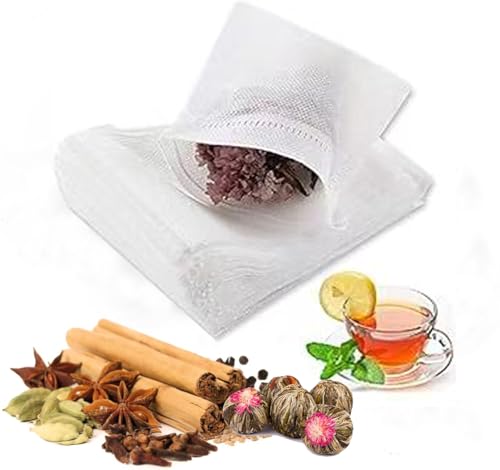
A 400-count pack of disposable loose-leaf filter bags that ships with a free scoop — a value play anchored in the count, not the fabric story.
🎯 Best for: Low-cost disposable loose-leaf brewing at home, Quick filling with the included scoop

✅ What Customers Love
- Low cost-per-bag at 400-count scale
- Clean filtration with no leaf bleed-through
- Included tea scoop as a filling aid
🎯 Best For
Low-cost disposable loose-leaf brewing at home • Quick filling with the included scoop
Brand: Shelling Home
Category: Tea Filter Bags
As an Amazon Associate we earn from qualifying purchases.
About This Product
A 400-count pack of disposable loose-leaf filter bags that ships with a free scoop — a value play anchored in the count, not the fabric story. Where filtration comes up, the small pocket of positive signal is consistent: reviewers report no leaves slipping through and the bags holding their shape in hot water. One dimension-level mention calls the bags "great quality," which at 1 of 13 we'd read as a positive data point rather than a consensus.
We'd reach for these for casual loose-leaf brewing at home or at a desk when you don't want to commit to a permanent infuser or deal with cleaning one. The included scoop earns a brief positive call-out as a filling convenience, and the cost-per-brew pitch drives the product — four of 13 reviewers explicitly reference low cost, good value, or sheer pack quantity.
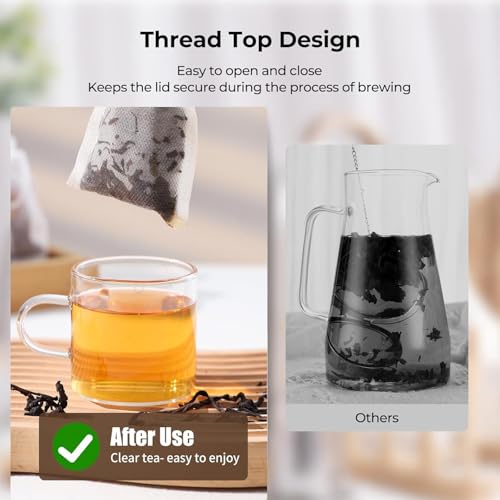
In use, each bag closes by manually tying off the drawstring, so plan for a small filling step before brewing rather than a press-and-go workflow. They're disposable, so there's no cleaning loop to manage afterward — fill, brew, discard.
On the honest side, two of 13 reviewers report that the fabric reads thick enough to hinder steeping, with one specifically noting poor hot-water penetration with denser grounds like Teeccino. If you mostly brew finely-ground botanicals or chicory-style blends where extraction depends on fast water contact, that's worth weighing. These also aren't the right tool for ceremonial matcha preparation, where the fabric layer defeats the point.
For everyday loose-leaf brewing where the count and the cost matter more than the fabric thickness, the 400-bag pack plus scoop does what it sets out to do.
Is Shelling Home Disposable Tea Bags for Loose Leaf Tea Right for You?
How many filter bags come in the pack?
The listing specifies 400 disposable filter bags per pack, along with a free tea scoop for filling. Several reviewers reference the sheer pack quantity as a draw.
What size are the bags and what can I put in them?
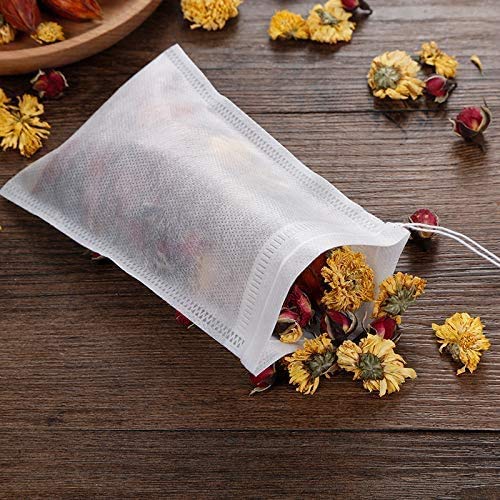
Each bag measures 3.54 by 2.75 inches, and the listing positions them for loose-leaf tea, coffee, herbs, and spices. That footprint suits casual at-home or desk brewing where you don't want to commit to a permanent infuser.
Do leaves slip through the fabric?
Reviewers who addressed filtration report no leaf bleed-through and say the bags hold their shape in hot water. It's a small pocket of positive signal rather than a heavily-discussed dimension across the 13 reviewers.
Is the fabric too thick to brew properly?
Two of 13 reviewers report the fabric reads thick enough to hinder steeping, with one specifically noting poor hot-water penetration on denser grounds like Teeccino. It's a real caveat worth weighing if you brew finely-ground botanicals.
How do you close the bag after filling?
These use a manual knot-tying closure rather than a drawstring or seal — one reviewer specifically flags the need to tie strings carefully to avoid spillage. Plan on a few extra seconds per bag versus a pull-tab style filter.
Is the included scoop actually useful?
The free scoop earns a brief positive call-out from reviewers as a filling convenience — it makes portioning loose leaf into the small bag opening less fiddly. It's a modest extra rather than a headline feature.
As an Amazon Associate we earn from qualifying purchases.
Can I use these for ceremonial matcha?
No — these are explicitly not suited to ceremonial matcha preparation, which requires direct whisking of powder into water rather than steeping through fabric. Stick to leaf and coarser ground botanicals here.
Do these work with coffee or herbs as well as tea?
The listing positions them for coffee, herbs, and spices alongside loose-leaf tea, and the 3.54 by 2.75 inch size accommodates a generous portion. Just note the fabric thickness caveat applies more to finely-ground material than to whole leaf.
Is the tea brewed in a bag the same as loose leaf?
When you fill these yourself with whole-leaf tea, you're brewing the same leaf you'd use loose — the bag is just a containment layer for easier cleanup. The trade-off is that fabric thickness can restrict extraction compared to free-floating leaves, especially with dense grounds.
Who are these best suited for?
We'd reach for these for casual at-home or desk loose-leaf brewing when you don't want to deal with cleaning a permanent infuser. Disposability and the 400-count pack do the heavy lifting here, not a refined fabric story.
How well do the bags hold up in hot water?
Reviewers who addressed structural performance report the bags hold their shape in hot water without falling apart. One reviewer calls overall build 'great quality' — a single data point rather than consensus across the 13 reviewers.
What kind of loose tea works best in these?
Whole-leaf and coarser cut teas appear to perform best, since the fabric's thickness can hinder extraction with finely-ground botanicals per a couple of reviewers. For a robust black or oolong leaf, filtration is clean and shape holds.
As an Amazon Associate we earn from qualifying purchases.
Category: What materials are empty tea filter bags made from?
The dominant material is paper — typically a blend of abaca (Manila hemp) fiber from the Philippines, wood-pulp cellulose, and a small percentage of thermoplastic fiber (PLA, polypropylene, or polyester) that enables heat-sealing. Alternatives include organic cotton muslin, hemp-cotton blends, PLA corn-fiber 'biodegradable' pyramids, and nylon or PET mesh. Two suppliers — Glatfelter and Ahlstrom-Munksjö — produce most of the world's tea-bag paper in heat-seal and non-heat-seal grades.
Category: How do I tell a quality empty filter bag from a poorly-made one?
Hold a single bag up to light — quality paper is pinhole-free with uniform fiber distribution. Look for explicit food-safe disclosure (FDA 21 CFR 176.170 for paper or EU 1935/2004 Declaration of Compliance), country of manufacture (Germany and Japan have rigorous food-contact regimes), and ECF or TCF bleaching status. For reusables, look for GOTS organic certification on cotton, reinforced double-stitched seams, and slide-toggle drawstrings that actually lock the bag closed against escaping leaf.
Category: Are reusable cotton or hemp filter bags better than disposable paper?
They're meaningfully better on waste and lifecycle once you cross the use threshold. A typical organic cotton muslin bag amortizes below disposable paper after roughly 30-120 uses depending on the paper benchmark, and well-maintained reusables last 150-300 uses. The trade-off is mesh: cotton's coarser weave leaks very fine particles (rooibos powder, matcha, hibiscus dust), so the practical pattern is muslin for whole-leaf and herbal blends, paper for fines and CTC.
Customer-Validated Strengths
based on 13-review analysis • Our methodology
- Low cost-per-bag at 400-count scale
- Clean filtration with no leaf bleed-through
- Included tea scoop as a filling aid
Quality & Care
At 400 bags per pack, the cost-per-brew pitch drives the product, and several reviewers echo it directly: four of 13 explicitly reference low cost, good value, or sheer pack quantity. Filtration earns a small pocket of positive signal where it comes up — reviewers who mention it report no leaves slipping through and the bags holding their shape in hot water. On structural build, we have one dimension-level mention calling the bags "great quality," which — at 1 of 13 — we'd read as a positive data point rather than a consensus.
Best Use Cases
🎯 Best For
- Low-cost disposable loose-leaf brewing at home
- Quick filling with the included scoop
⚠️ Not Ideal For
- Dense, finely-ground botanicals where fabric thickness may restrict extraction
- Ceremonial matcha preparation
How People Use It
We'd reach for these for casual loose-leaf brewing at home or at a desk when you don't want to commit to a permanent infuser or deal with cleaning one. The included scoop earns a brief positive call-out as a filling convenience.
What to Consider
Two of 13 reviewers report that the fabric reads thick enough to hinder steeping — one specifically notes poor hot-water penetration with denser grounds like Teeccino.
- Fabric thickness may restrict extraction with dense grounds
- Manual knot-tying required to close each bag
based on 13-review sample.
About This Analysis
This analysis is based on 13 customer reviews. We're showing you everything we found, but with our analysis, there's always more to discover.
✅ What we're confident about: What customers love and best use cases
⚠️ What may be incomplete: Potential issues and considerations
For more perspectives, check customer reviews on Amazon.
Product Selection
In short: We only feature high-rated products.
Products on TeaDelight.net are selected based on strong Amazon customer ratings, sufficient review volume, and market presence. We focus on well-regarded products that tea enthusiasts are actively considering and purchasing.
As an Amazon Associate we earn from qualifying purchases.
You Might Also Like

✅ Sturdy construction with no tearing in use
Yzurbu Cold Brew Coffee Filter Bags

✅ Solid build at commodity price
YQL Reusable Cotton Spice Bags with Drawstring

✅ Solid build for a disposable bag
Insiswiner Disposable Tea Filter Bags

✅ Sturdy build that holds up in boiling water