




We analyze real customer reviews to surface what matters: key strengths, ideal use cases, and honest considerations — so you can make an informed choice.
Weightman Espresso Scale with Timer
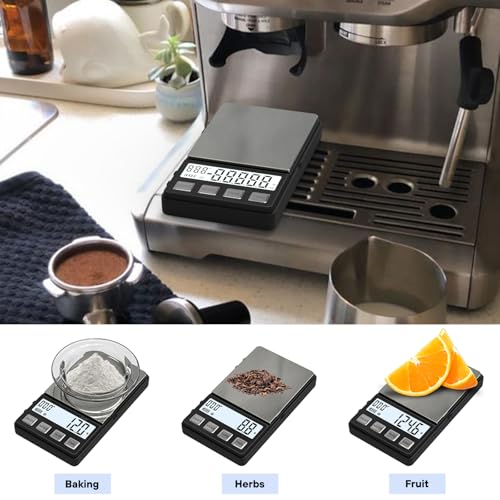
A pocket-sized espresso scale with 0.1g precision and built-in timer, compact enough to fit under most espresso machines for real-time shot weighing.
🎯 Best for: Espresso shot dosing and output weighing, Travel coffee setups with Aeropress or pour-over

✅ What Customers Love
- Compact and portable design, ideal for travel (15 mentions)
- Accurate measurements to 0.1g precision (12 mentions)
- Built-in timer function (8 mentions)
🎯 Best For
Espresso shot dosing and output weighing • Travel coffee setups with Aeropress or pour-over • Measuring coffee beans before grinding • Compact espresso machines (DeLonghi, Rancilio Silvia, Rocket Appartamento, Flair)
Brand: WEIGHTMAN
Category: Scales & Timers
As an Amazon Associate we earn from qualifying purchases.
About This Product
This scale reads to 0.1g increments — sensitive enough to detect a single coffee bean — making it a capable tool for dialing in espresso doses and shot output. The built-in timer runs alongside weighing, eliminating the need for a separate stopwatch during extraction. Its small footprint slides under machines like the DeLonghi, Rancilio Silvia, and Flair, and the lightweight build travels well with Aeropress or pour-over setups. The 1000g maximum capacity is a real constraint: heavy glass vessels or larger brew vessels can push past the limit, and the timer resets after 10 minutes. Best suited to espresso drinkers and travel-focused brewers who want precise dosing without the cost of a dedicated espresso scale.
Is Weightman Espresso Scale with Timer Right for You?
Does the Weightman scale fit under an espresso machine?
Yes — this is one of its standout features. The thin, compact profile is specifically designed to slide onto a drip tray under an espresso group head. Reviewers confirm it fits under DeLonghi machines, Rancilio Silvia, Rocket Appartamento, and even between the legs of a Cafelat Robot. That said, the small footprint means a full-size portafilter may overhang the edges, so you'll want to place your cup on the scale rather than trying to weigh a bottomless portafilter directly.
What are the downsides of the Weightman espresso scale?
Being honest: the 1000g max capacity is the biggest functional limitation — it means heavier brewing setups and larger beverages are off the table. It's not waterproof, so you need to be careful around espresso spray and spills. The timer resets after 10 minutes, which rules out long immersion brews. Build quality is lightweight plastic, and some reviewers report the plastic cover hinges can break. A few users received units that were slightly uncalibrated out of the box, though this is fixable with a calibration weight. And it runs on batteries rather than being rechargeable. None of these are dealbreakers at this price, but they're worth knowing.
How do I choose the right espresso scale?
For espresso specifically, you need three things: 0.1g precision (standard kitchen scales only do 1g increments, which isn't fine enough for dialing in shots), a compact footprint that fits under your portafilter or on your drip tray, and a built-in timer so you can track shot time without a separate device. The Weightman checks all three boxes at a fraction of what premium espresso scales cost. The main trade-off is the 1000g max capacity — fine for espresso dosing and shots, but limiting if you plan to weigh heavier vessels or larger brews.
How do you use a scale to weigh coffee for espresso?
For espresso dosing, place your portafilter on the scale, tare it to zero, then add ground coffee until you hit your target dose (typically 18-20g for a double shot). For weighing shot output, slide the scale onto your drip tray under the group head, place your cup, tare, and pull your shot — the Weightman's thin profile and small footprint make it one of the few affordable scales that actually fits under most espresso machines. Reviewers confirm it works with DeLonghi, Rancilio Silvia, Rocket Appartamento, and even fits between the legs of a Cafelat Robot.
How do you use this espresso scale step by step?
It's straightforward: place the scale on your drip tray or counter, power it on, and it automatically tares to zero on startup. Set your cup or portafilter on it, hit tare again to zero out the vessel weight, then dose your beans or pull your shot. Press the timer button when you start extraction so you can track shot time simultaneously. The physical buttons are simple and responsive — no touch-screen finickiness to deal with when your hands are wet or covered in grounds. One thing to note: the timer maxes out at 10 minutes and resets, so it's built for espresso and pour-over timing, not long steep methods.
How do I know if the Weightman scale is reading accurately?
The scale supports calibration with a 500g calibration weight, so you can verify and correct accuracy yourself. Some users report their units arrived slightly off, so it's worth checking when you first get it. A quick test: weigh a known object (a nickel weighs exactly 5.0g) and see if the reading matches. If it's off, run the calibration process. Most reviewers find the accuracy excellent once calibrated — it can detect the weight change of a single coffee bean, which tells you the 0.1g precision is real.
As an Amazon Associate we earn from qualifying purchases.
Is this scale waterproof?
No, and this is worth flagging if you plan to use it for espresso. The Weightman is not waterproof, so it's vulnerable to espresso spray, drips, and spills. A few reviewers mention needing to keep it wiped down during use. The stainless steel platform is easy to clean, but you'll want to avoid getting water into the electronics. If waterproofing is critical for your setup (messy espresso workflow, outdoor use), you may want to look at the Acaia Lunar or similar sealed scales — though they cost significantly more.
What espresso machines does this scale fit under?
Reviewers specifically confirm compatibility with DeLonghi machines, Rancilio Silvia, Rocket Appartamento, Flair manual espresso makers, and the Cafelat Robot (it fits between the legs). The thin profile is the key — it's designed to slide onto standard drip trays. If your machine has a removable drip tray with at least a couple centimeters of clearance under the group head, the Weightman will very likely fit. It's a good idea to measure your clearance before buying if you have an unusually tight setup.
Can I use this scale for pour-over coffee?
Yes, with some caveats. Reviewers report that a ceramic V60 plus about 300g of water fits fine on the scale and stays within the weight limit. The built-in timer is handy for tracking your pour phases. However, if you're using a heavier brewer like a Hario Switch #3 or a large Chemex, the combined weight of the vessel plus water can exceed the 1000g capacity. For lighter pour-over setups — plastic V60, Kalita Wave, or Aeropress — it works great. Just keep an eye on total weight.
Is this a good travel coffee scale?
It's one of the best options for travel coffee. The compact, lightweight design was called out by 15 reviewers as a key strength, and the included protective cover keeps it safe in a bag. It comes with batteries (no need to find a USB charger on the road), and the cover even doubles as a small weighing tray. If you travel with an Aeropress or portable pour-over kit, this scale fits right into that setup. The only downside is that battery power means carrying spare batteries on longer trips, though reviewers note the battery life is quite good.
Is this scale good for beginners?
Very much so. The straightforward physical buttons are easy to figure out without reading a manual, it comes with batteries included so it's ready to use right away, and the automatic tare on startup simplifies the workflow. At this price point, it's a low-risk way to start weighing your coffee — which is genuinely the single biggest improvement most people can make to their home espresso or pour-over. If you decide to upgrade to a premium scale later, the Weightman makes an excellent travel or backup scale.
Can you use this scale for food and kitchen measuring?
Absolutely. While it's marketed for coffee, reviewers use it for all kinds of kitchen tasks — measuring spices, portioning ingredients, even as a general food scale for calorie tracking. The 0.1g precision is actually overkill for most cooking, which means you'll get very accurate measurements. The only limitation is the 1000g (2.2 lb) maximum capacity, so it won't work for weighing larger quantities of food. Think of it as a precision supplement to a regular kitchen scale, not a replacement.
As an Amazon Associate we earn from qualifying purchases.
How long does the battery last on this scale?
Reviewers report good battery life, though exact numbers vary by usage. It runs on standard batteries (not rechargeable), which is actually a plus for travel since you can swap in fresh ones anywhere. The auto-off feature helps conserve power when you forget to turn it off. If you're using it daily for espresso dosing — a couple minutes of use each morning — expect to get several months from a set of batteries.
What should I look for when buying a coffee scale?
The big things are precision (0.1g is the sweet spot for coffee), response speed (you don't want readings bouncing around mid-pour), a timer function, and a size that works with your setup. The Weightman nails precision and includes a timer, and reviewers specifically praise its fast, stable readings that don't bounce. Where it compromises is build quality — it's lightweight plastic rather than the premium feel of an Acaia or Timemore. But at roughly half the price of competitor scales, most users find that trade-off very reasonable.
Why does my coffee scale show a different weight every time?
If your Weightman is giving inconsistent readings, a few things could be happening. First, make sure it's on a flat, stable surface — any wobble throws off precision scales. Second, check that you're not near drafts or vibrations (espresso machines generate vibration). Third, your unit may need calibration — the Weightman supports calibration with a 500g weight, and some units benefit from recalibrating out of the box. Reviewers generally praise the Weightman for stable, non-bouncing readings, so if yours is jumping around, calibration is the most likely fix.
How do you read this scale in grams?
The Weightman displays weight on a large backlit LCD screen, and it supports both grams and ounces — you can toggle between them. For coffee work, you'll want grams mode with the 0.1g display. The backlit screen is easy to read even in dim kitchen lighting or when the scale is tucked under an espresso machine on a drip tray. Readings show one decimal place in gram mode (e.g., 18.2g for a typical espresso dose).
Can I use this scale for measuring tea?
Definitely. The 0.1g precision is ideal for measuring loose leaf tea, where getting the right leaf-to-water ratio makes a noticeable difference in flavor. Most tea servings call for 2-5g of leaf, and a standard kitchen scale can't measure that accurately. The compact size also means it doesn't take up much counter space in a tea station. Just keep the 1000g limit in mind if you're weighing a full teapot — the scale is better suited for measuring dry leaf before brewing rather than weighing a loaded vessel.
Customer-Validated Strengths
based on 30-review analysis • Our methodology
- Compact and portable design, ideal for travel (15 mentions)
- Accurate measurements to 0.1g precision (12 mentions)
- Built-in timer function (8 mentions)
- Affordable price point compared to premium alternatives (7 mentions)
- Small footprint fits under espresso machines (6 mentions)
- Fast, stable readings that don't bounce (5 mentions)
- Protective cover for travel (5 mentions)
- Long battery life (3 mentions)
- Easy to clean and wipe down (3 mentions)
Best Use Cases
🎯 Best For
- Espresso shot dosing and output weighing
- Travel coffee setups with Aeropress or pour-over
- Measuring coffee beans before grinding
- Compact espresso machines (DeLonghi, Rancilio Silvia, Rocket Appartamento, Flair)
- Secondary brewing location or mother's house setup
- Pour-over brewing under 300g total weight
⚠️ Not Ideal For
- Larger beverages like lattes or Americanos (exceeds 300g capacity)
- Heavy glass brewing vessels (Hario Switch #3 + water exceeds 1000g)
- Weighing full portafilters (too small footprint)
- Brew times over 10 minutes (timer resets)
- Wet environments without protection (not waterproof)
What to Consider
- 1000g maximum capacity limits use with heavy vessels (4 mentions)
- Quality control issues - arrived scratched or with crooked plate (3 mentions)
- Lightweight build feels less sturdy than premium models (3 mentions)
- Timer has 10-minute maximum then resets (2 mentions)
- Not waterproof - vulnerable to espresso spray (2 mentions)
- Battery operated rather than rechargeable (2 mentions)
- Some units arrived uncalibrated or inaccurate (2 mentions)
- Plastic cover hinges prone to breaking (1 mentions)
- Slightly slow to update weight readings (1 mentions)
based on 30-review sample.
About This Analysis
This analysis is based on 30 customer reviews. We're showing you everything we found, but with our analysis, there's always more to discover.
✅ What we're confident about: What customers love and best use cases
⚠️ What may be incomplete: Potential issues and considerations
For more perspectives, check customer reviews on Amazon.
Product Selection
In short: We only feature high-rated products.
Products on TeaDelight.net are selected based on strong Amazon customer ratings, sufficient review volume, and market presence. We focus on well-regarded products that tea enthusiasts are actively considering and purchasing.
As an Amazon Associate we earn from qualifying purchases.
You Might Also Like

✅ Accurate timing for tea brewing
Lily's Home 3-in-1 Tea Timer Sand Hourglass

✅ Compact size - easy to store and portable
AMIR Digital Kitchen Scale 3000g

✅ High precision/accuracy (0.1g sensitivity)
HOTO Smart Food Scale with 0.1g Precision
✅ High accuracy and precision (0.1g increments)