



We analyze real customer reviews to surface what matters: key strengths, ideal use cases, and honest considerations — so you can make an informed choice.
UNIWEIGH Digital Espresso Scale with Timer 1000g
A 1000g pocket scale resolving to 0.1g, with a built-in timer, tare function, and gram/ounce units — the precision-and-portability bracket aimed at espresso pours and pour-over brews.
🎯 Best for: Espresso and pour-over weighing where 0.1g precision matters, Kitchen and bar use around occasional liquid splashes

✅ What Customers Love
- Precision called out by reviewers
- Holds up to liquid exposure
🎯 Best For
Espresso and pour-over weighing where 0.1g precision matters • Kitchen and bar use around occasional liquid splashes
Brand: UNIWEIGH
Category: Scales & Timers
As an Amazon Associate we earn from qualifying purchases.
About This Product
A 1000g pocket scale resolving to 0.1g, with a built-in timer, tare function, and gram/ounce units — the precision-and-portability bracket aimed at espresso pours and pour-over brews. At that 0.1g step across a 1000g range, the scale targets the precision baristas need for shot-pulling and ratio work, while a built-in timer, tare, and gram/ounce switching cover the basic feature set without ceremony.
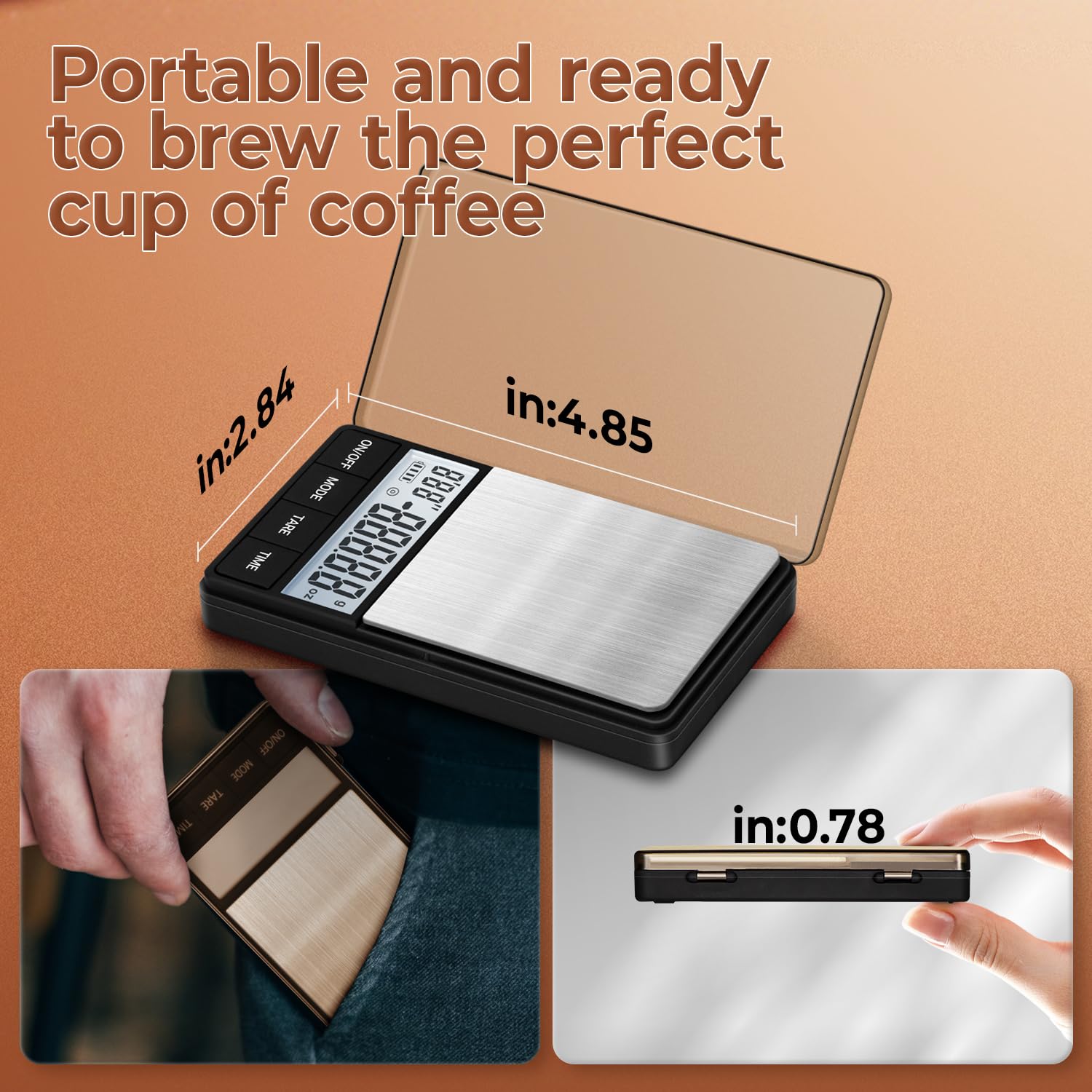
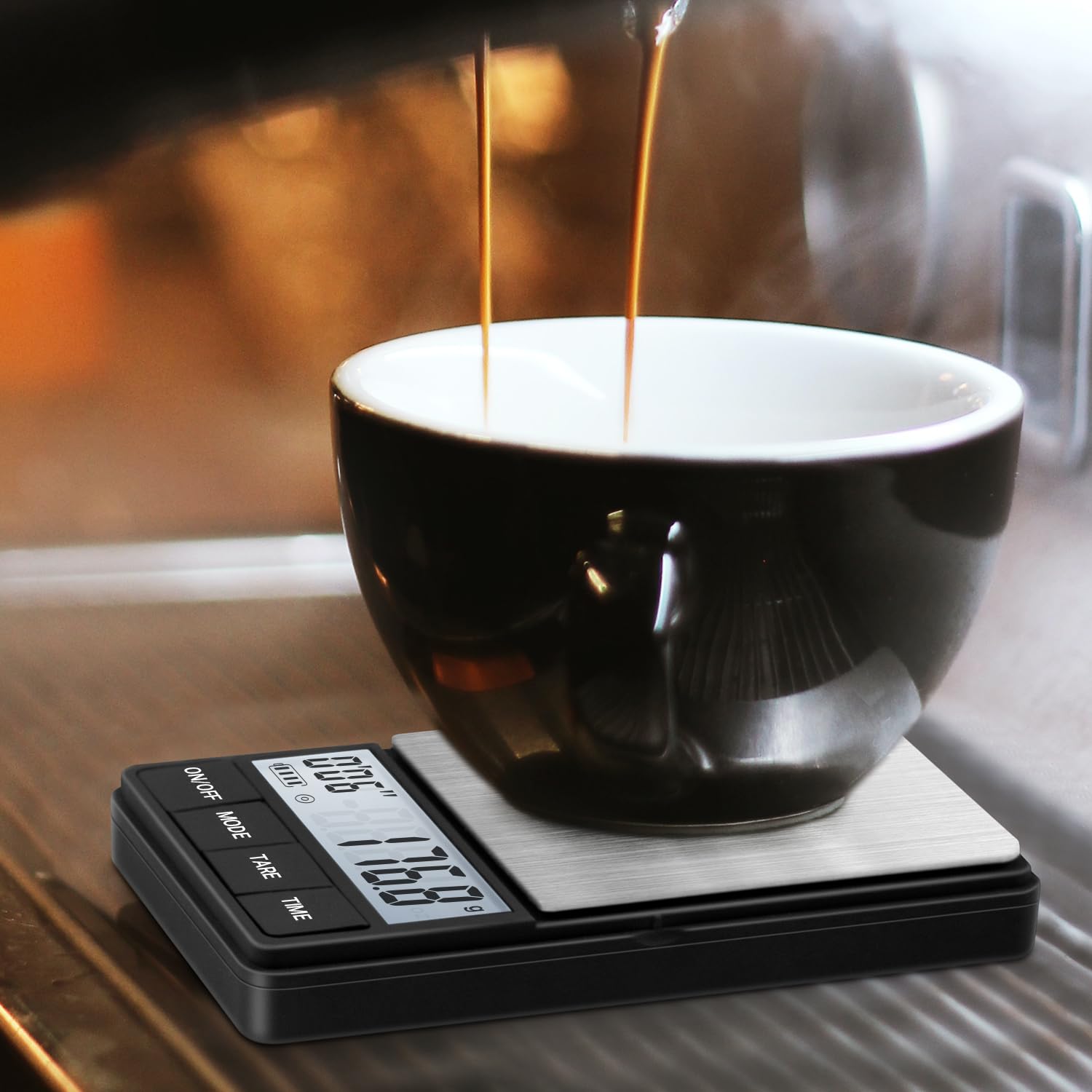
Sized for coffee and espresso prep, the 1000g cap covers a single shot through a full pour-over batch, and the 0.1g step lets you dial in ratios with confidence. The compact footprint reads as a counter scale that travels easily rather than a bench-anchored model — small enough to sit on a machine's drip tray or move between kitchen and bag without thought.
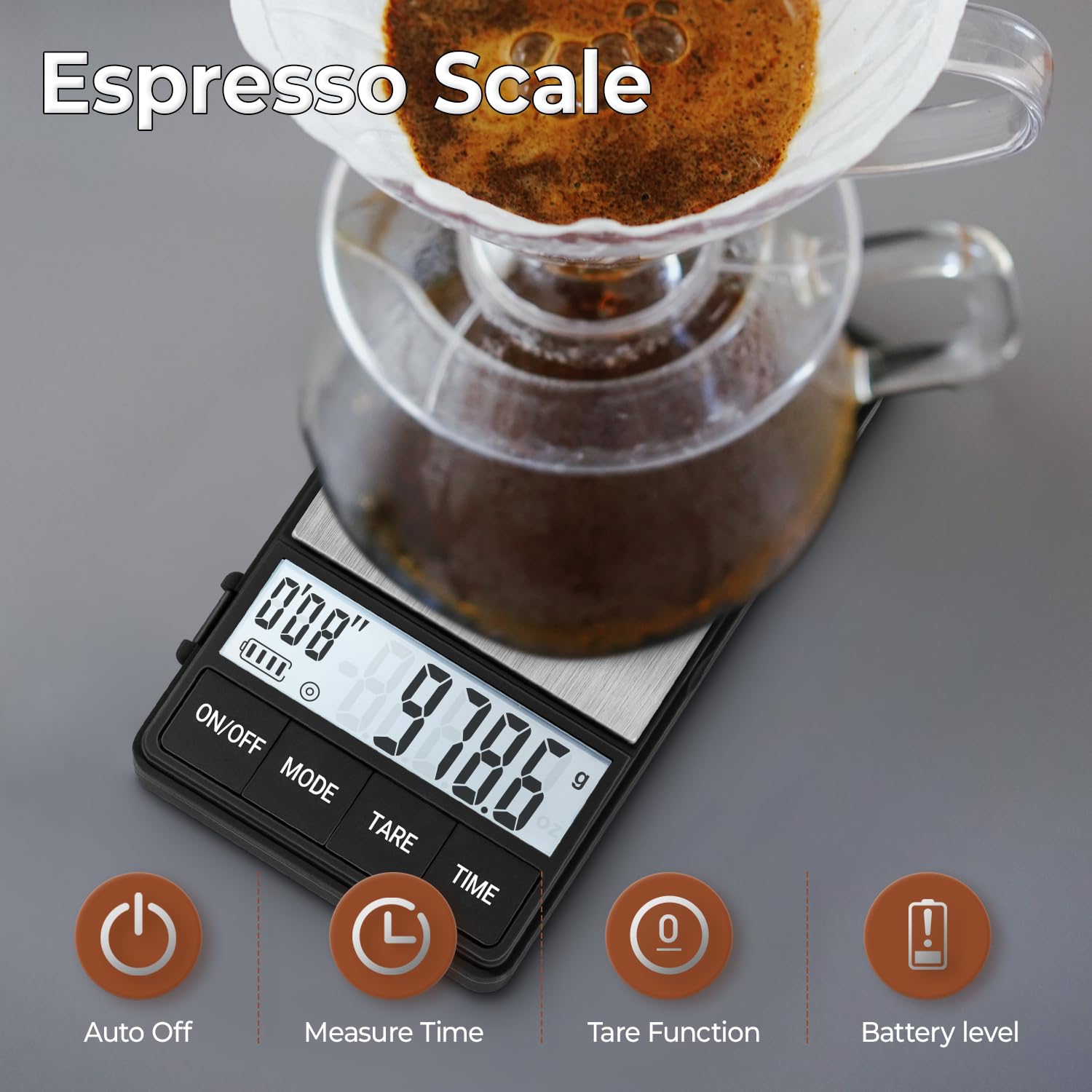
The built-in timer keeps brew time alongside weight without a second device crowding the counter, and the tare zeroes out cup or portafilter weight before pouring. Reviewers describe the scale as precise; one notes it still working after liquid spills, and another points to water resistance — useful around the routine splashes of pour-over and espresso prep, though that isn't a claim of full waterproofing.
With six eligible reviews the picture is thin but consistent in direction: precision called out, durability through occasional liquid exposure reported, and no reviewer flagging a functional problem. We have limited data on long-term durability across a sample that small, so buyers wanting deeper validation may want to weigh the lean review count against the consistent signal so far.
Is UNIWEIGH Digital Espresso Scale with Timer 1000g Right for You?
Why does an espresso scale need a built-in timer?
Espresso extraction is a time-and-weight relationship — you're tracking grams of output against seconds since the pump started, and a scale with an integrated timer lets you watch both numbers in one spot instead of juggling a phone stopwatch. This UNIWEIGH model bundles the timer into the same display as the weight readout.
Are coffee scales actually worth using for home brewing?
If you're pulling espresso shots or dialing in pour-over ratios, a 0.1g-resolution scale lets you repeat a recipe rather than guess at it — the difference between a 1:2 and 1:2.3 espresso ratio is the kind of thing only a precision scale catches. The synthesis frames this scale squarely at that precision-and-portability bracket.
How precise is the 0.1g resolution in real use?
The scale resolves to 0.1g across its 1000g range, and one of the six eligible reviewers explicitly describes it as precise. That's a small sample, so the claim is directional rather than proven across many users — but no reviewer flagged a precision problem either.
Can it handle the full weight of a pour-over setup?
The 1000g cap covers a single espresso shot through a full pour-over batch — dripper, filter, grounds, and water typically land well under that ceiling. The synthesis positions the capacity as comfortable for the espresso-and-pour-over bracket rather than for larger kitchen tasks.
What happens if water or coffee splashes onto it?
One reviewer reports the scale still working after liquid spills, and another notes water resistance — so initial impressions are encouraging on that front. With only six reviews to draw on, long-term behavior under repeated wet exposure isn't established yet.
Is this scale compact enough to travel with?
The listing describes it as a 'Mini Barista Scale' and 'Pocket Food Scale,' and the synthesis reads the footprint as a counter scale that travels easily rather than a bench-anchored model. If you take a portable espresso setup on the road, the form factor is built for that.
As an Amazon Associate we earn from qualifying purchases.
Does it switch between grams and ounces?
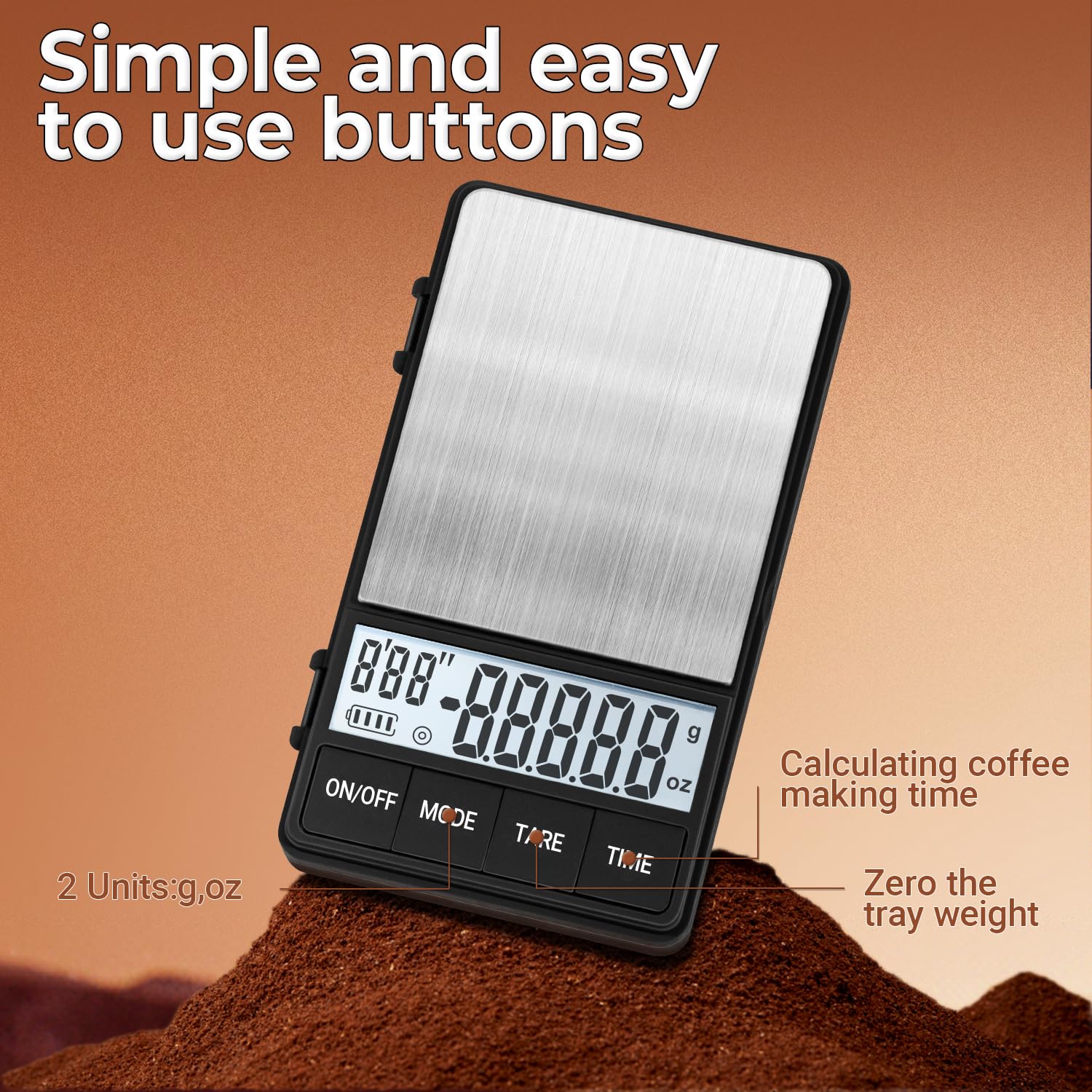
Yes — the listing specifies gram and ounce units alongside the LCD display and tare function. Useful if you toggle between metric espresso recipes and ounce-based kitchen measurements.
How does the tare function help with brewing?
Tare zeroes the scale with a vessel already on it, so you can place your portafilter or cup down, hit tare, and weigh only what you add next — grounds going in, or espresso coming out. The listing confirms tare is included alongside the timer and auto-off.
Who is this scale best suited for?
The synthesis frames two clear fits — espresso and pour-over weighing where 0.1g precision matters, and kitchen or bar use around occasional liquid splashes. It's pitched at people who want barista-level resolution without a full bench-scale footprint.
Does it auto-off to save the included batteries?
The listing calls out an auto-off function and notes that batteries are included in the box. That covers the basic battery-life housekeeping a pocket scale needs.
How confident can I be in the long-term durability?
Honest answer — with only six eligible reviews, long-term durability isn't well established yet. The signals that exist point in a positive direction (precision, surviving spills, water resistance), and no reviewer flagged a functional problem, but that's a thin base to extrapolate years of use from.
Is this overkill for someone who just makes drip coffee?
Probably — the 0.1g resolution and built-in timer are aimed at espresso shot-pulling and pour-over ratio work, where small weight differences change the cup noticeably. For a standard auto-drip setup that uses scoops, a simpler kitchen scale would do the same job.
As an Amazon Associate we earn from qualifying purchases.
Category: What features matter most when buying a tea scale?
Tare is non-negotiable so you can zero out a cha he or gaiwan. Look for a platform sized to your teaware (small jewelry footprints suit a tea tray better than wide coffee scales), a configurable or generous auto-shutoff so the scale does not die mid-session, and a large readable display. A built-in count-up timer is a strong nice-to-have because it consolidates two devices into one and shows weight and elapsed time simultaneously.
Category: Why does my scale read a different weight each session?
The likely culprits are thermal drift (a cold scale brought near a kettle reads high or low until it equilibrates — let it warm up for five minutes), vibration from a nearby appliance, an uneven surface that corner-loads the strain gauge, or a battery dropping below about 30%. Tare accumulation can also compound rounding error over many add-tare cycles, so re-zero from empty between sessions. Chronic drift that persists after re-tare points to a failing load cell.
Category: How often should I calibrate a tea scale?
Every 6-12 months is the standard cadence for home tea use, monthly for cafe or professional use, and always after moving the scale to a new location because altitude changes local gravity by 0.1-0.5% that a 0.01 g scale will reveal. Use a calibration weight matched to the scale's claim — a 100 g class M1 or F2 weight covers nearly every consumer scale. After 7+ years of heavy use, strain gauges fatigue and replacement is more reliable than recalibration.
Customer-Validated Strengths
based on 6-review analysis • Our methodology
- Precision called out by reviewers
- Holds up to liquid exposure
Quality & Care
At 0.1g resolution across a 1000g range, the scale targets the precision baristas need for espresso shot-pulling and pour-over ratio work — a built-in timer, tare, and gram/ounce switching cover the basic feature set without ceremony. With six eligible reviews, the picture is thin but consistent in direction: one reviewer describes it as precise, another reports the scale still working after liquid spills, and a third notes water resistance. We have limited data on long-term durability across a six-review sample, but no reviewer flagged a functional problem.
Best Use Cases
🎯 Best For
- Espresso and pour-over weighing where 0.1g precision matters
- Kitchen and bar use around occasional liquid splashes
How People Use It
Sized for coffee and espresso prep — the 1000g cap covers a single shot through a full pour-over batch, and the 0.1g step lets you dial in ratios with confidence. The compact footprint reads as a counter scale that travels easily rather than a bench-anchored model.
About This Analysis
This analysis is based on 6 customer reviews. We're showing you everything we found, but with our analysis, there's always more to discover.
✅ What we're confident about: What customers love and best use cases
⚠️ What may be incomplete: Potential issues and considerations
For more perspectives, check customer reviews on Amazon.
Product Selection
In short: We only feature high-rated products.
Products on TeaDelight.net are selected based on strong Amazon customer ratings, sufficient review volume, and market presence. We focus on well-regarded products that tea enthusiasts are actively considering and purchasing.
As an Amazon Associate we earn from qualifying purchases.