
Available Alternatives

✅ Compact size that fits espresso machine drip trays
BrewNimbus Mini Coffee Scale with Timer

✅ Easy-to-use interface with quick-access functions
RENPHO Calibarista Coffee Scale with Timer
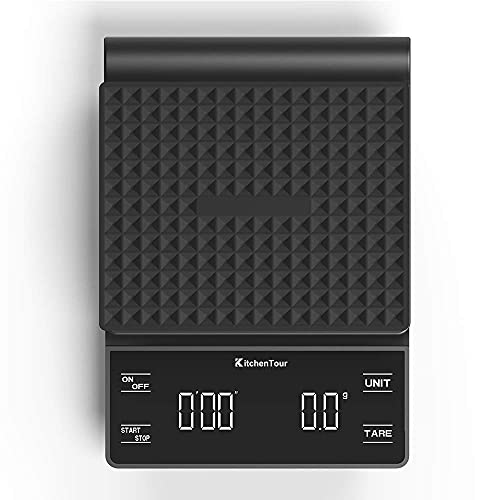
✅ Confirmed 0.1g precision and responsiveness
KitchenTour Coffee Scale with Timer

✅ Visual appeal as desk decor
ORDERSOON 3-in-1 Bamboo Sand Timer


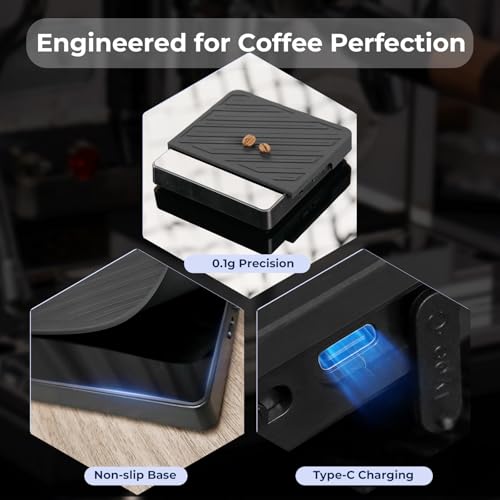
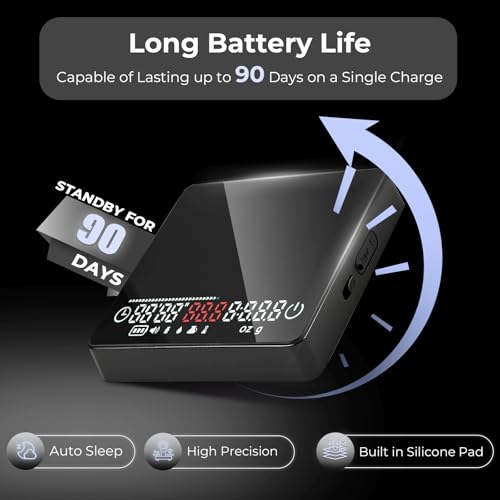

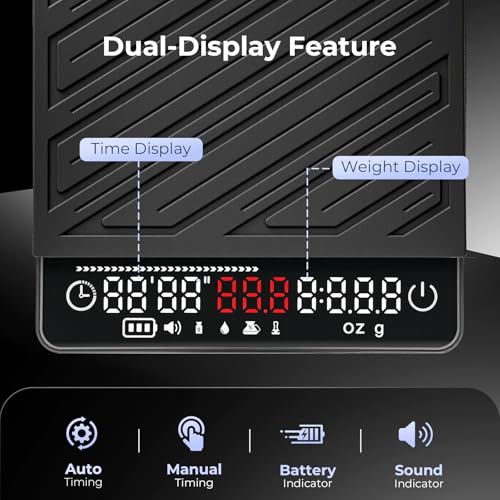
We analyze real customer reviews to surface what matters: key strengths, ideal use cases, and honest considerations — so you can make an informed choice.
IKAPE Espresso Coffee Scale with Timer and 4 Modes
A 2kg/0.1g espresso scale with built-in timer, four brewing modes, and an LED display — pitched at the pour-over and espresso bench rather than the kitchen counter.
🎯 Best for: Home espresso and pour-over setups needing a single scale for weight, timer, and ratio, Gift for someone outfitting a coffee station

✅ What Customers Love
- Four brewing modes on a single screen
- Solid build and easy ergonomics
- Accurate auto-start timer with auto-on and silent operation
🎯 Best For
Home espresso and pour-over setups needing a single scale for weight, timer, and ratio • Gift for someone outfitting a coffee station • Compact bench fits beside small espresso machines
Brand: IKAPE
Category: Scales & Timers
As an Amazon Associate we earn from qualifying purchases.
About This Product
The IKAPE espresso scale pairs 2kg/0.1g precision with a built-in timer and four brewing modes — Basic Weighing, Pour-Over, Brew Ratio, and Espresso — surfaced on a single LED screen that shows time, weight, flow rate, and ratio at once. Across the eligible review sample, nine reviewers describe the build as high-quality or solidly made, and the timer is reported to start accurately on first drop.
Auto-tare, auto-on, and silent operation are designed to let the scale disappear into a morning bench routine, and the compact footprint fits under small espresso machines like the Bambino Plus. Six of 25 reviewers also flag it as a strong gift pick for someone setting up a coffee station — a notably higher beginner-gift signal than the broader scales-and-timers category baseline.
In day-to-day use, the four-mode setup is what reviewers come back to: switch to Espresso for auto-timed shots, Pour-Over for water-only auto-tare, or Brew Ratio for an auto-calculated ratio, with everything visible on one screen. Seven reviewers specifically call it very easy to use once the modes are dialled in.
The most common complaint, by a clear margin, is the manual — four reviewers across poor instructions, poor documentation, confusing instructions, and unclear-manual themes report the printed guide is hard to follow, especially when switching between modes. Two reviewers also flag the price as roughly double comparable units, so shoppers who just want a basic gram scale at the lowest cost may want to look elsewhere.
We'd call this a credible all-in-one for a home espresso or pour-over setup, with the caveat that the review sample doesn't yet include enough long-term use to speak to multi-year durability.
Is IKAPE Espresso Coffee Scale with Timer and 4 Modes Right for You?
What does the 4-mode setup on the IKAPE scale actually do?
The four modes are Basic Weighing, Pour-Over, Brew Ratio, and Espresso, and reviewers consistently call out this setup as taking the guesswork out of brewing. One reviewer highlights that a single screen shows time, weight, flow rate, and ratio at once.
How accurate is the built-in timer on this espresso scale?
One reviewer specifically calls out that the timer accurately starts on first drop, alongside separate mentions of auto-on and silent operation. With limited individual mentions on each of these features, treat them as supportive signals rather than the dominant story.
Will this fit under a compact espresso machine like the Bambino Plus?
Yes — the compact footprint is specifically called out as fitting beside small espresso machines like the Bambino Plus, and the auto-tare and auto-on suit a morning bench routine where the scale needs to disappear into the workflow.
How well-built is the IKAPE scale day-to-day?
Build quality reads solid across the eligible sample: nine of 25 reviewers describe it as high-quality or solidly built, and another seven call it very easy to use day-to-day. That's a credible all-in-one signal for a home espresso or pour-over setup.
What's the biggest complaint reviewers have about this scale?
The most common complaint by a clear margin is the manual — five reviewers across poor instructions, poor documentation, confusing instructions, and unclear-manual themes report the printed guide is hard to follow, especially for switching between the four modes.
Is the IKAPE scale beginner-friendly for someone new to espresso?
Six of 25 reviewers describe this as a strong gift pick for someone setting up a coffee station — a notably higher beginner-gift signal than the scales_and_timers category baseline. The main friction for newcomers is the printed manual, which reviewers find hard to follow when switching between modes.
As an Amazon Associate we earn from qualifying purchases.
Can I use this scale for matcha preparation?
The synthesis explicitly flags matcha preparation as something this scale isn't suited for — the four modes are tuned to espresso and pour-over workflows rather than the very low gram weights and whisking ergonomics matcha calls for.
How precise is the 0.1g resolution in practice?
The listing positions this as a 2kg/0.1g high-precision digital scale, and reviewers describe it as solidly built and easy to use without flagging accuracy as an issue. The dedicated Espresso and Brew Ratio modes are designed around that precision register.
Does the scale make noise or beep during use?
One reviewer specifically calls out silent operation as a feature, which fits the use-context framing of a scale that needs to disappear into a morning bench routine. With a single reviewer on this theme, treat it as a supportive rather than dominant signal.
Would this make a good gift for someone setting up a coffee station?
Yes — gifting for someone outfitting a coffee station is one of the listed best-for use cases, and six of 25 reviewers independently flag it as a strong gift pick. Just expect the recipient to lean on YouTube rather than the printed manual when learning the modes.
How do I figure out how to use the 4 modes if the manual is confusing?
Four separate reviewers flag the printed manual as hard to follow, especially for switching between modes. The modes themselves are Basic Weighing, Pour-Over, Brew Ratio, and Espresso — most buyers in this situation cross-reference a video walkthrough rather than relying on the included documentation.
How long will this scale hold up over multiple years of daily use?
Build quality reads solid in the short term — nine of 25 reviewers describe it as high-quality or solidly built. The synthesis is explicit that one long-term reviewer isn't enough to speak to multi-year durability, so treat long-haul reliability as an open question at this review count.
As an Amazon Associate we earn from qualifying purchases.
Category: Do I really need a timer for Western-style brewing?
Western brewing tolerates a roughly ±15 second window, so minute-level precision from any kitchen timer, phone alarm, or hourglass is plenty. The standard targets are 3-5 minutes for black tea, 1-3 minutes for green, 4-6 minutes for white, and 5-8 minutes for herbal and rooibos. If you brew while doing chores, prioritize an audible alarm over sub-second accuracy.
Category: How can I tell a quality scale from a poorly-made one?
Look for a named brand with a published warranty (American Weigh Scales offers ten years on its pocket line; Tanita, Acaia, Fellow, and Hario all publish service docs), a clear specification of resolution AND accuracy rather than only resolution, and a stable reading when you press different corners of the platform. Unbranded import scales sold under rotating storefront names often have a fine load cell but unreliable factory calibration and span coefficients. A scale that reads correctly at 100 g but errs at 10 g indicates nonlinearity, which is usually unfixable.
Category: What scale do I need for matcha?
Matcha is the one tea where 0.01 g jewelry-grade resolution earns its keep. Usucha uses about 2 g of matcha to 70-80 mL of water and koicha uses 3-4 g to 30-40 mL, so a 0.1 g scale leaves a 5% error on the dose that you can taste in the foam structure and thickness. A scale that simultaneously shows grams and elapsed whisking time makes the workflow easier.
Customer-Validated Strengths
based on 25-review analysis • Our methodology
- Four brewing modes on a single screen
- Solid build and easy ergonomics
- Accurate auto-start timer with auto-on and silent operation
Quality & Care
On the function side, reviewers consistently call out the four-mode setup — Basic Weighing, Pour-Over, Brew Ratio, and Espresso — as taking the guesswork out of brewing, with the timer accurately starting on first drop and a single screen showing time, weight, flow rate, and ratio at once. Build quality reads solid across the eligible sample: nine reviewers describe it as high-quality or solidly built, and another seven call it very easy to use day-to-day. We'd call this a credible all-in-one for a home espresso or pour-over setup, with the caveat that one long-term reviewer isn't enough to speak to multi-year durability.
Best Use Cases
🎯 Best For
- Home espresso and pour-over setups needing a single scale for weight, timer, and ratio
- Gift for someone outfitting a coffee station
- Compact bench fits beside small espresso machines
⚠️ Not Ideal For
- Buyers who want a clearly written, mode-by-mode printed manual out of the box
- Shoppers focused purely on lowest cost for a basic gram scale
- Matcha preparation
How People Use It
The auto-tare, auto-on, and silent operation suit a morning bench routine where the scale needs to disappear into the workflow, and the compact footprint fits under espresso machines like the Bambino Plus. Six of 25 reviewers describe this as a strong gift pick for someone setting up a coffee station — a notably higher beginner-gift signal than the scales_and_timers category baseline.
What to Consider
The most common complaint, by a clear margin, is the manual: four reviewers across poor instructions, poor documentation, confusing instructions, and unclear-manual themes report the printed guide is hard to follow, especially for switching between the four modes. Two reviewers also flag the price as roughly double comparable units.
- Manual is hard to follow
- Premium price relative to comparable scales
based on 25-review sample.
About This Analysis
This analysis is based on 25 customer reviews. We're showing you everything we found, but with our analysis, there's always more to discover.
✅ What we're confident about: What customers love and best use cases
⚠️ What may be incomplete: Potential issues and considerations
For more perspectives, check customer reviews on Amazon.
Product Selection
In short: We only feature high-rated products.
Products on TeaDelight.net are selected based on strong Amazon customer ratings, sufficient review volume, and market presence. We focus on well-regarded products that tea enthusiasts are actively considering and purchasing.
As an Amazon Associate we earn from qualifying purchases.