



We analyze real customer reviews to surface what matters: key strengths, ideal use cases, and honest considerations — so you can make an informed choice.
Greater Goods Digital Coffee Scale with Timer
A 0.1g precision brewing scale with a built-in count-up/down timer and physical tactile buttons — designed for hands-on pour-over and espresso workflows.
🎯 Best for: Pour-over coffee (Chemex, V60, etc.), French press brewing

✅ What Customers Love
- Accurate measurements to 0.1g precision (18 mentions)
- Bright, clear, easy-to-read LED display with two-tone colors (15 mentions)
- Built-in timer with count up/down functionality (14 mentions)
🎯 Best For
Pour-over coffee (Chemex, V60, etc.) • French press brewing • Aeropress • Espresso dosing
Brand: Greater Goods
Category: Scales & Timers
As an Amazon Associate we earn from qualifying purchases.
About This Product
Physical tactile buttons and a bright two-tone LED display keep operation fast and readable during an active brew, with no finicky touch-surface to manage. The integrated timer eliminates a separate device from the counter, and the removable silicone cover means coffee spills wipe away cleanly. Reviewers note a slight refresh lag that rewards anticipating the pour rather than reacting to the readout — a small adjustment for most home brewers. The 0.1g resolution handles espresso dosing, Aeropress, French press, and matcha preparation comfortably. Best suited for home coffee brewers who want a clean, reliable tool without wireless connectivity or unnecessary complexity.
Is Greater Goods Digital Coffee Scale with Timer Right for You?
How do you use the Greater Goods digital coffee scale with timer?
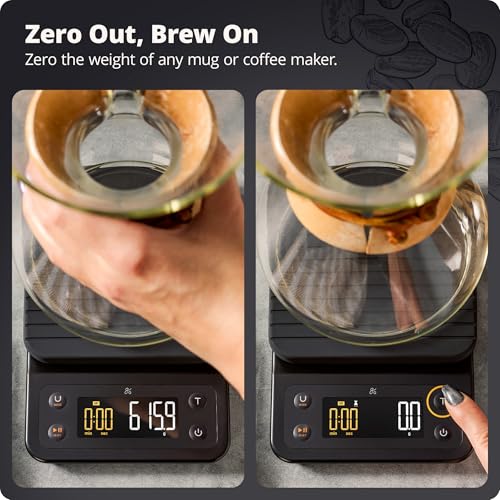
It's pretty straightforward — place it on a flat, stable surface, turn it on, and it auto-zeros. Put your brewing vessel on the scale, hit tare to zero it out, then add your coffee grounds to the desired weight. When you start pouring water, press the timer button to begin the count-up timer. The 0.1g precision lets you dial in your coffee-to-water ratio accurately. Users consistently note that the physical tactile buttons make operation intuitive — no fumbling with finicky touch controls mid-brew. One tip from experienced users: pour slightly under your target weight since there's a slight lag in the readout, and the scale will catch up.
What are the downsides of the Greater Goods coffee scale?
The most-mentioned issues in reviews: (1) No low battery indicator — it just dies without warning, which is frustrating mid-brew. (2) Weight can fluctuate if you have electronics nearby or if the surface isn't perfectly stable. (3) There's a slight lag in the readout, so you need to anticipate your target and stop pouring a couple grams early. (4) The silicone cover, while protective, can show stains and be tricky to clean thoroughly. (5) Minor weight drift of less than 1g over time. (6) No calibration function. None of these are dealbreakers for the price, but they're worth knowing about. The no-battery-indicator issue is the one that genuinely annoys people — keep spare batteries around.
How do I know if my coffee scale is accurate?
The simplest test is using a known reference weight — a nickel weighs exactly 5.0g. Place it on your scale and check the reading. With the Greater Goods scale, reviewers confirm it's accurate to its advertised 0.1g precision, which is more than sufficient for pour-over, French press, Aeropress, and even espresso dosing. One thing to be aware of: some users report minor weight drift or float of less than 1g, and the scale can be sensitive to vibrations from the floor or nearby electronics. For the most accurate readings, place it on a solid, stable surface away from appliances. If you're seeing different readings each time, it's likely an environmental issue rather than a scale defect.
Why does my scale show a different weight every time?
With the Greater Goods scale specifically, this is almost always an environmental issue rather than a defect. Reviewers identify two main culprits: vibrations from the floor or countertop (especially on uneven surfaces), and interference from nearby electronics. The scale is quite sensitive to both. Make sure you're using it on a solid, stable surface — not a wobbly table or near a running dishwasher. Keep phones and other electronics a reasonable distance away. Some users also report minor weight drift of less than 1g over time, which is normal for scales at this price point. If you're seeing large fluctuations, try fresh batteries — the scale has no low battery indicator, so dying batteries can cause erratic readings before it shuts off entirely.
How long does the battery last on the Greater Goods coffee scale?
Users report good battery life overall, getting several months of regular home use from a set of batteries. The main complaint isn't battery life itself — it's that there's no low battery indicator. The scale just dies unexpectedly, sometimes mid-brew, with no warning. Multiple reviewers flag this as the most frustrating aspect of the scale. The practical workaround is keeping spare batteries on hand. Some users wish it were rechargeable via USB-C instead of battery-powered, but at this price point, the battery approach keeps costs down.
Is the Greater Goods scale waterproof?
It's designed to be waterproof and spillproof, and it comes with a removable silicone cover that protects the electronics from water and coffee splashes — which is inevitable during pour-over brewing. Reviewers confirm that spills are easy to clean up and the cover does its job. One note: while the silicone cover protects well, some users mention it can be difficult to clean thoroughly and tends to show stains over time, especially from coffee. It's not 'submerge it in water' waterproof, but it handles the everyday splashes and drips of coffee brewing without any issues.
As an Amazon Associate we earn from qualifying purchases.
Is the Greater Goods scale good enough for serious coffee enthusiasts?
Yes, with realistic expectations. The 0.1g precision is sufficient for dialing in recipes across all home brewing methods. The fast response time supports controlled pours. Physical buttons are what enthusiasts actually prefer over touch controls. And the timer integration supports proper brewing protocols. Where it falls short of premium scales: the refresh rate has a slight lag (experienced pour-over brewers learn to anticipate), there's no Bluetooth for logging recipes, and you can't calibrate it. But multiple enthusiast reviewers make the same point — this scale delivers 90% of what scales costing 4–10x more offer. Unless you're competing or need sub-0.1g accuracy, it's genuinely hard to justify the premium.
Why do people prefer physical buttons over touch controls on coffee scales?
This comes up constantly in reviews of the Greater Goods scale — users specifically call out the physical tactile buttons as a major advantage. The reason is practical: when you're mid-brew with wet hands, steam rising, and water dripping, touch-sensitive controls on competing scales often misfire, don't register, or trigger from water droplets landing on the surface. Physical buttons work every time regardless of moisture. Twelve reviewers specifically praised this feature. It's one of those design choices that sounds minor on paper but makes a real difference when you're using the scale daily.
Does the Greater Goods scale work for espresso?
Yes, with a caveat. The 0.1g precision is sufficient for espresso dosing — measuring your 18g dose into a portafilter works reliably. Reviewers confirm using it for espresso without issues. However, for ultra-precise espresso work where you need sub-0.1g accuracy or a very fast refresh rate to track shot flow in real time, you'd want a dedicated espresso scale. The slight lag in readout that some users mention is fine for dosing but could be frustrating if you're trying to hit exact yield targets during extraction. For home espresso where you're dosing grounds and occasionally weighing output, it does the job well at a fraction of the cost of dedicated espresso scales.
How does the timer work on the Greater Goods coffee scale?
The scale has a built-in timer with both count-up and count-down functionality. For pour-over, most people use the count-up mode — start the timer when you begin pouring and track total brew time alongside water weight on the same display. The two-tone LED display shows both simultaneously so you don't need to look at a separate device. A couple of reviewers note that switching between timer modes can feel slightly cumbersome, but once you settle into your preferred mode, it becomes second nature. The timer integration is one of the scale's strongest features — it eliminates the need for a separate phone timer or standalone timer, which simplifies your whole brewing setup.
Does the Greater Goods scale turn off by itself during brewing?
This is a common concern with coffee scales, and the Greater Goods handles it well. It has a generous auto-shutoff delay that's long enough to get through a full brew without interruption. Reviewers specifically praise this, noting they haven't experienced the scale turning off mid-pour — a frustrating issue with many cheaper scales. The auto-shutoff still activates eventually to save battery life, but it gives you plenty of time to complete even a slow, methodical pour-over.
Can I use the Greater Goods scale for pour-over with a large brewer like a Chemex?
Yes — reviewers specifically mention compatibility with large brewers including the 10-cup Chemex. The flat, stable base handles the weight without wobbling, and the display remains visible even with a larger vessel sitting on top. The compact footprint works in the scale's favor here since it fits under most brewers without the edges hanging over. The timer is especially useful for pour-over since you can track both bloom time and total brew time while monitoring water weight, all without needing a separate device.
As an Amazon Associate we earn from qualifying purchases.
How do I choose the right scale for coffee brewing?
For coffee brewing, you want three essentials: 0.1g precision (critical for consistent ratios), a built-in timer (so you're not juggling a separate device), and a design that handles spills. The Greater Goods scale checks all three boxes at a fraction of the cost of premium options like Acaia or Fellow. Beyond that, consider whether you prefer physical buttons or touch controls — this scale uses tactile buttons, which reviewers strongly prefer because they actually work when your hands are wet. If you're brewing pour-over or French press at home, this scale has everything you need. If you're competing in barista competitions or need sub-0.1g accuracy for ultra-precise espresso work, you'd want to step up to a lab-grade scale.
Can you use the Greater Goods scale for making tea and matcha?
Absolutely. While it's marketed primarily for coffee, reviewers specifically mention using it for matcha preparation, and it works great for any tea brewing that benefits from precise measurements. For matcha, you typically need 1–2g of powder — the 0.1g precision lets you nail that consistently. For loose-leaf tea, measuring by weight rather than volume gives you much more consistent results cup to cup, since different teas have very different densities. The built-in timer is equally useful for tea steeping as it is for coffee bloom timing. It's really a versatile brewing scale, not just a coffee scale.
How do I use a weighing scale step by step for coffee?
Here's the process with the Greater Goods scale: (1) Place the scale on a flat, stable surface and turn it on — it auto-zeros. (2) Set your brewer on the scale and press tare to zero it out. (3) Add your ground coffee and note the weight — for pour-over, a common starting ratio is 1:16 coffee to water. (4) Tare again with the coffee in the brewer. (5) Start the built-in timer and begin pouring your water, watching both the weight and time on the two-tone display. (6) Pour to your target weight. Pro tip from users: anticipate the slight lag in readings by stopping your pour about 2–3g short of your target. The scale's physical buttons make taring and timer control easy even with wet hands.
What should I look for when buying a coffee scale?
The must-haves are 0.1g resolution (anything less and you can't dial in recipes), a built-in timer, a tare function, and some kind of spill protection. Nice-to-haves include a clear display you can read from above, a generous auto-shutoff delay so it doesn't turn off mid-brew, and easy cleanup. The Greater Goods scale nails the essentials — its bright two-tone LED display is easy to read, the removable silicone cover makes cleanup simple after spills, and the auto-shutoff is long enough that users report no mid-brew interruptions. What it doesn't have: Bluetooth connectivity, rechargeable battery, or calibration capability. For most home brewers, those aren't dealbreakers.
Can you hang the Greater Goods scale on the wall for storage?
Yes, it has a keyhole hanger on the back specifically for wall mounting. It's a small but thoughtful design touch — the scale is compact and light enough to hang on a hook or nail near your brewing station, keeping your counter clear. Multiple reviewers mention this as an unexpected bonus, especially in smaller kitchens where counter space is at a premium.
Customer-Validated Strengths
based on 30-review analysis • Our methodology
- Accurate measurements to 0.1g precision (18 mentions)
- Bright, clear, easy-to-read LED display with two-tone colors (15 mentions)
- Built-in timer with count up/down functionality (14 mentions)
- Physical tactile buttons (not touch-sensitive) (12 mentions)
- Removable silicone cover for easy cleaning (11 mentions)
- Fast, responsive weight readout (10 mentions)
- Good battery life (8 mentions)
- Stable, flat base with proper button placement (no wobble) (6 mentions)
- Compact size with good display visibility (5 mentions)
- Waterproof/spillproof design (4 mentions)
Best Use Cases
🎯 Best For
- Pour-over coffee (Chemex, V60, etc.)
- French press brewing
- Aeropress
- Espresso dosing
- Matcha preparation
- General kitchen/baking tasks requiring 0.1g precision
- Home coffee brewing routines
⚠️ Not Ideal For
- Professional barista competition use (not lab-grade precision)
- Environments with heavy vibrations or nearby electronics
- Users needing calibration capability
- Ultra-precise espresso work requiring sub-0.1g accuracy
What to Consider
- No low battery indicator (dies unexpectedly mid-brew) (6 mentions)
- Weight fluctuations/instability when objects or electronics nearby (8 mentions)
- Slight lag/slow refresh rate (needs pour anticipation) (5 mentions)
- Silicone surface difficult to clean, shows stains (4 mentions)
- Minor weight drift or float (typically <1g) (5 mentions)
- Very sensitive to vibrations from floor/surroundings (3 mentions)
- Short lifespan for some units (broken after 5 months) (2 mentions)
- Timer controls somewhat cumbersome to switch between modes (2 mentions)
based on 30-review sample.
About This Analysis
This analysis is based on 30 customer reviews. We're showing you everything we found, but with our analysis, there's always more to discover.
✅ What we're confident about: What customers love and best use cases
⚠️ What may be incomplete: Potential issues and considerations
For more perspectives, check customer reviews on Amazon.
Product Selection
In short: We only feature high-rated products.
Products on TeaDelight.net are selected based on strong Amazon customer ratings, sufficient review volume, and market presence. We focus on well-regarded products that tea enthusiasts are actively considering and purchasing.
As an Amazon Associate we earn from qualifying purchases.
You Might Also Like

✅ Accurate timing for tea brewing
Lily's Home 3-in-1 Tea Timer Sand Hourglass

✅ Compact and portable design, ideal for travel
Weightman Espresso Scale with Timer

✅ Compact size - easy to store and portable
AMIR Digital Kitchen Scale 3000g

✅ High precision/accuracy (0.1g sensitivity)