




We analyze real customer reviews to surface what matters: key strengths, ideal use cases, and honest considerations — so you can make an informed choice.
AMIR Digital Kitchen Scale 3000g
A compact 3000g kitchen scale with a bright backlit display and reliable tare function — well-suited for coffee dosing, baking, and portioned meal prep.
🎯 Best for: Coffee brewing (pour over and espresso dosing), Baking with precise flour/spice measurements

✅ What Customers Love
- Compact size - easy to store and portable (15 mentions)
- Accurate and consistent measurements (12 mentions)
- Bright, easy-to-read backlit LCD display (8 mentions)
🎯 Best For
Coffee brewing (pour over and espresso dosing) • Baking with precise flour/spice measurements • Meal prep and portion control for dieting • Weighing small craft materials (beads, resin components)
Brand: AMIR
Category: Scales & Timers
As an Amazon Associate we earn from qualifying purchases.
About This Product
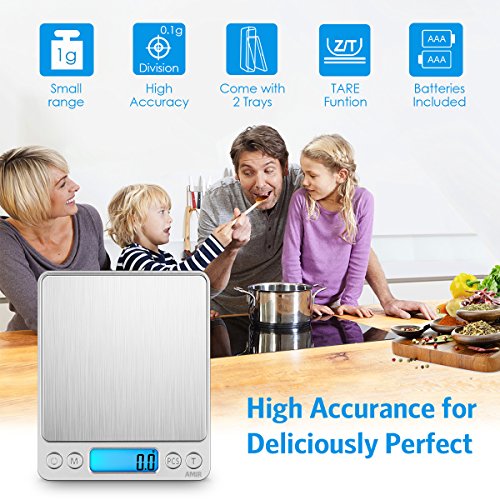
This scale delivers consistent 0.1g accuracy across a 3000g range, making it practical for weighing coffee grounds, flour, and spice blends without excess bulk on the counter. The backlit LCD reads clearly in low light, and the tare function handles net-weight measurement without fumbling. Its slim profile fits easily in a drawer and travels well. Worth noting: accuracy stops at 0.1g — not the 0.01g precision some listings imply — so it's not the right tool for applications that demand finer resolution. A reliable everyday choice for home brewers, bakers, and meal-preppers who need honest portioning without a dedicated lab-grade instrument.
Is AMIR Digital Kitchen Scale 3000g Right for You?
Is the AMIR scale really 0.01g accurate like the title says?
No — this is one of the most common complaints. Despite the title mentioning 0.01oz/0.1g, the actual resolution is 0.1g. Some buyers feel misled by this. For most kitchen uses — tea, coffee, baking, meal prep — 0.1g is perfectly fine. But if you specifically need 0.01g precision for something like measuring supplements or very small spice quantities, this isn't the right scale. Check the unit display: it reads to one decimal place in grams (e.g., 5.2g), not two (e.g., 5.23g).
How do I know if the AMIR scale is giving accurate readings?
The AMIR auto-calibrates on startup, which helps maintain consistency. Users consistently report accurate and repeatable measurements for items over 1g. A good test is to weigh a known item — a nickel weighs exactly 5g, for example. If you're getting inconsistent readings, make sure the scale is on a flat, stable surface and that the stainless steel platform is seated properly (it's attached with double-sided tape and can occasionally shift). For very light items under 100g, precision may drop slightly, so keep that in mind for small tea portions.
Why does my AMIR scale show a different weight every time?
A few things could cause inconsistent readings. First, make sure the scale is on a hard, flat surface — soft surfaces like tablecloths or uneven counters throw off the sensors. Second, check that the stainless steel platform is firmly seated, as it's held on by double-sided tape and can shift if it comes loose. Third, the AMIR is less reliable with very light items under 1g, so small fluctuations there are normal for a scale at this price point. If you're seeing wild jumps with heavier items, try fresh batteries — low battery voltage affects accuracy. If none of that helps, it may be a defective unit, which some buyers have unfortunately encountered.
How do I use the AMIR kitchen scale step by step?
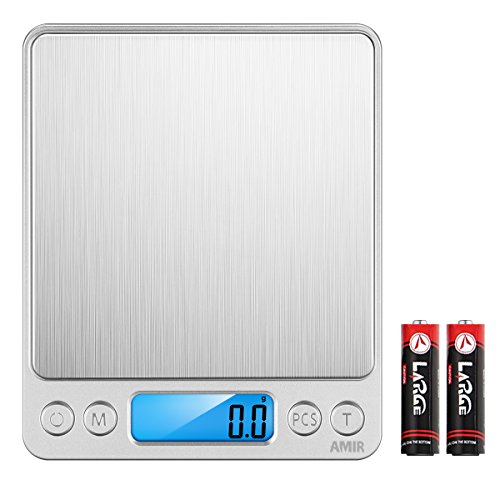
It's genuinely simple — just four buttons. Press the power button and wait a second for it to auto-calibrate (you'll see 0.0g on the backlit display). Place your container on the platform and hit the tare button to zero it out. Add your tea leaves or coffee grounds until you reach your target weight. If you're measuring multiple ingredients, just hit tare again between each one. Use the Mode button to switch between grams, ounces, and other units. The scale also has a piece-counting function — press PCS — which is handy for counting tea bags or capsules.
Is the AMIR scale accurate enough for pour-over and espresso coffee?
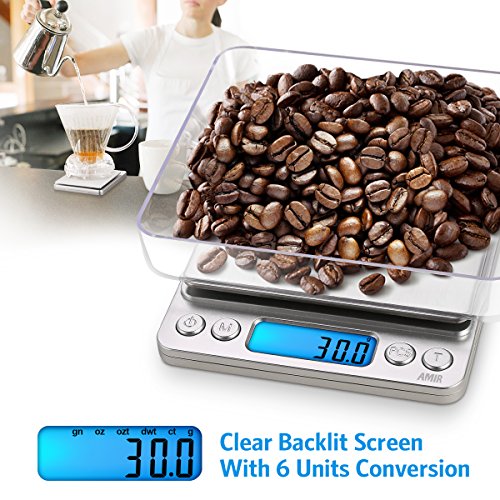
For pour-over, absolutely. A typical recipe calls for 15-22g of coffee, and the 0.1g resolution gives you excellent control at that range. Reviewers who use it specifically for coffee dosing report excellent precision. For espresso, where you're often dialing in 18.0g doses, it works well too — though serious espresso enthusiasts sometimes prefer scales with a built-in timer and faster response. The AMIR's main advantage for coffee is its compact footprint, which fits easily on or beside a drip tray. Just know it won't weigh in real-time as quickly as dedicated coffee scales.
Is the AMIR scale good for baking?
Yes, it works well for most baking needs. The 3000g capacity handles a 500g batch of flour without issue, and the 0.1g resolution gives you precision for smaller ingredients like baking powder, salt, and spices. The tare function makes measuring multiple ingredients into one bowl fast and painless. The main limitation is the small platform — under 5 inches — so large mixing bowls will overhang, though reviewers note even a Pyrex measuring jug fits. For serious bakers who scale recipes regularly, it's solid value.
As an Amazon Associate we earn from qualifying purchases.
Are there any durability concerns with the AMIR scale?
This is the honest trade-off for the low price. Some users have reported the display failing or going blank after 1-7 months of use. The weighing platform is attached with double-sided tape rather than a mechanical connection, so it can come loose over time. The buttons have a somewhat cheap feel to them. That said, many reviewers have used theirs without issue and consider it excellent value. If you treat it gently and keep it stored with the protective covers on, it should serve you well for casual home use. For daily professional use, you'd want to invest in something more heavy-duty.
How long do the batteries last in the AMIR kitchen scale?
Users report good battery life overall, helped by the auto-off feature that shuts the scale down after a period of inactivity. It runs on two AAA batteries (which are included, despite one reviewer claiming otherwise). For typical home use — weighing a few times a day — you can expect several months before needing to replace them. If you notice readings becoming inconsistent or the display dimming, that's usually a sign the batteries are getting low.
How do I read the AMIR scale's display correctly?
The bright backlit LCD makes reading easy, even in dim kitchens — multiple reviewers highlight this as a standout feature. The display shows your weight value and the current unit (g, oz, ozt, dwt, ct, or gn). In gram mode, readings show one decimal place (e.g., 15.3g). Make sure you check which unit is displayed before recording your measurement — it's easy to accidentally switch units if you bump the Mode button. The display auto-dims after a period of inactivity and the scale auto-shuts off to save battery life.
Who is the AMIR digital kitchen scale best for?
It's ideal for home coffee brewers, casual bakers, meal preppers, and anyone who needs a compact, affordable scale for general kitchen use. It's also surprisingly popular with crafters — people use it for weighing beads, resin components, and balm-making ingredients. Beginners will appreciate the dead-simple four-button interface and auto-calibration. It's not the best choice for professional applications demanding 0.01g precision, anyone needing a waterproof scale, or heavy-duty kitchen use where a larger, more durable scale would hold up better over time.
Can I take the AMIR scale traveling?
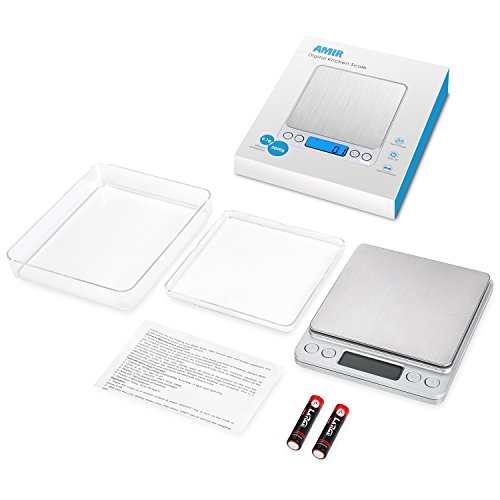
It's one of the best features of this scale. The compact, pocket-sized design makes it genuinely portable — multiple reviewers specifically mention using it for travel. It comes with two plastic covers that protect the weighing surface and can double as small weighing trays. If you're a coffee or tea enthusiast who wants consistent brewing on the road, it slips easily into a bag. Just note it's not waterproof, so keep it protected from spills in your luggage.
What comes in the box with the AMIR scale?
You get the scale itself with a stainless steel weighing platform, two AAA batteries, and two plastic tray covers that serve as both protection for the platform and lightweight weighing trays. Several reviewers appreciate the included trays as a nice touch for the price. No calibration weight is included, which is worth noting — if you ever need to recalibrate, a proper calibration weight can cost about twice the price of the scale itself.
As an Amazon Associate we earn from qualifying purchases.
How does the piece-counting function work on the AMIR scale?
Press the PCS button to enter piece-counting mode. You'll first need to place a reference sample — say, 10 tea bags or coffee capsules — on the scale so it can calculate the average weight per piece. Then remove them, place your bulk quantity on the scale, and it'll tell you the count. Reviewers use this for counting all sorts of things: pins, pennies, seeds, nuts, even beads for craft projects. It's surprisingly handy once you discover it, though it works best with uniform items where each piece weighs roughly the same.
How do I choose the right kitchen scale for tea and coffee brewing?
For tea and coffee, you want a scale that reads in 0.1g increments, has a tare function, and responds quickly. The AMIR scale checks those boxes — it offers 0.1g resolution up to 3000g, a responsive tare button, and fast readings that work well for pour-over coffee dosing. Its compact size also fits neatly into most brewing setups. One thing to note: if you need true 0.01g precision for very light tea leaves (under 1g), you'd want a more specialized scale, since the AMIR's accuracy is actually 0.1g despite what the title suggests.
What should I look for when buying a digital kitchen scale?
The big things are accuracy, capacity, readability, and reliability. The AMIR scale does well on most of these — its backlit LCD display is bright and easy to read, the 3000g capacity handles everything from a single espresso dose to a 500g batch of flour, and the tare function makes measuring multiple ingredients simple. Where it falls a bit short is long-term durability — some users have reported display failures after several months. If you're buying for occasional use, it's solid value. For daily heavy use, you might want something more robust.
How do I use a food scale for portion control and calorie counting?
The AMIR makes portion control straightforward. Weigh your food in grams (more precise than ounces for calorie tracking), then look up the calories per gram for that food. The tare function is especially useful here — put your plate on the scale, tare it, add your protein, note the weight, tare again, add your carbs, and so on. Users specifically mention using it for meal prep and dieting. The 3000g capacity means you can weigh even larger portions without maxing out, and the compact size lets you keep it on the counter without it taking over your kitchen.
What type of scale is most accurate for measuring tea and coffee?
For most tea and coffee brewing, a 0.1g resolution scale like the AMIR is more than adequate — a typical pour-over dose is 15-20g, where 0.1g precision gives you excellent control. Espresso fans who dial in to the exact tenth of a gram will find it works well too. However, if you're measuring very small quantities of rare teas (say, 0.5g of a premium gyokuro), the AMIR's accuracy drops off for items under 1g. In that case, a true 0.01g analytical scale would be better. For everyday brewing, though, this scale hits the sweet spot of accuracy, speed, and price.
How do I use the AMIR scale to weigh food accurately?
Start by placing the scale on a hard, flat surface — this is critical for accuracy. Turn it on, let it auto-calibrate to 0.0g, then place your bowl or plate on the platform and press Tare. Add your food and read the weight on the backlit LCD. For the most accurate results, add ingredients slowly as you approach your target weight, since the display updates quickly but not instantaneously. The weighing surface is under 5 inches across, so larger items like a Pyrex measuring jug will work (reviewers confirm this) but may overhang the edges — just make sure the weight is centered.
As an Amazon Associate we earn from qualifying purchases.
How do I use the AMIR scale to measure tea in grams?
Turn the scale on and press the Mode button until the display shows 'g' for grams. Place your teacup, brewing vessel, or a small bowl on the platform and press Tare to zero it out. Then add your loose leaf tea until you hit your desired weight — most teas call for 2-3g per cup or 5-7g for a gongfu session. The 0.1g resolution is perfect for this range. One nice touch: the AMIR comes with two small plastic trays that work as weighing platforms for loose leaf tea, so you don't necessarily need your own container.
How do I use a food scale for weight loss?
It's all about awareness and consistency. Weigh everything you eat in grams, log it in your preferred calorie tracking app, and you'll quickly learn what realistic portions actually look like. The AMIR's tare function makes this painless — zero out your plate, add each ingredient, and record. Several reviewers bought this specifically for meal prep and dieting and found it accurate enough for consistent results. The compact size is a bonus — it fits in a drawer when you're not using it and is even portable enough to take to work if you meal prep there.
Customer-Validated Strengths
based on 30-review analysis • Our methodology
- Compact size - easy to store and portable (15 mentions)
- Accurate and consistent measurements (12 mentions)
- Bright, easy-to-read backlit LCD display (8 mentions)
- Tare function works well (7 mentions)
- Good value for price (6 mentions)
- Includes two plastic trays/covers (6 mentions)
- Long battery life (4 mentions)
- Fast startup and quick readings (3 mentions)
- Multiple unit options (g/oz/ozt/dwt/ct/gn) (3 mentions)
Best Use Cases
🎯 Best For
- Coffee brewing (pour over and espresso dosing)
- Baking with precise flour/spice measurements
- Meal prep and portion control for dieting
- Weighing small craft materials (beads, resin components)
- Home wine making ingredient measurement
- Travel and portable weighing needs
⚠️ Not Ideal For
- Very light items under 1g (inconsistent accuracy)
- Large kitchen items requiring 5kg+ capacity
- Wet environments (not waterproof)
- Applications requiring 0.01g precision
What to Consider
- Display failure or blank screen (4 mentions)
- Accuracy only 0.1g, not 0.01g as title suggests (2 mentions)
- Platform held by double-sided tape, comes unattached (1 mentions)
- Small weighing surface (under 5 inches) (2 mentions)
- Buttons feel cheap (1 mentions)
- Gets stuck in calibration mode (1 mentions)
- Not waterproof (1 mentions)
- May require recalibration (1 mentions)
- Less accurate with very light items (under 100g) (1 mentions)
- Batteries not included despite listing claim (1 mentions)
based on 30-review sample.
About This Analysis
This analysis is based on 30 customer reviews. We're showing you everything we found, but with our analysis, there's always more to discover.
✅ What we're confident about: What customers love and best use cases
⚠️ What may be incomplete: Potential issues and considerations
For more perspectives, check customer reviews on Amazon.
Product Selection
In short: We only feature high-rated products.
Products on TeaDelight.net are selected based on strong Amazon customer ratings, sufficient review volume, and market presence. We focus on well-regarded products that tea enthusiasts are actively considering and purchasing.
As an Amazon Associate we earn from qualifying purchases.
You Might Also Like

✅ Accurate timing for tea brewing
Lily's Home 3-in-1 Tea Timer Sand Hourglass

✅ Compact and portable design, ideal for travel
Weightman Espresso Scale with Timer

✅ High precision/accuracy (0.1g sensitivity)
HOTO Smart Food Scale with 0.1g Precision
✅ High accuracy and precision (0.1g increments)