

We analyze real customer reviews to surface what matters: key strengths, ideal use cases, and honest considerations — so you can make an informed choice.
The Tao of Tea Green Dragon Oolong
A green-style oolong leaning light and grassy rather than mineral-roasted — reviewers settle on smooth, mild, and "different than the rich oolongs" they were expecting.
🎯 Best for: drinkers who want a lighter, greener-style oolong rather than a roasty profile, loose-leaf brewing with multiple infusions from the same leaves
🍃 Strength: Light

What Stands Out
🍃 Flavor Profile
Strength: Light
Grass and light vegetal notes lead, tempered by a smooth, mild body — though several reviewers found it weak rather than full. Toasted-chestnut and lightly roasted notes pick up in later infusions. We'd place this on the green-oolong end of the spectrum, not the roasty Wuyi side.
✅ What Customers Love
- smooth, mild body
- resteeps well across two to three infusions
- whole-leaf quality at the price
🎯 Best For
drinkers who want a lighter, greener-style oolong rather than a roasty profile • loose-leaf brewing with multiple infusions from the same leaves • moving up from tea bags to whole-leaf oolong
Brand: The Tao of Tea
Category: Oolong Tea
As an Amazon Associate we earn from qualifying purchases.
About This Oolong Tea
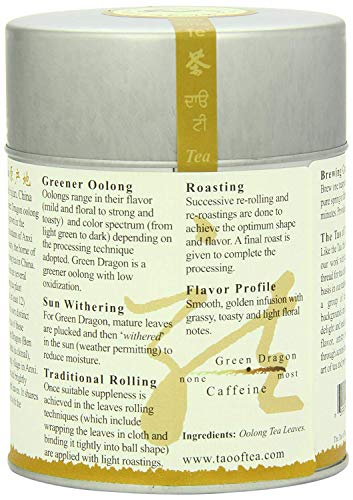
The Tao of Tea's Green Dragon is a green-style oolong that leans light and grassy rather than mineral-roasted. Reviewers settle on smooth, mild, and "different than the rich oolongs" they were expecting. Grass and light vegetal notes lead, tempered by a smooth, mild body — though several reviewers found it weak rather than full. Toasted-chestnut and lightly roasted notes pick up in later infusions, placing this on the green-oolong end of the spectrum, not the roasty Wuyi side.
It works best as an unhurried loose-leaf cup that resteeps well. Three infusions from the same leaves drew specific praise, and four of thirteen reviewers came back for repeat purchases. The whole-leaf quality at this price point suits drinkers stepping up from tea bags into loose-leaf oolong, and the lighter profile makes it a reasonable entry point for anyone exploring greener-style oolongs.
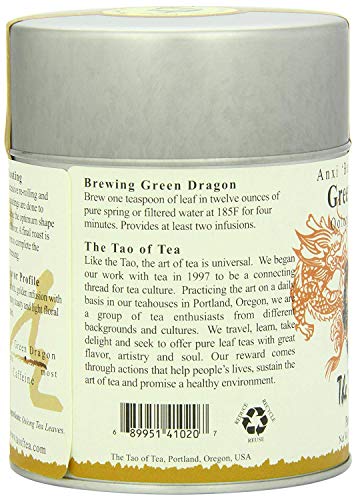
Follow the tin's recommendation — a heaping teaspoon per 10 oz, a four-minute steep, brief agitation up front — and expect it to hold up across a second and even third infusion. A touch of honey works for drinkers who want a little more sweetness in the cup.
Intensity is the real trade-off. Five of thirteen reviewers describe the flavor as subtle, weak, light, or "not bold enough," so this isn't the cup for anyone reaching for a roasty, full-bodied oolong or prioritizing a strong, dominant flavor. A few reviewers also flagged a short expiration date on arrival and occasional packaging issues, and the grassy, vegetal lean won't suit every palate.
Reach for it when you want a mild, multi-infusion oolong session rather than a bold one-and-done cup.
Is The Tao of Tea Green Dragon Oolong Right for You?
What does this oolong actually taste like?
Across 12 eligible reviewers, the profile leans grassy and lightly vegetal with a smooth, mild body, and a few drinkers pick up toasted-chestnut and lightly roasted notes in later infusions. It sits on the green-oolong end of the spectrum rather than the roasty side.
Is this a roasty, full-bodied oolong or a lighter one?
This is the lighter, greener style — several reviewers note it tasted 'different than the rich oolongs' they were expecting. If you're reaching for a roasty Wuyi-style cup, this won't scratch that itch.
Will the flavor feel strong enough, or is it on the weak side?
Intensity is the main trade-off — about 5 of 13 reviewers describe it as subtle, weak, light, or 'not bold enough.' If a dominant, full-bodied cup matters to you, this leaf will likely read as underpowered.
Does it hold up to multiple infusions?
Yes — reviewers specifically call out that it resteeps well, with one noting good results through a third steep. Re-using the same leaves twice or three times appears to be a reliable use pattern at this review count.
How should I brew it?
Follow the tin's directions: a heaping teaspoon per 10 ounces, steep about four minutes, and give it a brief stir up front. Reviewers who stuck with these parameters got cleaner results and a second or third usable infusion.
Is this a good first loose-leaf oolong for someone moving up from tea bags?
It appears to suit that transition — the smooth, mild body forgives brewing variation, the tin gives clear instructions, and a couple of reviewers explicitly prefer it to bagged tea. Just go in expecting a light cup rather than a bold one.
As an Amazon Associate we earn from qualifying purchases.
Does anything pair well with it?
One reviewer mentions a touch of local honey when they want a little more sweetness — fitting for a light, grassy oolong. Otherwise the synthesis treats this as a straight-sipping cup rather than a food-pairing tea.
Are reviewers actually coming back for repeat purchases?
Yes — 4 of 13 reviewers signal repurchase intent, which is a meaningful repeat-buy share at this review count. That tracks with the 'smooth, mild, resteeps well' profile finding a regular-drinker audience even if it doesn't wow on first sip.
Is the tin's seal sturdy enough to keep the leaf fresh once opened?
The lid seal is the weak spot a couple of reviewers flag, so plan to transfer the leaf to an airtight container or clip the inner liner well once you crack it open. Most reviewers don't raise this, but it's worth knowing if long-term freshness matters to you.
Category: What does oolong tea taste like?
Flavor varies enormously with oxidation and roast. Lightly oxidized oolongs like modern Anxi Tieguanyin and Taiwanese high-mountain teas tend toward floral, creamy, orchid-like profiles with a pale golden-green liquor. Medium-oxidized styles shift into fruity, honeyed, and nutty territory with amber liquor, while heavily oxidized and charcoal-roasted oolongs such as Wuyi rock teas deliver mineral, woody, and dark-chocolate notes closer in profile to coffee or stout.
Category: What is Wuyi rock tea (yancha)?
Yancha refers to oolongs grown in the Wuyi Mountains on weathered volcanic and sedimentary rock, which gives the tea its characteristic mineral 'rock rhyme' (yan yun). These teas are typically heavily oxidized and charcoal-roasted, producing mineral, woody, and dark-chocolate flavors. The most famous cultivars are Da Hong Pao, Rou Gui (spicy and cinnamon-like), and Shui Xian (smooth and mossy). Quality is hierarchically ranked by growing zone, with Zhengyan ('true rock,' inside the protected scenic area) at the top.
Category: Can oolong tea be re-steeped?
Yes — oolong is the category most rewarding to re-infuse. Ball-rolled oolongs like Tieguanyin or Alishan slowly unfurl across infusions and commonly yield 5-8 cups, each revealing a slightly different facet of the leaf. Wuyi rock teas and Dan Congs also re-steep multiple times. This is the principle behind gongfu brewing: a small vessel, a high leaf-to-water ratio, and short repeated steeps.
What Customers Love
⚠️ Limited sample based on limited customer feedback (13 reviews) • Our methodology
- smooth, mild body
- resteeps well across two to three infusions
- whole-leaf quality at the price
- repeat-purchase signal
Taste Profile
Grass and light vegetal notes lead, tempered by a smooth, mild body — though several reviewers found it weak rather than full. Toasted-chestnut and lightly roasted notes pick up in later infusions. We'd place this on the green-oolong end of the spectrum, not the roasty Wuyi side.
- honey, when a touch more sweetness is wanted
Brewing: Follow the tin's recommendation — a heaping teaspoon per 10 oz, four-minute steep, brief agitation up front — and expect it to hold up across a second and even third infusion.
Best Use Cases
🎯 Best For
- drinkers who want a lighter, greener-style oolong rather than a roasty profile
- loose-leaf brewing with multiple infusions from the same leaves
- moving up from tea bags to whole-leaf oolong
⚠️ Not Ideal For
- drinkers seeking a bold, roasty, full-bodied oolong
- anyone prioritizing strong, dominant flavor
How People Use It
It works best as an unhurried loose-leaf cup that resteeps well — three infusions from the same leaves drew specific praise, and four of thirteen reviewers came back for repeat purchases.
Good for Beginners
✅ Yes
- smooth, mild body that forgives brewing variation
- container provides clear brewing instructions
For Experienced Users
Has Some Depth
- limited source-based descriptor depth and no origin or processing specificity to reward connoisseur attention
What to Consider
Intensity is the real trade-off: five of thirteen reviewers describe the flavor as subtle, weak, light, or "not bold enough," so this isn't the cup for anyone reaching for a roasty, full-bodied oolong.
- subtle / weak flavor intensity
- short expiration date on arrival
- occasional packaging issues
- grassy / vegetal lean may not suit all palates
⚠️ Important: This analysis is based on limited customer feedback (13 reviews). We've shared what we found, but there may be additional considerations we haven't captured.
About This Analysis
This analysis is based on 13 customer reviews. We're showing you everything we found, but with a small sample, there's a lot we likely haven't captured yet.
✅ What we're confident about: What customers love and best use cases
⚠️ What may be incomplete: Potential issues and considerations
For more perspectives, check customer reviews on Amazon.
Product Selection
In short: We only feature high-rated products.
Products on TeaDelight.net are selected based on strong Amazon customer ratings, sufficient review volume, and market presence. We focus on well-regarded products that tea enthusiasts are actively considering and purchasing.
As an Amazon Associate we earn from qualifying purchases.
You Might Also Like

✅ Balanced fruit-and-tea profile with a sweet finish
NESTLADY Peach Oolong Tea

✅ Clean oolong + jasmine combination when it lands
Bigelow Organic Oolong with Jasmine Green Tea

Tealyra Osmanthus Gui Hua Oolong Tea
✅ Roasted, woody character without overbearing char