




We analyze real customer reviews to surface what matters: key strengths, ideal use cases, and honest considerations — so you can make an informed choice.
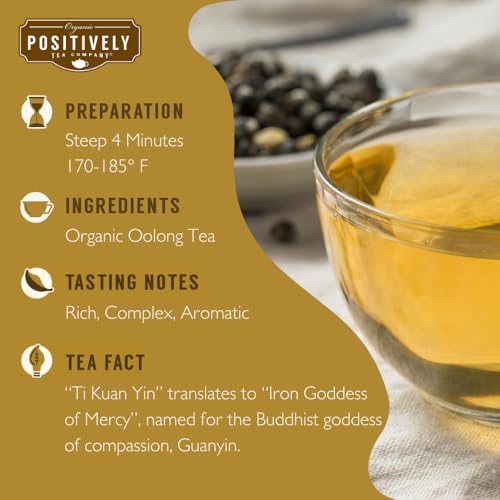
Positively Tea Company Organic Ti Kuan Yin Oolong Tea
An organic, ball-rolled Anxi Tieguanyin in a one-pound bag — reviewers praise the leaf quality, while the flavor profile divides them.
🎯 Best for: loose-leaf drinkers buying oolong in bulk, gongfu-style brewing in a gaiwan or yixing pot
🍃 Strength: Light

🍃 Flavor Profile
Strength: Light
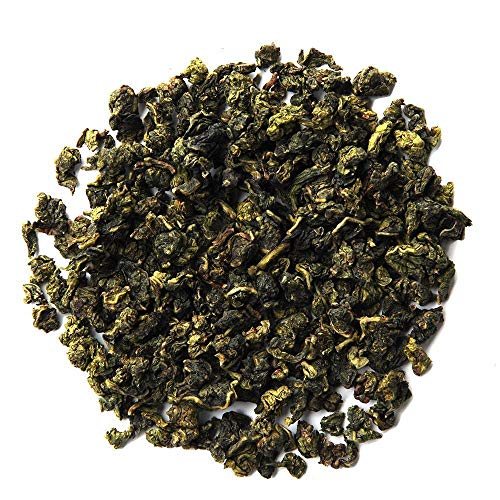
The aroma reads floral overall, with individual reviewers picking up kettle corn and a lightly vegetal-ocean note. On the cup, some drinkers find it earthy and crisp with green-tea-adjacent character, while others detect seaweed, nori, or smoked-fish notes that overshadow the typical Tieguanyin profile. The leaves themselves arrive tightly rolled and full, expanding dramatically on steeping.
✅ What Customers Love
- high physical leaf quality — tightly rolled balls that expand to full leaves
- value at the one-pound size
- repeat-purchase signal
🎯 Best For
loose-leaf drinkers buying oolong in bulk • gongfu-style brewing in a gaiwan or yixing pot • drinkers who appreciate green-style Anxi Tieguanyin
Brand: Organic Positively Tea Company
Category: Oolong Tea
As an Amazon Associate we earn from qualifying purchases.
About This Oolong Tea
This is an organic, ball-rolled Anxi Tieguanyin sold loose-leaf in a one-pound bag. The aroma reads floral overall, with individual reviewers picking up kettle corn and a lightly vegetal-ocean note. On the cup, some drinkers find it earthy and crisp with a green-tea-adjacent character, while others detect seaweed, nori, or smoked-fish notes that overshadow the typical Tieguanyin profile. The leaves themselves arrive tightly rolled and full, expanding dramatically on steeping.
A few reviewers brew this gongfu-style — short, multi-infusion preparation in a gaiwan or yixing pot, the setup that suits a quality oolong. One drinker also uses it as a kombucha base. The one-pound format suits loose-leaf drinkers buying in bulk, and the green-style character will appeal to those who prefer a lighter Anxi Tieguanyin over a heavily roasted one.
Give the rolled leaves room to fully unfurl. A gaiwan or yixing pot for short, gongfu-style infusions is the preparation reviewers reach for, and the leaves have the structure to support multiple infusions.
Roughly a third of reviewers report an expectation gap. One wanted a more oxidized roast; another describes the leaves arriving brown-to-black rather than the vibrant green of the listing; another finds the flavor leaning toward smoked fish rather than Tieguanyin's nutty character. Newcomers hoping for the classic nutty profile may find this polarizing, and a few reviewers note batch variance and some aroma loss between orders.
Caffeine sits at a moderate level, making this better suited to daytime drinking than evening cups.
Is Positively Tea Company Organic Ti Kuan Yin Oolong Tea Right for You?
What does this Ti Kuan Yin actually taste like?
Reviewers split sharply on the flavor. Some find it earthy and crisp with a green-tea-adjacent character, while others pick up seaweed, nori, or smoked-fish notes that overshadow the typical Tieguanyin profile. With only 10 eligible reviews to draw from, expect a polarizing cup rather than a settled house style.
How does it smell when you open the bag?
The aroma reads floral overall, with individual reviewers picking up kettle corn and a lightly vegetal, ocean-leaning note. A couple of drinkers report the opposite — stale or fishy smell — which points to possible batch variance at this review count.
How do reviewers brew these rolled leaves?
A few reviewers brew it gongfu style — short, multi-infusion preparation in a gaiwan or yixing pot — which suits a ball-rolled oolong. The tightly rolled leaves need room to fully unfurl, so a vessel that lets them open is the setup drinkers reach for.
Is the leaf quality itself good?
The physical leaf is the strongest signal across the small review pool. Reviewers describe tightly rolled balls that expand to full leaves, with the product called out as clean and free of dust and stems.
Will this satisfy someone expecting the classic nutty Tieguanyin profile?
Probably not. The synthesis flags an expectation gap — one reviewer wanted a more oxidized roast, another describes leaves arriving brown-to-black rather than vibrant green, and one finds the flavor leaning toward smoked fish rather than the nutty character Tieguanyin is associated with. Drinkers who know the heavier-roast style appear to be the most disappointed group.
Who does this oolong appear to suit best?
Based on a handful of reviews, it appears to land best with loose-leaf drinkers buying oolong in bulk, gongfu brewers using a gaiwan or yixing pot, and people who already appreciate the green-style Anxi Tieguanyin rather than a roasted one.
As an Amazon Associate we earn from qualifying purchases.
How does it compare to other Tieguanyin or oolongs reviewers have tried?
Comparisons in the small review pool point in different directions — one reviewer calls it similar to green tea, another compares it to a Ti Kuan Yin they had previously enjoyed, and one likens it to oolongs at local shops. The takeaway is that this leans green-style rather than the heavier-roast Tieguanyin some drinkers are benchmarking against.
Do reviewers come back for a second bag?
Three of ten reviewers signal they would buy it again, which is a positive repeat-purchase signal at this review count even with the polarizing flavor reports running alongside it.
Is it a good choice for evening drinking?
The synthesis explicitly lists evening drinking under not-good-for, and oolong generally carries enough caffeine to keep sensitive drinkers awake. Reviewers describe it as a morning brew rather than a wind-down cup.
Can this oolong be used for anything besides drinking straight?
One reviewer uses it as a kombucha base, which the synthesis calls out as a pairing suggestion. It's a single-reviewer signal rather than a widespread use, so treat it as a niche option rather than a documented strength.
Category: What does oolong tea taste like?
Flavor varies enormously with oxidation and roast. Lightly oxidized oolongs like modern Anxi Tieguanyin and Taiwanese high-mountain teas tend toward floral, creamy, orchid-like profiles with a pale golden-green liquor. Medium-oxidized styles shift into fruity, honeyed, and nutty territory with amber liquor, while heavily oxidized and charcoal-roasted oolongs such as Wuyi rock teas deliver mineral, woody, and dark-chocolate notes closer in profile to coffee or stout.
Category: Can oolong tea be re-steeped?
Yes — oolong is the category most rewarding to re-infuse. Ball-rolled oolongs like Tieguanyin or Alishan slowly unfurl across infusions and commonly yield 5-8 cups, each revealing a slightly different facet of the leaf. Wuyi rock teas and Dan Congs also re-steep multiple times. This is the principle behind gongfu brewing: a small vessel, a high leaf-to-water ratio, and short repeated steeps.
As an Amazon Associate we earn from qualifying purchases.
Category: What is Dan Cong oolong?
Dan Cong ('single bush') is the oolong of the Phoenix Mountains in Guangdong, famous for cultivars whose natural aromas mimic specific flowers and fruits. Classic types include Mi Lan Xiang (honey orchid), Ya Shi Xiang (the cheekily named 'duck shit,' actually intensely floral and creamy), Huang Zhi Xiang (gardenia), and Xing Ren Xiang (almond). They are strip-style, often heavily roasted, and known for an intense perfume-like fragrance.
What Customers Love
⚠️ Limited sample based on limited customer feedback (10 reviews) • Our methodology
- high physical leaf quality — tightly rolled balls that expand to full leaves
- value at the one-pound size
- repeat-purchase signal
- clean product, free of dust and stems
Taste Profile
The aroma reads floral overall, with individual reviewers picking up kettle corn and a lightly vegetal-ocean note. On the cup, some drinkers find it earthy and crisp with green-tea-adjacent character, while others detect seaweed, nori, or smoked-fish notes that overshadow the typical Tieguanyin profile. The leaves themselves arrive tightly rolled and full, expanding dramatically on steeping.
- kombucha base
Brewing: Give the rolled leaves room to fully unfurl; a gaiwan or yixing pot for short, gongfu-style infusions is the preparation reviewers reach for.
Best Use Cases
🎯 Best For
- loose-leaf drinkers buying oolong in bulk
- gongfu-style brewing in a gaiwan or yixing pot
- drinkers who appreciate green-style Anxi Tieguanyin
⚠️ Not Ideal For
- drinkers expecting a heavily oxidized or roasted Tieguanyin
- newcomers who want the classic nutty Tieguanyin profile
- evening drinking
How People Use It
A few reviewers brew this gongfu-style — the short, multi-infusion preparation — in a gaiwan or yixing pot, the setup that suits a quality oolong; one drinker also uses it as a kombucha base.
For Experienced Users
✅ Worth Exploring
- ball-rolled, full-leaf Anxi-style Tieguanyin appreciated by gongfu drinkers
- yixing-pot preparation reference
What to Consider
Roughly a third of reviewers report an expectation gap — one wanted a more oxidized roast, another describes the leaves arriving brown-to-black rather than the vibrant green of the listing, and one finds the flavor leaning toward smoked fish rather than Tieguanyin's nutty character.
- expectation gap — appearance and oxidation/profile sometimes do not match listing or category norms
- polarizing flavor — seaweed, nori, or smoked-fish notes for some drinkers
- batch-variance and aroma-loss reports
⚠️ Important: This analysis is based on limited customer feedback (10 reviews). We've shared what we found, but there may be additional considerations we haven't captured.
About This Analysis
This analysis is based on 10 customer reviews. We're showing you everything we found, but with a small sample, there's a lot we likely haven't captured yet.
✅ What we're confident about: What customers love and best use cases
⚠️ What may be incomplete: Potential issues and considerations
For more perspectives, check customer reviews on Amazon.
Product Selection
In short: We only feature high-rated products.
Products on TeaDelight.net are selected based on strong Amazon customer ratings, sufficient review volume, and market presence. We focus on well-regarded products that tea enthusiasts are actively considering and purchasing.
As an Amazon Associate we earn from qualifying purchases.
You Might Also Like

✅ Balanced fruit-and-tea profile with a sweet finish
NESTLADY Peach Oolong Tea

✅ Clean oolong + jasmine combination when it lands
Bigelow Organic Oolong with Jasmine Green Tea

Tealyra Osmanthus Gui Hua Oolong Tea

✅ Mild, smooth, low-bitterness profile