




We analyze real customer reviews to surface what matters: key strengths, ideal use cases, and honest considerations — so you can make an informed choice.
Golden Moon Tea Organic Tie Guan Yin Oolong Tea
A lightly-baked organic Tieguanyin in loose-leaf tin form — with nine reviews on the books, the verdict splits between drinkers who find it pleasantly subtle and those who find it disappearingly faint.
🎯 Best for: a mild, low-intensity daily oolong, an everyday energy lift
🍃 Strength: Light

What Stands Out
🍃 Flavor Profile
Strength: Light
Across a limited sample, the consistent thread is mildness: reviewers reach for words like fresh, subtle, and mild, with one drinker singling out a natural, subtle fragrance as a feature rather than a flaw. The flip side appears just as often — several reviewers describe the cup as bland, weak, or lacking oolong character even after steeping longer, with one comparison to gas station coffee on the aftertaste side. Aroma reads floral but quiet; a single reviewer flagged it as a low 2 on a five-point fragrance scale. We'd call this a light-baked Anxi-style oolong (low oxidation, minimal roast) where the gentleness is the design — whether that reads as elegant or absent depends on the drinker.
✅ What Customers Love
- Natural, subtle floral fragrance
- Whole-leaf appearance after steeping
- Daily energy lift
🎯 Best For
a mild, low-intensity daily oolong • an everyday energy lift • drinkers who prefer light-baked, floral-leaning oolong
Brand: Golden Moon Tea
Category: Oolong Tea
As an Amazon Associate we earn from qualifying purchases.
About This Oolong Tea
This is a lightly-baked organic Tieguanyin sold as loose leaf in a reusable travel tin — an Anxi-style oolong where low oxidation and minimal roast keep the cup deliberately quiet. Across nine reviews the consistent thread is mildness: drinkers reach for words like fresh, subtle, and mild, and one singled out a natural, subtle fragrance as a feature rather than a flaw. The aroma reads floral but soft; one reviewer scored fragrance a low 2 on a five-point scale.
We'd reach for this as a daily, all-day pour rather than a sit-down tasting tea. One reviewer specifically mentions an energy boost across the day, which fits the moderate caffeine label. With its quiet profile it lives in the background of a working morning or afternoon rather than the foreground of a gongfu session — the multi-infusion, short-steep preparation that lets oolong unfold leaf by leaf.
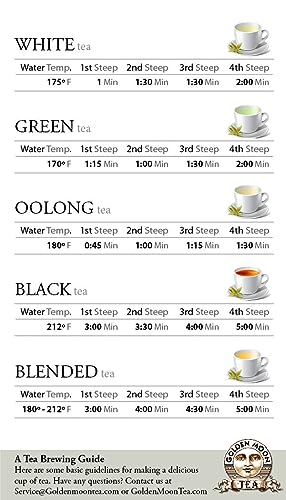
If you want more body, reviewers who chased it reached for the same lever: more leaf, a longer steep around three minutes, or both. Start there before judging the tea — a lightly-baked Tieguanyin will rarely deliver a commanding cup, but it can carry a fuller floral lift with a heavier hand on the tin.
The headline caveat is intensity. Across nine reviews, at least five separate notes flag low fragrance, mild flavor, lack of flavor, weakness despite extra leaf, or not-strong-enough — a cluster well above what we'd treat as anecdotal, and likely the defining trade-off of this style. One drinker compared the aftertaste to gas station coffee; another disputed leaf quality, citing broken pieces and stems; one tin arrived dented in shipping. Whether the gentleness reads as elegant or absent will depend on the drinker.
For light-baked, floral-leaning oolong drinkers who want an everyday cup with a moderate caffeine lift, this is a reasonable daily tin. For anyone who wants their oolong assertive, look elsewhere.
Is Golden Moon Tea Organic Tie Guan Yin Oolong Tea Right for You?
Is Golden Moon's Tieguanyin a strong or mild oolong?
Across the small review pool, the loudest signal is mildness — at least five of nine reviewers describe it as subtle, mild, weak, or lacking oolong character, while others appreciate that same softness as a natural, gentle fragrance. Expect a light-baked Anxi-style cup that sits in the background rather than punching forward.
What does this Tieguanyin taste like?
Reviewers reach for words like fresh, subtle, smooth, and floral, with one drinker singling out a natural, subtle fragrance. A couple of voices push back — one describes a foul, gas-station-coffee aftertaste — so the profile reads quiet and floral when it lands, faint or off when it doesn't.
How should I brew this to get more flavor out of it?
Reviewers who wanted a fuller cup all reached for the same lever — more leaf, longer steep, or both. Specific notes mention doubling the leaf in a tea ball and letting it sit in hot water for around three minutes before judging the cup.
Is this a good everyday oolong to drink daily?
It appears to fit that role well — the synthesis frames it as a daily, all-day pour rather than a sit-down tasting tea, and one reviewer specifically calls out an energy boost across the day. The quiet profile means it lives in the background of a working morning instead of demanding attention.
Is this a good oolong for someone new to the category?
Yes — the synthesis flags it as beginner-friendly precisely because the low intensity won't overwhelm a new oolong drinker, and the steep window appears forgiving (reviewers added more leaf and longer steeps without bitterness complaints). Just don't expect the bold, roasted oolong character experienced drinkers seek out.
Will this hold up for a gongfu-style session?
Probably not the strongest fit. The synthesis positions it as a background daily pour rather than a foreground tasting tea, and review data is too thin and evaluative-only to support the orchid, honey, or mineral notes connoisseurs look for in a gongfu Tieguanyin. A few reviewers do note full-size leaves in the cup, so the raw material isn't broken — the profile is just quiet.
As an Amazon Associate we earn from qualifying purchases.
Are the leaves actually whole loose-leaf?
Mostly yes, with one dissenting voice. Two of nine reviewers specifically note full-size leaves after steeping, while one reviewer disputes that and reports broken pieces and stems — a small split, but worth flagging at this review count.
What's the most common complaint about this tea?
Intensity, by a wide margin. At least five of nine reviewers cluster around the same critique — low fragrance, mild flavor, lack of flavor, weakness despite extra leaf, or not strong enough. That's the defining trade-off of this lightly-baked Anxi style and the single biggest thing to know before buying.
Is this tea organic?
Yes — the listing identifies it as USDA-organic loose-leaf packed in a reusable travel tin, and the synthesis flags the organic, loose-leaf-in-tin format as one of the product's structural strengths.
Does this oolong give a noticeable caffeine lift?
Based on a handful of early reports, one reviewer specifically mentions an energy boost that carried across the day, which fits the moderate caffeine you'd expect from a light-baked Tieguanyin. With only nine reviews on the books, treat that as a single data point rather than a settled pattern.
Category: How much caffeine does oolong tea have?
Caffeine in brewed oolong typically falls between green and black tea, but the range overlaps heavily with both — there is no fixed 'oolong number.' Importantly, the leaf itself contains the same caffeine regardless of oxidation; color does not predict caffeine. Cultivar (the lower-caffeine Camellia sinensis var. sinensis versus the higher-caffeine var. assamica), leaf maturity, water temperature, and steep time matter far more than the 'oolong' label itself.
Category: Can oolong tea be re-steeped?
Yes — oolong is the category most rewarding to re-infuse. Ball-rolled oolongs like Tieguanyin or Alishan slowly unfurl across infusions and commonly yield 5-8 cups, each revealing a slightly different facet of the leaf. Wuyi rock teas and Dan Congs also re-steep multiple times. This is the principle behind gongfu brewing: a small vessel, a high leaf-to-water ratio, and short repeated steeps.
As an Amazon Associate we earn from qualifying purchases.
Category: What is Wuyi rock tea (yancha)?
Yancha refers to oolongs grown in the Wuyi Mountains on weathered volcanic and sedimentary rock, which gives the tea its characteristic mineral 'rock rhyme' (yan yun). These teas are typically heavily oxidized and charcoal-roasted, producing mineral, woody, and dark-chocolate flavors. The most famous cultivars are Da Hong Pao, Rou Gui (spicy and cinnamon-like), and Shui Xian (smooth and mossy). Quality is hierarchically ranked by growing zone, with Zhengyan ('true rock,' inside the protected scenic area) at the top.
What Customers Love
⚠️ Limited sample based on limited customer feedback (8 reviews) • Our methodology
- Natural, subtle floral fragrance
- Whole-leaf appearance after steeping
- Daily energy lift
- USDA-organic loose-leaf in a reusable tin
Taste Profile
Across a limited sample, the consistent thread is mildness: reviewers reach for words like fresh, subtle, and mild, with one drinker singling out a natural, subtle fragrance as a feature rather than a flaw. The flip side appears just as often — several reviewers describe the cup as bland, weak, or lacking oolong character even after steeping longer, with one comparison to gas station coffee on the aftertaste side. Aroma reads floral but quiet; a single reviewer flagged it as a low 2 on a five-point fragrance scale. We'd call this a light-baked Anxi-style oolong (low oxidation, minimal roast) where the gentleness is the design — whether that reads as elegant or absent depends on the drinker.
Brewing: Reviewers who wanted more body reached for the same lever — more leaf, longer steep (around 3 minutes), or both — so if you like a fuller cup, start there before judging the tea.
Best Use Cases
🎯 Best For
- a mild, low-intensity daily oolong
- an everyday energy lift
- drinkers who prefer light-baked, floral-leaning oolong
⚠️ Not Ideal For
- drinkers who want a bold, full-bodied oolong
- evening or late-night sipping
How People Use It
We'd reach for this as a daily, all-day pour rather than a sit-down tasting tea — one reviewer specifically mentions an energy boost across the day, fitting the moderate caffeine label. With its quiet profile, it lives in the background of a working morning or afternoon rather than the foreground of a gongfu session (the multi-infusion, short-steep preparation that lets oolong unfold).
Good for Beginners
✅ Yes
- Mild, low-intensity profile that won't overwhelm a new oolong drinker
- Forgiving steep window — reviewers suggest longer steeps and more leaf without bitterness complaints
For Experienced Users
Has Some Depth
- Review data is too thin and evaluative-only to support connoisseur positioning — no source-based descriptors (orchid, honey, mineral) that experienced oolong drinkers look for
What to Consider
The headline weakness is intensity: across nine reviews, at least five separate notes flag low fragrance, mild flavor, lack of flavor, weakness despite extra leaf, or not-strong-enough — a cluster well above the 10% threshold, and likely the defining trade-off of this lightly-baked style.
- Low flavor and aroma intensity (cluster)
- Foul aftertaste reported by one drinker
- Shipping packaging let the tin arrive dented
- One reviewer disputed leaf quality (broken pieces and stems)
⚠️ Important: This analysis is based on limited customer feedback (8 reviews). We've shared what we found, but there may be additional considerations we haven't captured.
About This Analysis
This analysis is based on 8 customer reviews. We're showing you everything we found, but with a small sample, there's a lot we likely haven't captured yet.
✅ What we're confident about: What customers love and best use cases
⚠️ What may be incomplete: Potential issues and considerations
For more perspectives, check customer reviews on Amazon.
Product Selection
In short: We only feature high-rated products.
Products on TeaDelight.net are selected based on strong Amazon customer ratings, sufficient review volume, and market presence. We focus on well-regarded products that tea enthusiasts are actively considering and purchasing.
As an Amazon Associate we earn from qualifying purchases.
You Might Also Like
✅ Balanced fruit-and-tea profile with a sweet finish
NESTLADY Peach Oolong Tea
✅ Clean oolong + jasmine combination when it lands
Bigelow Organic Oolong with Jasmine Green Tea

✅ Distinct osmanthus character
Tealyra Osmanthus Gui Hua Oolong Tea

✅ Roasted, woody character without overbearing char