



We analyze real customer reviews to surface what matters: key strengths, ideal use cases, and honest considerations — so you can make an informed choice.
Reinmoson Extra Fine Mesh Tea Strainer
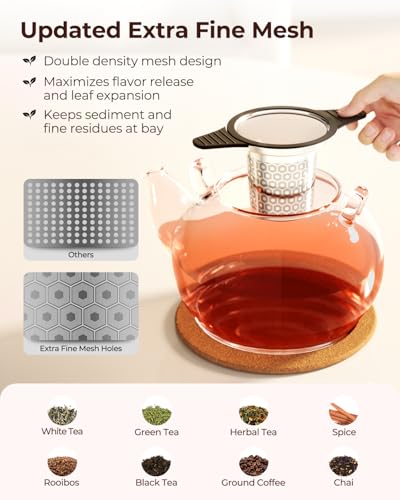
Extra-fine mesh basket with a dual-purpose lid that retains heat while steeping and inverts to serve as a drip coaster — fits most standard mugs securely.
🎯 Best for: Finely chopped loose leaf teas, Herbal teas requiring longer steeping

✅ What Customers Love
- Extra fine mesh prevents tea particles from passing through (18 mentions)
- Fits multiple mug sizes securely (12 mentions)
- Easy to clean - rinses easily without tea leaves sticking (10 mentions)
🎯 Best For
Finely chopped loose leaf teas • Herbal teas requiring longer steeping • Single cup brewing in various mug sizes • Loose leaf tea beginners transitioning from tea bags
Brand: Reinmoson
Category: Infusers & Strainers
As an Amazon Associate we earn from qualifying purchases.
About This Product
The basket's extra-fine mesh filters virtually all tea particles, making it well-suited for finely cut loose leaf and herbal teas that defeat coarser infusers. A dual-function lid retains heat during steeping, then inverts to catch drips as a coaster — a small but practical detail. Metal parts are dishwasher safe, and reviewers note the mesh rinses clean without leaves clinging. The silicone grips can slide when wet, and the lid seal may trap water if not fully air-dried after washing. A low-fuss choice for beginners transitioning from tea bags and for office or daily use where quick cleanup matters.
Is Reinmoson Extra Fine Mesh Tea Strainer Right for You?
How do you use the Reinmoson extra fine mesh tea strainer?
It's about as simple as it gets. Place the strainer on top of your mug — the silicone handles sit on the rim to hold it in place. Add your loose leaf tea into the basket, pour hot water over it, and put the lid on to retain heat while it steeps. Once your tea is ready, lift the strainer out and flip the lid over — it doubles as a drip tray so you have a clean spot to set the wet strainer. No latches, no twisting, no complicated mechanisms. Reviewers specifically call out how beginner-friendly it is compared to ball infusers.
Does the extra fine mesh actually prevent tea particles from getting through?
This is the single most mentioned feature in reviews — 18 people specifically call it out. The mesh is fine enough to handle even finely chopped loose leaf teas, rooibos, and other small-particle teas that would slip through a standard infuser. Reviewers report virtually no leaf particles in their cup. The only caveat is that the ultra-fine mesh can slow things down a bit if you're straining something thick (like nut milk), but for tea, it works exactly as promised.
Is the Reinmoson strainer easy to clean?
This is one of its strongest points. Ten reviewers specifically mention how easily it rinses clean — tea leaves don't stick to the stainless steel mesh the way they can with silicone or plastic infusers. A quick rinse under running water and the leaves slide right out. The metal parts are dishwasher safe too. One heads-up though: the inside has some edges that a couple of reviewers found sharp, so use a small brush rather than rubbing your fingers inside. Also, make sure to air dry completely — water can get trapped under the silicone seal if you put it away damp.
How do Reinmoson strainers compare to tea strainer balls?
They're fundamentally different designs, and most tea enthusiasts prefer the basket style. Ball infusers are small and cramped — leaves can't expand properly, which limits flavor extraction. The Reinmoson basket gives your leaves significantly more room to unfurl and circulate. It's also much easier to load and clean than a ball, which requires you to fiddle with a clasp and can be awkward to fill without spilling. The trade-off is that a ball infuser is fully enclosed, so it won't tip over, while the Reinmoson sits on top of your mug and a few reviewers mention the silicone grips can slide on wet rims.
How do you use a tea infuser strainer with a drip cup?
The Reinmoson comes with a lid that doubles as a drip tray, which is essentially the same function as a drip cup. After steeping, lift the strainer out and set it down on the flipped-over lid — it catches the drips so your counter stays clean. You don't need a separate drip cup or saucer. Nine reviewers specifically called out this dual-purpose lid as a standout feature. It's one of those small design touches that makes a real difference in daily use.
What types of tea work best with this strainer?
The extra fine mesh makes it especially good for finely chopped teas that other infusers struggle with — think CTC black teas, rooibos, and finely cut herbals. It handles full-leaf teas beautifully too, since the large basket gives leaves room to expand. Reviewers have used it successfully for black tea, green tea, herbal blends, rooibos, and even coffee. It's also great for herbal teas that need longer steeping times, since the lid helps retain heat. The only limitation is if you're using very thick or oily infusions — the fine mesh can slow the flow.
As an Amazon Associate we earn from qualifying purchases.
Is the Reinmoson strainer durable? Will it rust?
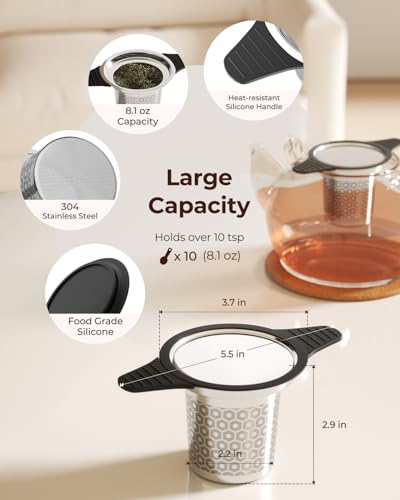
The mesh is made from 304 stainless steel, which is a food-grade alloy known for corrosion resistance. Seven reviewers specifically mention the quality construction, and multiple confirm no rust or staining after extended use. The handles and lid are food-grade silicone, which is durable but does require a bit of care — air dry completely after washing to prevent water from getting trapped under the silicone seal. The steel itself should last for years of daily use.
Are there any downsides to the Reinmoson tea strainer?
A few things to be aware of. The silicone grips can slide around on wet mug rims — three reviewers mention this, so just make sure the rim is dry when you set it down. Water can get trapped under the silicone seal if you don't air dry it completely after washing. A couple of reviewers received lids that were sticky or scratched out of the package. And there are some sharp edges inside the mesh basket, so use a brush for cleaning rather than rubbing with your fingers. None of these are dealbreakers, but they're worth knowing.
Does the Reinmoson strainer fit all mug sizes?
It fits most standard mugs well — 12 reviewers specifically mention the secure fit across different mug sizes. The silicone handles rest on the rim and accommodate a range of widths. However, it may not work perfectly with every mug. A few reviewers found it too tall or too tight for smaller teacups. If you're using a standard 10-16 oz mug, you should be fine. For dainty teacups or very wide-brimmed bowls, measure first.
Do the silicone handles stay cool while steeping?
Yes, six reviewers specifically mention that the silicone handles stay cool to the touch and are comfortable to grip, even while your tea is steeping in near-boiling water. This is a nice advantage over all-metal strainers where you might burn your fingers lifting them out. The silicone also provides a softer, more ergonomic grip when you're removing the strainer from a hot cup.
Is the Reinmoson strainer good for work or office use?
It's practically designed for it. The two-pack means you can keep one at home and one at your desk. It rinses clean in seconds under a break room tap — no soap needed for a quick rinse — and the lid doubles as a drip tray so you won't leave tea rings on your desk. It's compact enough to stash in a drawer. Several reviewers use it as their daily office brewer, and the simplicity means you're not messing around with complicated gear during a work break.
Can you use the Reinmoson strainer for things besides tea?
People get surprisingly creative with it. Reviewers mention straining homemade cashew milk, making yogurt cheese by straining yogurt, and filtering café con leche with cinnamon. The extra fine mesh that makes it great for tea also makes it useful for any beverage or liquid where you want to catch small particles. It's not marketed for these uses, but the food-grade stainless steel and silicone are perfectly safe for them.
As an Amazon Associate we earn from qualifying purchases.
Can you use this strainer with a tea infuser bottle or travel mug?
The Reinmoson is designed for open-top mugs — it sits on the rim with silicone handles. It won't fit inside a narrow-mouthed travel bottle. However, some reviewers have gotten creative: one person cold-brews tea in a jar by securing the strainer with rubber bands. For actual infuser bottles with built-in baskets, you'd want something purpose-built for that form factor. Where the Reinmoson shines is work and office use with a regular mug — it's easy to keep at your desk and rinse in a break room sink.
Can you cold brew tea with the Reinmoson strainer?
Yes — one reviewer actually does this by placing the strainer in a jar and securing it with rubber bands for cold brewing in the refrigerator. It's not the strainer's intended design, but the fine mesh works just as well with cold water. Just keep in mind the strainer is designed to sit on top of a mug, not submerge inside a container, so the rubber band method is a creative workaround. For dedicated cold brewing, a pitcher with a built-in infuser might be more convenient, but the Reinmoson can do double duty in a pinch.
What type of tea infuser is best for loose leaf tea?
It depends on how you brew, but basket-style strainers like the Reinmoson are widely considered the best design for everyday loose leaf tea. They give leaves plenty of room to expand and circulate — unlike ball infusers that cramp the leaves and limit flavor extraction. The Reinmoson's extra fine mesh is especially useful if you drink finely chopped teas like rooibos or CTC black teas, which would slip right through a standard infuser. If you mostly brew single cups and want easy cleanup, a basket strainer is hard to beat.
What's the difference between a tea strainer and a tea infuser?
Technically, a strainer sits on top of your cup and you pour brewed tea through it to catch leaves, while an infuser holds the leaves inside it and sits in your water while it steeps. The Reinmoson is actually a hybrid — it's marketed as a strainer but functions as an infuser. You load it with tea, set it in your mug, and pour water over it. The leaves steep inside the basket. So you get the best of both worlds: the generous leaf capacity of a strainer with the steep-and-remove convenience of an infuser.
How does a mesh tea infuser work?
The concept is simple: hot water passes through the fine mesh holes to reach the tea leaves inside, extracts the flavor compounds, and flows back through those same holes into your cup — minus the leaves. The Reinmoson uses an extra fine mesh that's tight enough to block even the smallest tea particles. That's the key differentiator here — 18 reviewers specifically mention that virtually no particles get through. With a coarser mesh, you'd get sediment at the bottom of your cup, especially with finely cut teas or rooibos.
How do I choose the right tea infuser or strainer?
Three things matter most: mesh fineness, basket size, and how it fits your mug. The Reinmoson checks all three — its extra fine mesh catches even tiny particles from rooibos and finely cut black teas (18 reviewers specifically mention this), the large basket gives leaves room to expand for better flavor, and the silicone handles adjust to fit various mug sizes. One thing to watch: if you use small teacups, this strainer may be too tall. A few reviewers noted it's a tight fit on smaller cups. For standard-sized mugs, though, it's a reliable all-rounder.
As an Amazon Associate we earn from qualifying purchases.
How do you make loose tea with an infuser like this?
Here's the full process with the Reinmoson: Heat your water to the right temperature for your tea type (boiling for black tea and herbal, around 175°F for green tea). Place the strainer on your mug and add about one teaspoon of loose leaf tea per cup. Pour the hot water through the leaves, then put the lid on to keep the heat in — reviewers confirm the lid noticeably helps with heat retention. Steep for the recommended time (usually 3-5 minutes for black, 2-3 for green, 5-7 for herbal). Lift the strainer out and set it on the flipped lid. That's it.
Can you use this with a tea infuser mug?
It depends on the mug. If your infuser mug has a wide, open top like a standard mug, the Reinmoson will sit on the rim just fine — it's designed to fit multiple mug sizes. If your mug has a built-in infuser basket that you'd be replacing, the Reinmoson actually works well as a replacement — one reviewer specifically bought it to replace a broken glass infuser that came with their tea mug. Just check that the mug opening isn't too small, since a few users found it's a tight fit on smaller cups.
Where is Reinmoson made?
Reinmoson doesn't prominently advertise their manufacturing origin. What we do know from the product specs is that it's constructed with 304 stainless steel mesh and food-grade silicone — both materials that meet food safety standards. Multiple reviewers have confirmed the stainless steel holds up well over time with no rust or staining, which is a good indicator of genuine 304-grade steel.
Customer-Validated Strengths
based on 30-review analysis • Our methodology
- Extra fine mesh prevents tea particles from passing through (18 mentions)
- Fits multiple mug sizes securely (12 mentions)
- Easy to clean - rinses easily without tea leaves sticking (10 mentions)
- Dual-purpose lid - covers while steeping and serves as coaster (9 mentions)
- Large capacity holds generous amount of tea (8 mentions)
- High quality 304 stainless steel construction - durable and rust-resistant (7 mentions)
- Silicone handles stay cool to touch and comfortable to grip (6 mentions)
- Affordable price point ($6.99 mentioned) (3 mentions)
- Attractive honeycomb/hive pattern design (2 mentions)
Best Use Cases
🎯 Best For
- Finely chopped loose leaf teas
- Herbal teas requiring longer steeping
- Single cup brewing in various mug sizes
- Loose leaf tea beginners transitioning from tea bags
- Work/office use
- Users wanting easy cleanup
- Straining fine particles from other beverages
⚠️ Not Ideal For
- Very small teacups (may be too tall)
- Users wanting completely sealed/clamped infusers
What to Consider
- Silicone grips slide around and don't stay put when wet (3 mentions)
- Water can get trapped under silicone seal if not air-dried (2 mentions)
- Poor quality silicone lid arrived sticky/scratched (2 mentions)
- Can be too tall or tight fit for small teacups (1 mentions)
- Sharp edges inside can cut fingers during cleaning (1 mentions)
- Extremely fine mesh slows straining for thick liquids (1 mentions)
based on 30-review sample.
About This Analysis
This analysis is based on 30 customer reviews. We're showing you everything we found, but with our analysis, there's always more to discover.
✅ What we're confident about: What customers love and best use cases
⚠️ What may be incomplete: Potential issues and considerations
For more perspectives, check customer reviews on Amazon.
Product Selection
In short: We only feature high-rated products.
Products on TeaDelight.net are selected based on strong Amazon customer ratings, sufficient review volume, and market presence. We focus on well-regarded products that tea enthusiasts are actively considering and purchasing.
As an Amazon Associate we earn from qualifying purchases.
You Might Also Like

✅ Very fine mesh quality
Rainspire Stainless Steel Fine Mesh Strainer

✅ Affordable price/good value
ELEEN Premium Stainless Steel Fine Mesh Strainers

✅ Fits well on various cup sizes
Homestia Fine Mesh Strainer Set

✅ Extra-fine mesh filters extremely well, minimal tea particles