



We analyze real customer reviews to surface what matters: key strengths, ideal use cases, and honest considerations — so you can make an informed choice.
Bekith 7-Pack Silicone Tea Infuser with Drip Tray
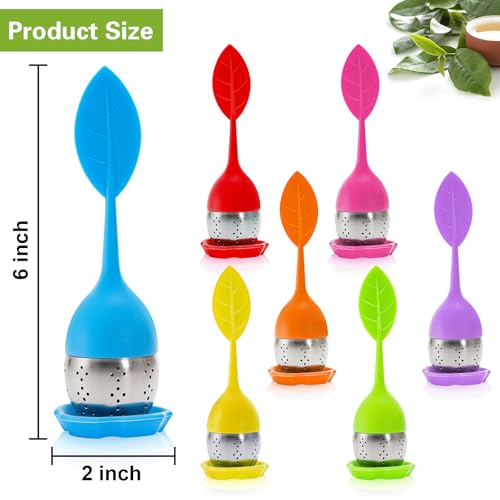
A 7-pack of silicone-topped fine-mesh stainless infusers with individual drip trays — a commodity multipack priced for a household, shared office, or entry-level gift.
🎯 Best for: Standard-cut bagless tea brewed in a regular mug, Household or shared-office multipack use

What Stands Out
✅ What Customers Love
- Easy to clean and dishwasher safe
- Drip tray earns independent praise
- Ergonomically easy to use day-to-day
🎯 Best For
Standard-cut bagless tea brewed in a regular mug • Household or shared-office multipack use • Accessible-kit gifting for early tea drinkers
Brand: Bekith
Category: Infusers & Strainers
As an Amazon Associate we earn from qualifying purchases.
About This Product
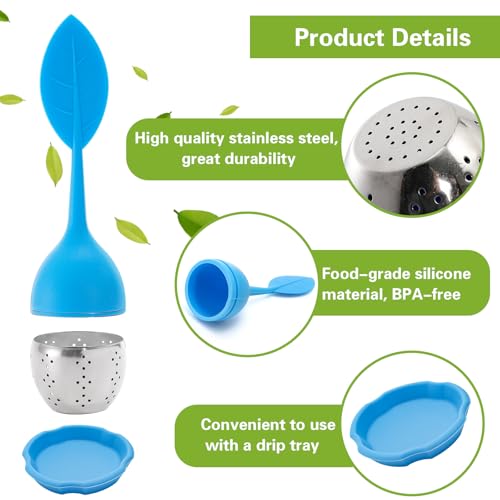
A 7-pack of silicone-topped fine-mesh stainless infusers with individual drip trays — a commodity multipack priced for a household, shared office, or entry-level gift. The binary test for any infuser is particle containment, and the data here places the mesh at the standard end of the spectrum rather than ultra-fine: four of 35 reviewers report tea passing through the holes, across holes-too-big, mesh-fineness, and ineffective-filtration themes. The cleaning story is the clearest strength — four reviewers describe them as easy to clean, and one confirms they are dishwasher safe. Six reviewers describe the infusers as easy to use day-to-day, and the drip tray draws independent praise from five reviewers as a clean desk-side touch. At 7-pack commodity pricing, the per-unit value is straightforward.
We'd reach for these for standard-cut bagless tea in a regular mug — a household, a shared office, or a loose-leaf tin you dip into occasionally. For fine-cut or broken-leaf tea, a finer-mesh single-basket infuser is the better choice. Reviewers working with loose leaf note the basket compacts quickly; keeping the dose to a couple of teaspoons gives the leaves room to open.
Care is simple: rinse the basket with water after use. The stainless mesh rinses clean without scrubbing, and reviewers confirm dishwasher-safe handling. The individual drip tray catches the post-steep drip on its way back to the sink, which is the small touch reviewers keep calling out.
Two honest caveats. The mesh is standard, not ultra-fine — particles can escape into the cup with finer-cut teas, so this isn't the pick if sediment-free brewing is non-negotiable. Separately, four reviewers received a shipment with a missing piece (across missing-piece, missing-parts, and missing-item themes) — a quality-control flag worth noting on a multipack purchase.
For a household stocking up, an office tea station, or an accessible gift for someone just moving from bags to loose leaf, the mix of cleanability, drip-tray convenience, and per-unit pricing carries the pack.
Is Bekith 7-Pack Silicone Tea Infuser with Drip Tray Right for You?
Is the silicone top safe to use with hot tea?
Food-grade silicone is widely used for tea infuser lids and tolerates boiling-water temperatures without leaching, and the listing positions these as silicone-topped stainless mesh strainers built for steeping in a mug. Reviewers in the dataset don't flag taste-transfer or odor issues from the silicone.
How fine is the mesh — will tea particles end up in my cup?
The mesh sits at the standard end of the spectrum rather than ultra-fine: four of 35 reviewers report tea passing through the holes, across holes-too-big, mesh-fineness, and ineffective-filtration themes. Standard-cut bagless tea contains well; fine-cut, broken-leaf, or CTC tea will throw some sediment.
What kind of loose-leaf tea works best with these infusers?
We'd reach for these for standard-cut bagless tea brewed in a regular mug — a household, a shared office, or a loose-leaf tin you dip into occasionally. For fine-cut or broken-leaf tea, a finer-mesh single-basket infuser is the better choice.
Are these dishwasher safe, or do I need to hand-wash?
Dishwasher-safe handling is confirmed by a reviewer, and four of 35 describe them as easy to clean overall. The stainless mesh rinses clean without scrubbing if you'd rather just give it a quick rinse after use.
What is the drip tray for and is it actually useful?
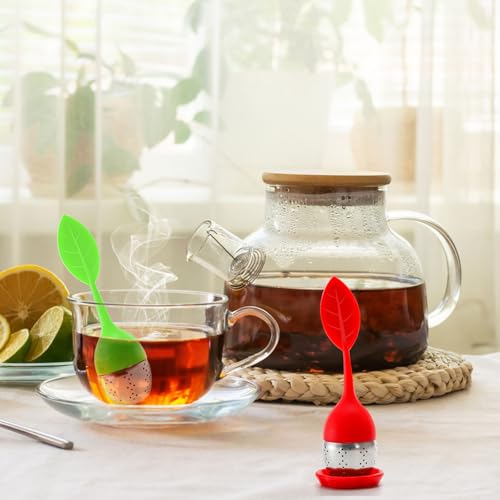
The drip tray catches the wet infuser when you lift it out so you don't spot the desk or counter — five reviewers across utility, inclusion, and function themes call it out independently as a clean desk-side touch. It's the small touch that earns the most unsolicited praise here.
How do I use the infuser with the drip tray?
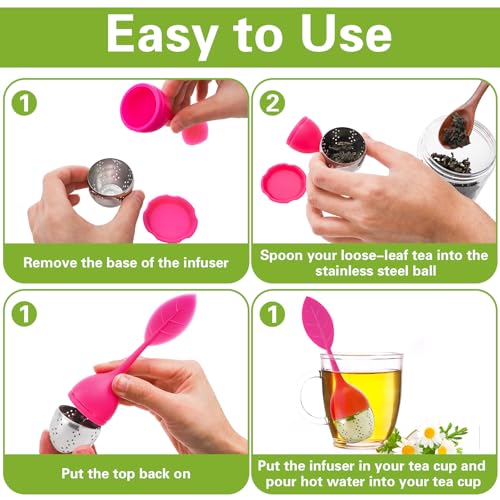
Spoon a teaspoon or two of loose tea into the silicone-topped basket, drop it into your mug, pour hot water over it, and steep. Lift the basket out by the silicone top when done and rest it on the drip tray to keep your desk dry while it cools.
As an Amazon Associate we earn from qualifying purchases.
How much loose tea should I put in each infuser?
Reviewers working with loose leaf note the basket compacts quickly, so a couple of teaspoons is the sweet spot — enough to brew a strong mug while still giving leaves room to open. Overfilling crushes the leaves against the mesh and weakens the infusion.
Are they easy to handle day-to-day?
Six of 35 reviewers describe handling as easy, which is a clear cluster on a sample this size. The silicone top gives you a heat-safe grip to lift the basket out of a hot mug without juggling a spoon.
Will all 7 infusers actually arrive in the package?
Worth checking the box on arrival — four of 35 reviewers received a shipment with a missing piece, across missing-piece, missing-parts, and missing-item themes. It's a quality-control flag worth noting on a multipack purchase, even though most shipments arrive complete.
Would these work for ceremonial matcha or gongfu brewing?
No — a basket infuser isn't built for either. Matcha is whisked as a suspension rather than steeped through mesh, and gongfu-scale brewing wants a teapot or gaiwan with leaf room to fully unfurl across short, repeated infusions.
Are these a reasonable gift for someone new to loose-leaf tea?
Yes — the synthesis flags accessible-kit gifting for early tea drinkers as a fit, and the beginner-gift segment shows up across roughly a third of reviewers. A 7-pack also gives the recipient enough infusers to leave one at home, one at the office, and a few spares.
How do I clean them after use?
Rinse the basket with water after use; the stainless mesh rinses clean without scrubbing, and dishwasher-safe handling is confirmed if you'd rather batch-clean a stack of them. Don't let wet leaves dry inside the mesh — they're harder to dislodge once stuck.
As an Amazon Associate we earn from qualifying purchases.
Category: What's the difference between a tea infuser and a tea strainer?
An infuser is a leaf-containment device placed inside the brewing vessel during steeping — a mesh basket, ball, spoon, or paper sac that holds the leaves while water flows through. A strainer is a separate filter used after steeping, when brewed liquor is decanted from a teapot, gaiwan, or pitcher into the cup. The two solve different problems, and the best home setups often use both — for example, a teapot with no built-in filter plus a fine-mesh strainer at the spout.
Category: When should I retire a tea infuser?
Replace it when you see visible rust or dark spotting inside the mesh weave, mesh that sags or wrinkles after dishwasher cycles, persistent odor that survives a deep baking-soda soak, plastic-frame cracks, or a separated chain link on a tea ball. Don't try to 'season' a rusty tea ball — iron compounds will leach into the brew. Pitting on a cheaper infuser almost always points to 18/0 alloy that has reached the end of its corrosion resistance, and upgrading to a 304-stainless basket prevents the next round of the same problem.
Category: How do I clean a tea infuser and remove tannin stains?
Rinse immediately after every brew — a 30-second post-brew rinse versus letting wet leaves dry overnight is the difference between a decade of service and one year, because tannin polymerizes onto stainless surfaces over time. For built-up stains, soak in baking soda (1 tsp in a mug of hot water, four hours or overnight) which is the highest-rated method in comparative tests. White vinegar also works but smells. Use a soft toothbrush from both sides of the mesh; never wire brushes or steel wool, which tear the weave.
Customer-Validated Strengths
based on 35-review analysis • Our methodology
- Easy to clean and dishwasher safe
- Drip tray earns independent praise
- Ergonomically easy to use day-to-day
- Multipack value at commodity pricing
Quality & Care
The binary test for any infuser is particle containment, and the data here places the mesh at the standard end of the spectrum rather than ultra-fine: four of 35 reviewers report tea passing through the holes, across holes-too-big, mesh-fineness, and ineffective-filtration themes. The cleaning story is the clearest strength — four reviewers describe them as easy to clean, and one confirms they are dishwasher safe. Six reviewers describe the infusers as easy to use day-to-day, and the drip tray draws independent praise from five reviewers as a clean desk-side touch. At 7-pack commodity pricing, we'd call the per-unit value straightforward.
Care
Rinse the basket with water after use; the stainless mesh rinses clean without scrubbing, and reviewers confirm dishwasher-safe handling.
Best Use Cases
🎯 Best For
- Standard-cut bagless tea brewed in a regular mug
- Household or shared-office multipack use
- Accessible-kit gifting for early tea drinkers
⚠️ Not Ideal For
- Fine-cut, broken-leaf, or CTC teas where sediment is unacceptable
- Gongfu-scale loose-leaf brewing
- Ceremonial matcha preparation
How People Use It
We'd reach for these for standard-cut bagless tea in a regular mug — a household, a shared office, or a loose-leaf tin you dip into occasionally. For fine-cut or broken-leaf tea, a finer-mesh single-basket infuser is the better choice. Reviewers working with loose leaf note the basket compacts quickly; keeping the dose to a couple of teaspoons gives leaves room to open.
What to Consider
Separately, four reviewers received a shipment with a missing piece (across missing-piece, missing-parts, and missing-item themes) — a quality-control flag worth noting on a multipack purchase.
- Mesh is standard, not ultra-fine — particles can escape into the cup
- Quality-control: missing piece on arrival for a subset of shipments
based on 35-review sample.
About This Analysis
This analysis is based on 35 customer reviews. We're showing you everything we found, but with our analysis, there's always more to discover.
✅ What we're confident about: What customers love and best use cases
⚠️ What may be incomplete: Potential issues and considerations
For more perspectives, check customer reviews on Amazon.
Product Selection
In short: We only feature high-rated products.
Products on TeaDelight.net are selected based on strong Amazon customer ratings, sufficient review volume, and market presence. We focus on well-regarded products that tea enthusiasts are actively considering and purchasing.
As an Amazon Associate we earn from qualifying purchases.
You Might Also Like

✅ Fine-mesh particle containment
CTIANWXY Extra Fine Mesh Tea Infuser

✅ Effective particle containment
LULLATTI Large Tea Infuser for Loose Tea

✅ Effective particle containment
FORLIFE Brew-in-Mug Extra-Fine Tea Infuser
✅ Versatile across home and casual loose-leaf brewing setups