
Available Alternatives

✅ Strong repeat-purchase loyalty
Herbalife Herbal Tea Concentrate Lemon

✅ Versatile across morning and evening use
Bigelow Cinnamon Apple Herbal Tea

✅ lavender-chamomile pairing dominates the flavor impression
Elevate Lavender Chamomile Loose Leaf Herbal Tea

✅ Soothing, throat-coating character that pairs well with sore-throat relief
Traditional Medicinals Cold Care Seasonal Tea


We analyze real customer reviews to surface what matters: key strengths, ideal use cases, and honest considerations — so you can make an informed choice.
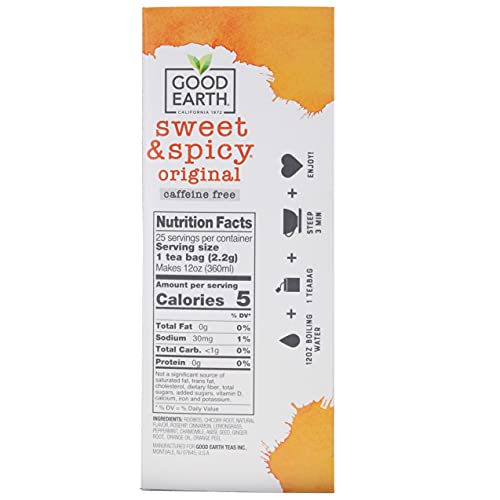
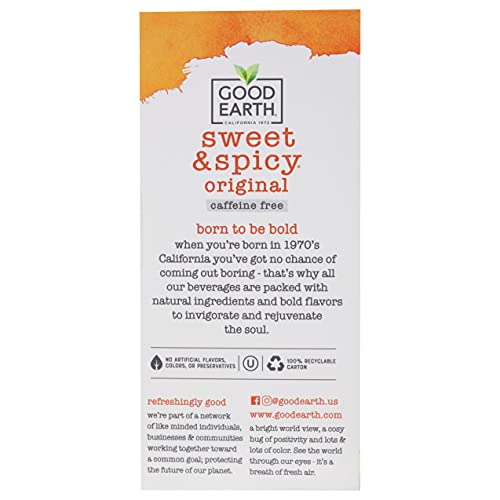
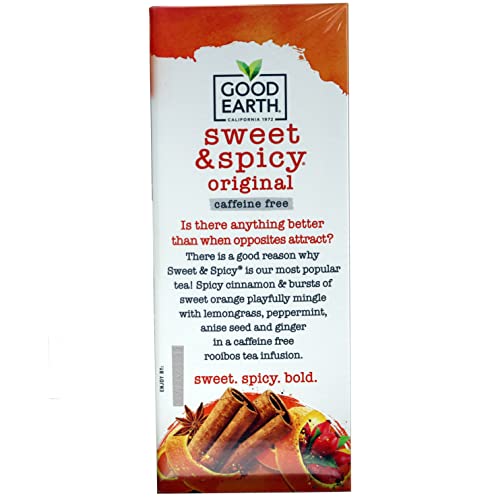
Good Earth Sweet & Spicy Herbal Tea
Cinnamon-and-orange with a zesty bite — a caffeine-free herbal blend that reviewers compare to cinnamon candy, though softer than a Fireball.
🎯 Best for: iced preparation, caffeine-free substitute for black tea
🍃 Strength: Medium

🍃 Flavor Profile
Strength: Medium
Cinnamon leads the profile (5 of 21 reviews), with orange close behind (4 of 21), and reviewers describe the taste as naturally sweet — enough that several skip added sugar. Most find it mild with a zesty finish, compared variously to cinnamon candy or a gentler Fireball. The aroma reads strong and pleasant.
✅ What Customers Love
- Cinnamon-and-orange signature with a zesty finish
- Naturally sweet — no added sugar needed
- Caffeine-free — drinkable across the day
🎯 Best For
iced preparation • caffeine-free substitute for black tea • cinnamon-orange flavor fans who want a mild, naturally sweet cup • any-time-of-day drinking, including evening
Brand: Good Earth Tea Co.
Category: Herbal Tea
As an Amazon Associate we earn from qualifying purchases.
About This Herbal Tea
Good Earth Sweet & Spicy is a caffeine-free herbal blend built around cinnamon and orange, with a zesty bite that reviewers compare to cinnamon candy — softer than a Fireball, but still distinctly warming. Cinnamon leads the profile (5 of 21 reviews) with orange close behind (4 of 21), and the cup reads naturally sweet enough that several drinkers skip added sugar. The aroma is strong and pleasant; the finish, mild and zesty.
Iced leads the use-context picture, with hot close behind, and several reviewers reach for it as a caffeine-free stand-in for black tea. It's a pantry staple for cinnamon-orange fans — pairings with honey or caramel creamer come up, and one reviewer notes it works any time of day, evenings included.
For brewing, two bags per medium-large teapot is the usual starting point. Recent batches may need three to four bags for full strength, so adjust upward if the cup reads thin. It takes well to iced preparation in warm weather, where the cinnamon-orange profile holds up over ice.
A few recent buyers note the formula feels different from what they remember. One flags missing original ingredients — papaya, ginseng leaves, dandelion root — another needs three to four bags where two used to do, and a third calls it not quite as good as the original. If you're returning to the blend after a gap, expect a milder cup than the older formulation.
Best reached for when you want a caffeine-free cinnamon-orange cup that works hot or iced, sweetens itself, and pairs easily with honey or a splash of caramel creamer.
Is Good Earth Sweet & Spicy Herbal Tea Right for You?
How much caffeine is in Good Earth Sweet & Spicy tea?
It's caffeine-free — the blend is herbal, and reviewers explicitly reach for it as a caffeine-free stand-in for black tea and an any-time-of-day cup, including in the evening.
What does this tea actually taste like?
Cinnamon leads the profile (5 of 21 reviews) with orange close behind (4 of 21), and most drinkers describe it as mild with a zesty finish. Several compare it to cinnamon candy — or a gentler Fireball — and the aroma reads strong and pleasant.
Is it really sweet enough to drink without adding sugar?
For most reviewers, yes — sweetness comes up in 4 of 26 reviews and two drinkers specifically call out that it's 'sweet without sugar'. The naturally sweet character is one of the most repeated praise points.
Can I make this as iced tea?
Iced is actually the leading use context in the reviews (3 of 26), edging out hot preparation (2 of 26). It's a common warm-weather pick for cinnamon-orange fans.
How many tea bags should I use per pot?
Two bags per medium-to-large teapot is the usual starting point. A few recent buyers note they now need three to four bags to get the strength they remember from earlier batches.
Has the formula changed recently?
Some reviewers think so — about 3 of 21 flag formula-change or freshness concerns. One specifically names missing original ingredients (papaya, panax ginseng leaves, dandelion root), and another says it's 'not quite as good as the original'.
As an Amazon Associate we earn from qualifying purchases.
Why do some buyers say it tastes weaker than it used to?
A handful of recent reviewers report less flavor in current orders, with one needing three to four bags where two used to be enough. It appears to be a small but consistent thread in the more recent feedback rather than a broad complaint.
What does it pair well with?
Reviewers reach for honey or a caramel creamer to lean into the cinnamon-orange profile, and the iced preparation is the most-mentioned serving style for warm weather.
Is this a good choice for someone who doesn't usually drink tea?
Yes — the mild, naturally sweet profile and convenient tea-bag format make it approachable, and the synthesis specifically calls it enjoyable for non-tea drinkers.
How does it compare to a cinnamon candy like Fireball?
Reviewers describe it as 'like cinnamon candy' but softer — one drinker calls it 'a Fireball but a bit milder'. Expect a zesty cinnamon kick rather than a hot, candy-intensity burn.
What's in the blend besides cinnamon and orange?
Reviewers also mention rooibos, chicory root, peppermint, ginger and caramel notes coming through (each in 1 of 26 reviews), but cinnamon and orange are the two flavors that dominate the cup.
Category: What exactly is herbal tea?
Herbal tea, more accurately called a tisane, is any infusion made from plant material other than Camellia sinensis (the true tea plant). It can be brewed from leaves, flowers, roots, barks, seeds, or fruits of thousands of species, from chamomile flowers to rooibos needles to ginger root. The word 'tea' is colloquial here; botanically, only Camellia sinensis produces real tea.
As an Amazon Associate we earn from qualifying purchases.
Category: How are herbal tea blends usually built?
A common formulation follows a 60-30-10 structure. The base (60%) is mild and bulky—rooibos, nettle, oatstraw, or lemon balm provide the foundation. The modifier or support (30%) drives the therapeutic effect or main flavor—peppermint, hibiscus, tulsi, cinnamon chips. The accent (10%) is potent and would overpower the cup at higher proportions—lavender, cloves, ginger, citrus peel, rose petals. This balance is why a well-blended tisane tastes layered rather than flat.
Category: What's the difference between Ceylon and cassia cinnamon in tea?
Cassia cinnamon is the common grocery-store variety—thick, hard bark with a spicy 'red hot' flavor—and it contains up to 7% coumarin, a compound that acts as a blood thinner and can be hepatotoxic at high doses. Ceylon cinnamon ('true' cinnamon from Sri Lanka) has thin, fragile layers, a delicate floral citrusy flavor, and only 0.004% coumarin. For regular tea use, Ceylon is the safer choice.
What Makes This Product Special
⚠️ Preliminary analysis based on 21-review sample • Our methodology
- Cinnamon-and-orange signature with a zesty finish
- Naturally sweet — no added sugar needed
- Caffeine-free — drinkable across the day
- Versatile across iced and hot preparations
- Earns repeat-purchase loyalty
Taste Profile
Cinnamon leads the profile (5 of 21 reviews), with orange close behind (4 of 21), and reviewers describe the taste as naturally sweet — enough that several skip added sugar. Most find it mild with a zesty finish, compared variously to cinnamon candy or a gentler Fireball. The aroma reads strong and pleasant.
- honey
- caramel creamer
- iced preparation in warm weather
Brewing: Two bags per medium-large teapot is the usual starting point, though recent batches may need three to four for full strength.
Best Use Cases
🎯 Best For
- iced preparation
- caffeine-free substitute for black tea
- cinnamon-orange flavor fans who want a mild, naturally sweet cup
- any-time-of-day drinking, including evening
⚠️ Not Ideal For
- morning caffeine lift
- connoisseur-tier loose-leaf exploration
How People Use It
Iced leads the use-context picture, with hot close behind; several reviewers reach for it as a caffeine-free stand-in for black tea. We'd call it a pantry staple for cinnamon-orange fans — pairings with honey or caramel creamer come up, and one reviewer notes it works any time of day.
Good for Beginners
✅ Yes
- Mild profile with naturally sweet character — no added sugar needed
- Explicitly enjoyable for non-tea drinkers
- Tea-bag format removes brewing-equipment barrier
What to Consider
A few recent buyers note the formula feels different — one flags missing original ingredients (papaya, ginseng leaves, dandelion root), another needs three to four bags where two used to do, and a third calls it not quite as good as the original.
- Recent batches read as weaker or reformulated compared to the original
⚠️ based on 21-review sample. Some issues may not be captured.
About This Analysis
This analysis is based on 21 customer reviews. We're showing you everything we found, but with a moderate sample, there's a lot we likely haven't captured yet.
✅ What we're confident about: What customers love and best use cases
⚠️ What may be incomplete: Potential issues and considerations
For more perspectives, check customer reviews on Amazon.
Product Selection
In short: We only feature high-rated products.
Products on TeaDelight.net are selected based on strong Amazon customer ratings, sufficient review volume, and market presence. We focus on well-regarded products that tea enthusiasts are actively considering and purchasing.
As an Amazon Associate we earn from qualifying purchases.