




We analyze real customer reviews to surface what matters: key strengths, ideal use cases, and honest considerations — so you can make an informed choice.
FullChea Longjing Dragon Well Green Tea
A first-grade Longjing worth exploring — chestnut and spring beans over a buttery body, in a loose-leaf format reviewers keep flagging as unusually fair value.
🎯 Best for: Drinkers exploring traditional first-grade Chinese green tea, Morning or afternoon loose-leaf brewing
🍃 Strength: Light

What Stands Out
🍃 Flavor Profile
Strength: Light
One reviewer captures the textbook Long Jing (Dragon Well) signature: chestnut, spring beans, and a mild sweetness layered over a creamy, full-bodied mouthfeel, with fresh-flower and warm-bread aroma. Across the broader pool, drinkers more often describe the cup as light-bodied and distinct — flavorful and gentle, in line with Longjing's traditional register rather than a bolder green-tea style.
✅ What Customers Love
- Canonical Longjing flavor profile (chestnut, spring beans, mild sweetness)
- Buttery, full-bodied mouthfeel uncommon in this price range
- Value framing is one of the strongest signals in the pool
🎯 Best For
Drinkers exploring traditional first-grade Chinese green tea • Morning or afternoon loose-leaf brewing • Gongfu-style preparation in a Yixing teapot
Brand: FullChea
Category: Green Tea
As an Amazon Associate we earn from qualifying purchases.
About This Green Tea
FullChea's Longjing is a loose-leaf Chinese green tea that reviewers keep flagging as unusually fair value for a first-grade Dragonwell. One reviewer captures the textbook signature — chestnut, spring beans, and a mild sweetness layered over a creamy, full-bodied mouthfeel, with fresh-flower and warm-bread aroma. Across the broader pool, drinkers more often describe the cup as light-bodied and distinct: flavorful and gentle, in line with Longjing's traditional register rather than a bolder green-tea style.
We'd reach for this in the morning or afternoon — the two contexts reviewers actually mention. The loose-leaf format leans toward a deliberate brewing setup, and one drinker specifically prepares it gongfu-style (high-leaf, short-steep) in a Yixing teapot. It sits most naturally with people exploring traditional first-grade Chinese green tea rather than functional or wellness-driven use cases.
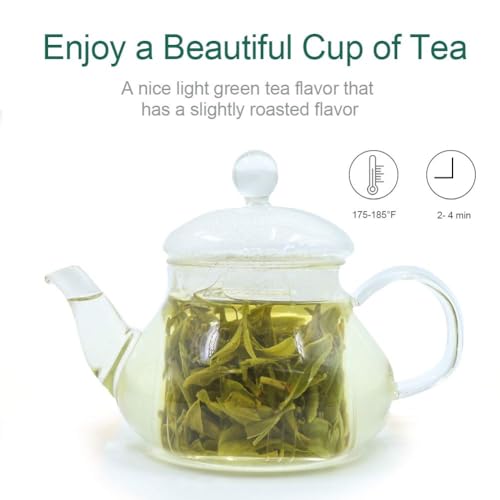
For brewing, a reviewer suggests lower water temperature around 170°F and treating the first steep as the primary cup — the second steep tends to come out weaker, so don't expect a long gongfu session of consistent strength from these leaves.
One caveat worth taking seriously: a detailed negative review flags the package as broken-leaf rather than the uniform whole leaves shown in product photos, calling the actual grade closer to loose-teabag tier than first-grade Longjing. That's a real consideration if leaf appearance matters to you, and it pairs with the second-steep flavor drop-off as the two consistent weaknesses in the pool. If you're buying primarily on visual grade or planning multi-resteep gongfu sessions, look elsewhere; if you want the canonical Longjing flavor profile at a fair price for a first cup, this delivers.
Is FullChea Longjing Dragon Well Green Tea Right for You?
What does this Longjing actually taste like?
Reviewers describe the classic Long Jing register — chestnut, spring beans, and a mild sweetness — layered over a creamy, full-bodied mouthfeel with fresh-flower and warm-bread aroma. The broader pool more often calls the cup light-bodied and distinct rather than bold, which is in keeping with Longjing's traditional style.
Is the leaf quality really first-grade as the listing claims?
This is the main caveat in the pool. One detailed negative review flags the package as broken-leaf rather than the uniform whole leaves shown in product photos, calling the actual grade closer to loose-teabag tier than first-grade Longjing — a real consideration if leaf appearance matters to you.
How should I brew this for the best cup?
One reviewer suggests lower water temperature around 170°F and treating the first steep as the primary cup. With limited brewing-note data, this matches general Longjing practice, where cooler water preserves the chestnut and spring-bean notes that hotter water can scorch.
Can I get multiple good steeps from these leaves?
A couple of reviewers note the second steep weakens or thins out, and the synthesis flags this as a real pattern — about 2 of 20 drinkers mention the drop-off. If you're planning a multi-steep gongfu session expecting consistent strength across infusions, this likely isn't the leaf for that.
Is this a good first green tea for someone new to Longjing?
Probably not the easiest entry point. The synthesis flags it as leaning toward experienced drinkers — the flavor profile is light and distinct rather than bold, and getting the most out of it benefits from careful temperature control and an understanding of the chestnut-and-beans register.
When do reviewers actually drink this?
The two contexts that come up in the review data are morning and afternoon — each mentioned by one drinker. That's a small sample, but it tracks with how loose-leaf Longjing is traditionally enjoyed as a daytime sipper rather than an evening tea.
As an Amazon Associate we earn from qualifying purchases.
Can I brew this gongfu-style in a Yixing teapot?
Yes — one reviewer specifically prepares it that way, using high-leaf short-steep gongfu method in a Yixing pot. The loose-leaf format supports that approach, though keep in mind the second-steep drop-off noted by other drinkers means you may not get the consistency a longer gongfu session expects.
How does this compare to other Dragon Well teas reviewers have tried?
Comparisons across the pool run in both directions — some drinkers find it meets the quality of Dragon Well from a local Chinese tea store and rate it above another vendor who supplies Whole Foods, while one reviewer finds it less smoky and full-bodied than finer Longjing they've had. The picture is mixed rather than uniformly above or below peers.
Do reviewers say they'd buy it again?
Repurchase intent is one of the stronger signals in the pool — 6 of 20 reviewers indicate they plan to buy again, which the synthesis flags as above the category median at this review count.
What's the body and mouthfeel like?
Two of 16 reviewers describe it as full-bodied, and the lead sensory review specifically calls out a creamy, buttery mouthfeel — texture that's uncommon for a light green tea of this register. The broader pool leans toward light-bodied, so expect a cup that reads as gentle but with some weight on the palate.
Category: How much caffeine is in green tea?
A typical cup of green tea contains roughly 20-45 mg of caffeine, depending on the leaf, water temperature, and steep time. That is less than coffee but not low — high-grade shaded teas like gyokuro and matcha can rival or exceed a cup of brewed coffee because the youngest buds and shaded leaves carry the highest caffeine concentration in the plant.
Category: How can I tell good-quality green tea from low-quality?
Look at the leaf first — high-grade green tea has uniform color (vivid deep green for shaded, glossy emerald for sencha), tight needle or flake shape with minimal stems and dust, and a fresh, marine or grassy aroma rather than a dusty or hay-like smell. On the label, harvest date matters (April-May ichibancha beats summer harvests), and specificity in region or cultivar (Uji, Shizuoka, Yabukita, Saemidori) generally signals a producer targeting quality over volume.
As an Amazon Associate we earn from qualifying purchases.
Category: What water temperature should I use to brew green tea?
Most green teas brew best between 70C and 80C (160-175F). Boiling water aggressively extracts catechins and produces bitterness and astringency, while cooler water preserves the amino acids responsible for sweetness and umami. Shaded teas like gyokuro are typically brewed even lower, around 50-60C, specifically to draw out L-theanine without pulling harsh catechins.
What Makes This Product Special
⚠️ Preliminary analysis based on 20-review sample • Our methodology
- Canonical Longjing flavor profile (chestnut, spring beans, mild sweetness)
- Buttery, full-bodied mouthfeel uncommon in this price range
- Value framing is one of the strongest signals in the pool
- Repeat-purchase intent above category median
Taste Profile
One reviewer captures the textbook Long Jing (Dragon Well) signature: chestnut, spring beans, and a mild sweetness layered over a creamy, full-bodied mouthfeel, with fresh-flower and warm-bread aroma. Across the broader pool, drinkers more often describe the cup as light-bodied and distinct — flavorful and gentle, in line with Longjing's traditional register rather than a bolder green-tea style.
Brewing: A reviewer suggests lower water temperature around 170°F and treating the first steep as the primary cup — the second steep tends to come out weaker.
Best Use Cases
🎯 Best For
- Drinkers exploring traditional first-grade Chinese green tea
- Morning or afternoon loose-leaf brewing
- Gongfu-style preparation in a Yixing teapot
⚠️ Not Ideal For
- Buyers expecting visually uniform whole-leaf grade
- Functional or wellness-driven tea use cases
- Multiple-resteep gongfu sessions expecting consistent strength
How People Use It
We'd reach for this in the morning or afternoon — the two contexts reviewers actually mention. The loose-leaf format leans toward a deliberate brewing setup; one drinker specifically prepares it gongfu-style (high-leaf, short-steep) in a Yixing teapot.
For Experienced Users
✅ Worth Exploring
- Single-origin first-grade Longjing in loose-leaf format supports gongfu-style brewing
- Source-based flavor profile (chestnut, spring beans, buttery mouthfeel) rewards careful temperature control
What to Consider
One detailed negative review flags the package as broken-leaf rather than the uniform whole leaves shown in product photos, calling the actual grade closer to loose-teabag tier than first-grade Longjing — a real consideration if leaf appearance matters to you.
- Grade/leaf-appearance concerns vs first-grade positioning
- Second-steep flavor drops off
⚠️ based on 20-review sample. Some issues may not be captured.
About This Analysis
This analysis is based on 20 customer reviews. We're showing you everything we found, but with a moderate sample, there's a lot we likely haven't captured yet.
✅ What we're confident about: What customers love and best use cases
⚠️ What may be incomplete: Potential issues and considerations
For more perspectives, check customer reviews on Amazon.
Product Selection
In short: We only feature high-rated products.
Products on TeaDelight.net are selected based on strong Amazon customer ratings, sufficient review volume, and market presence. We focus on well-regarded products that tea enthusiasts are actively considering and purchasing.
As an Amazon Associate we earn from qualifying purchases.
You Might Also Like

✅ familiar Twinings character that drinkers return to
Twinings Green Tea with Jasmine

✅ Versatile organic everyday green
Bigelow Steep Pure Organic Green Tea

✅ Named Ureshino origin and gyokuro grade
Tealyra Gyokuro Ureshinocha Japanese Green Tea

✅ Versatile across morning, daily, iced, and evening use